
Cookie preferences
This website uses cookies, which are necessary for the technical operation of the website and are always set. Other cookies, which increase the comfort when using this website, are used for direct advertising or to facilitate interaction with other websites and social networks, are only set with your consent.
Configuration
Technically required
These cookies are necessary for the basic functions of the shop.
"Allow all cookies" cookie
"Decline all cookies" cookie
CSRF token
Cookie preferences
Currency change
Customer-specific caching
FACT-Finder tracking
Individual prices
Selected shop
Session
Comfort functions
These cookies are used to make the shopping experience even more appealing, for example for the recognition of the visitor.
Note
Show the facebook fanpage in the right blod sidebar
Statistics & Tracking
Affiliate program
Conversion and usertracking via Google Tag Manager
Track device being used

| Item number | Size | Datasheet | Manual | SDS | Delivery time | Quantity | Price |
|---|---|---|---|---|---|---|---|
| NSJ-FY12463 | 100 µg | - | - |
3 - 10 business days* |
790.00€
|
If you have any questions, please use our Contact Form.
You can also order by e-mail: info@biomol.com
Larger quantity required? Request bulk
You can also order by e-mail: info@biomol.com
Larger quantity required? Request bulk
Adding 0.2 ml of distilled water will yield a concentration of 500 ug/ml. PLCB1 antibody... more
Product information "Anti-PLCB1 / Phospholipase C beta 1"
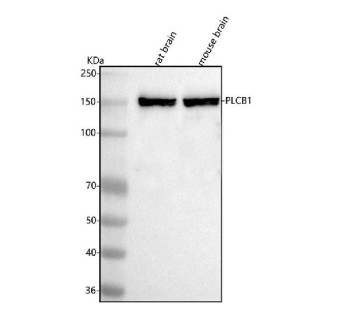
Adding 0.2 ml of distilled water will yield a concentration of 500 ug/ml. PLCB1 antibody recognizes Phospholipase C beta 1, an enzyme that hydrolyzes phosphatidylinositol 4,5-bisphosphate (PIP2) to generate the key second messengers inositol 1,4,5-trisphosphate (IP3) and diacylglycerol (DAG). This reaction triggers intracellular calcium release and activates protein kinase C, integrating multiple receptor-mediated signaling cascades. Phospholipase C beta 1 functions downstream of G-protein-coupled receptors and plays an essential role in neuronal excitability, synaptic plasticity, and cellular growth regulation. The PLCB1 antibody is widely used to study intracellular signaling pathways, phosphoinositide metabolism, and neurological disorders involving aberrant calcium signaling.PLCB1 is encoded by the PLCB1 gene on human chromosome 20p12.3 and belongs to the phospholipase C family, which includes beta, gamma, delta, epsilon, eta, and zeta isoforms. The protein contains characteristic catalytic X and Y domains, a C2 domain responsible for calcium-dependent membrane association, and a C-terminal G-protein-binding domain. Activation occurs via interaction with Galphaq or Gbetagamma subunits of heterotrimeric G proteins. Within neurons, PLCB1 is highly expressed in the cerebral cortex, hippocampus, and striatum, where it contributes to muscarinic acetylcholine and glutamate receptor signaling. Dysregulation of PLCB1 signaling has been linked to epilepsy, schizophrenia, and bipolar disorder, emphasizing its importance in brain function.Using the PLCB1 antibody, researchers can detect multiple isoforms of phospholipase C beta 1 ranging from 120-150 kDa depending on tissue and post-translational modifications. Western blot and immunohistochemical studies demonstrate strong neuronal cytoplasmic staining, often enriched near the plasma membrane. Functional analyses reveal that PLCB1 interacts with scaffolding proteins and cytoskeletal elements, coupling receptor activation to localized calcium dynamics and neurotransmitter release. In addition to neuronal tissues, PLCB1 is expressed in cardiac, hepatic, and endothelial cells, where it mediates G-protein-linked responses controlling vascular tone, secretion, and metabolism.Loss of PLCB1 activity impairs signal transduction, while overactivation can lead to excitotoxicity and dysregulated calcium homeostasis. Knockout models show severe neurodevelopmental defects and altered behavior, confirming its critical physiological role. Beyond the nervous system, PLCB1 contributes to immune cell activation, insulin signaling, and smooth muscle contraction. NSJ Bioreagents provides a validated PLCB1 antibody optimized for western blot, immunofluorescence, and immunohistochemistry, supporting investigations into GPCR-driven signaling, phosphoinositide metabolism, and disease mechanisms involving calcium-dependent processes.
| Keywords: | Anti-PLCB1, Anti-PLC-154, Anti-Phospholipase C-I, Anti-Phospholipase C-beta-1, Anti-Phosphoinositide phospholipase C-beta-1, Anti-1-phosphatidylinositol 4,5-bisphosphate phosphodiesterase beta-1, PLCB1 Antibody / Phospholipase C beta 1 |
| Supplier: | NSJ Bioreagents |
| Supplier-Nr: | FY12463 |
Properties
| Application: | WB, ELISA |
| Antibody Type: | Polyclonal |
| Conjugate: | No |
| Host: | Rabbit |
| Species reactivity: | human, mouse, rat |
| Immunogen: | E.coli-derived human PLCB1 recombinant protein (Position: H9-D834) |
| Format: | Purified |
Database Information
| KEGG ID : | K05858 | Matching products |
| UniProt ID : | Q9NQ66 | Matching products |
| Gene ID : | GeneID 23236 | Matching products |
Handling & Safety
| Storage: | +4°C |
| Shipping: | +4°C (International: +4°C) |
Caution
Our products are for laboratory research use only: Not for administration to humans!
Our products are for laboratory research use only: Not for administration to humans!
Information about the product reference will follow.
more
You will get a certificate here
Viewed