
Cookie preferences
This website uses cookies, which are necessary for the technical operation of the website and are always set. Other cookies, which increase the comfort when using this website, are used for direct advertising or to facilitate interaction with other websites and social networks, are only set with your consent.
Configuration
Technically required
These cookies are necessary for the basic functions of the shop.
"Allow all cookies" cookie
"Decline all cookies" cookie
CSRF token
Cookie preferences
Currency change
Customer-specific caching
FACT-Finder tracking
Individual prices
Selected shop
Session
Comfort functions
These cookies are used to make the shopping experience even more appealing, for example for the recognition of the visitor.
Note
Show the facebook fanpage in the right blod sidebar
Statistics & Tracking
Affiliate program
Conversion and usertracking via Google Tag Manager
Track device being used


| Item number | Size | Datasheet | Manual | SDS | Delivery time | Quantity | Price |
|---|---|---|---|---|---|---|---|
| NSJ-FY12680 | 100 µg | - | - |
3 - 10 business days* |
790.00€
|
If you have any questions, please use our Contact Form.
You can also order by e-mail: info@biomol.com
Larger quantity required? Request bulk
You can also order by e-mail: info@biomol.com
Larger quantity required? Request bulk
Adding 0.2 ml of distilled water will yield a concentration of 500 ug/ml. PHKG1 antibody detects... more
Product information "Anti-PHKG1 / Phosphorylase kinase gamma 1"
Adding 0.2 ml of distilled water will yield a concentration of 500 ug/ml. PHKG1 antibody detects Phosphorylase kinase gamma 1, a catalytic subunit of the phosphorylase kinase (PhK) complex that plays a central role in glycogen metabolism. The UniProt recommended name is Phosphorylase kinase gamma 1 (PHKG1). This enzyme functions as a serine/threonine-specific protein kinase responsible for activating glycogen phosphorylase, the enzyme that catalyzes the rate-limiting step in glycogen breakdown. PHKG1 serves as the catalytic component within the multimeric PhK complex, which also includes alpha, beta, and delta subunits that provide regulatory and calcium-binding functions.Phosphorylase kinase gamma 1 is predominantly expressed in skeletal muscle, where it regulates glycogenolysis in response to hormonal and neural stimulation. Activation of the enzyme occurs through phosphorylation and calcium binding, linking it directly to adrenergic and calcium signaling pathways. The PhK complex functions as a molecular bridge between intracellular calcium release and the mobilization of energy reserves during muscle contraction, ensuring that glucose-1-phosphate is made available for rapid ATP production.Structurally, PHKG1 contains conserved kinase domains typical of the protein kinase superfamily, including the ATP-binding site and catalytic loop that mediates phosphate transfer. The gamma 1 isoform differs from the gamma 2 isoform (encoded by PHKG2), which is more abundant in liver tissue, highlighting its tissue-specific regulation. The PHKG1 gene is located on chromosome 7p11.2 and its expression is tightly regulated according to metabolic demand and muscle fiber type.Defects or mutations in PHKG1 can lead to glycogen storage disease type IXd, a rare inherited metabolic disorder characterized by reduced phosphorylase kinase activity, muscle weakness, and exercise intolerance. Because of its key role in energy metabolism, PHKG1 is also investigated in studies of muscle physiology, insulin signaling, and exercise adaptation. Detection of Phosphorylase kinase gamma 1 using PHKG1 antibody allows researchers to monitor enzyme expression, activity, and localization in muscle and metabolic tissues.PHKG1 antibody is useful for applications such as immunohistochemistry, immunofluorescence, and related assays examining kinase regulation and energy metabolism. By identifying the catalytic subunit of phosphorylase kinase, this antibody supports research into glycogen regulation, muscle energy dynamics, and kinase-mediated signaling networks. NSJ Bioreagents provides PHKG1 antibody reagents optimized for studies of glycogen metabolism and skeletal muscle biochemistry.
| Keywords: | Anti-PHKG1, Anti-Phosphorylase kinase subunit gamma-1, Anti-Serine/threonine-protein kinase PHKG1, Anti-Phosphorylase b kinase gamma catalytic chain, skeletal muscle/heart isoform, PHKG1 Antibody / Phosphorylase kinase gamma 1 |
| Supplier: | NSJ Bioreagents |
| Supplier-Nr: | FY12680 |
Properties
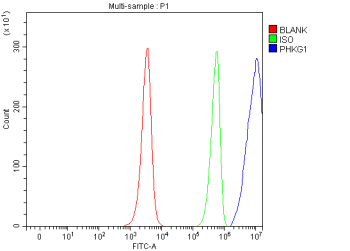
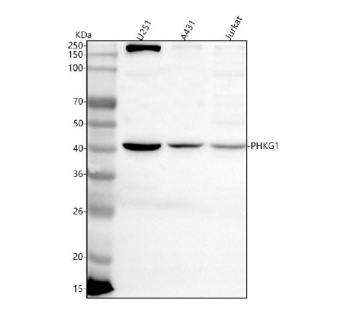
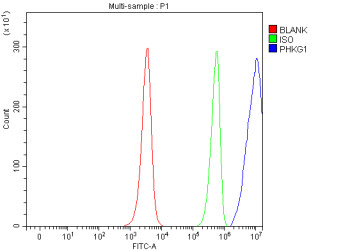
| Application: | WB, FC, ELISA |
| Antibody Type: | Polyclonal |
| Conjugate: | No |
| Host: | Rabbit |
| Species reactivity: | human |
| Immunogen: | E.coli-derived human PHKG1 recombinant protein (Position: E62-R353) |
| Format: | Purified |
Database Information
| KEGG ID : | K00871 | Matching products |
| UniProt ID : | Q16816 | Matching products |
| Gene ID : | GeneID 5260 | Matching products |
Handling & Safety
| Storage: | +4°C |
| Shipping: | +4°C (International: +4°C) |
Caution
Our products are for laboratory research use only: Not for administration to humans!
Our products are for laboratory research use only: Not for administration to humans!
Information about the product reference will follow.
more
You will get a certificate here
Viewed