
Cookie preferences
This website uses cookies, which are necessary for the technical operation of the website and are always set. Other cookies, which increase the comfort when using this website, are used for direct advertising or to facilitate interaction with other websites and social networks, are only set with your consent.
Configuration
Technically required
These cookies are necessary for the basic functions of the shop.
"Allow all cookies" cookie
"Decline all cookies" cookie
CSRF token
Cookie preferences
Currency change
Customer-specific caching
FACT-Finder tracking
Individual prices
Selected shop
Session
Comfort functions
These cookies are used to make the shopping experience even more appealing, for example for the recognition of the visitor.
Note
Show the facebook fanpage in the right blod sidebar
Statistics & Tracking
Affiliate program
Conversion and usertracking via Google Tag Manager
Track device being used



| Item number | Size | Datasheet | Manual | SDS | Delivery time | Quantity | Price |
|---|---|---|---|---|---|---|---|
| NSJ-FY12654 | 100 µg | - | - |
7 - 12 business days* |
790.00€
|
If you have any questions, please use our Contact Form.
You can also order by e-mail: info@biomol.com
Larger quantity required? Request bulk
You can also order by e-mail: info@biomol.com
Larger quantity required? Request bulk
Adding 0.2 ml of distilled water will yield a concentration of 500 ug/ml. PEPD antibody detects... more
Product information "Anti-PEPD / Peptidase D"
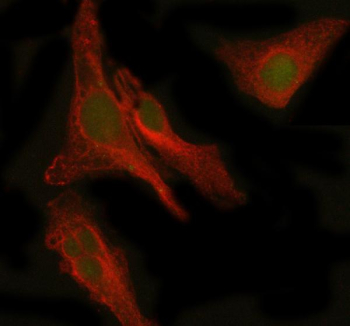
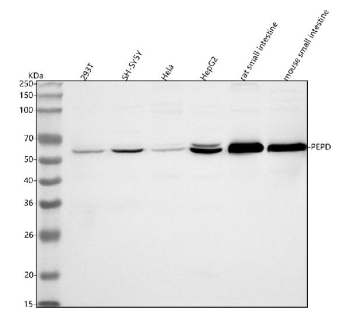
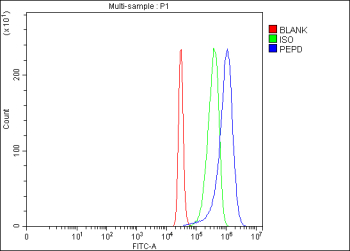
Adding 0.2 ml of distilled water will yield a concentration of 500 ug/ml. PEPD antibody detects Peptidase D, a cytosolic metalloprotease involved in the final step of collagen degradation and proline recycling. PEPD hydrolyzes dipeptides containing proline or hydroxyproline at the carboxy terminus, contributing to amino acid salvage and collagen turnover. The PEPD antibody is widely used in metabolism, connective tissue, and enzymology research to study peptide hydrolysis, collagen catabolism, and metabolic disorders.PEPD is encoded by the PEPD gene located on human chromosome 19q13.11. The protein is approximately 493 amino acids long and requires manganese as a cofactor for catalytic activity. PEPD functions as a homodimer, with each subunit contributing to the active site. It is expressed in a wide range of tissues, particularly in the liver, kidney, and fibroblasts, where it facilitates collagen metabolism and amino acid homeostasis.The PEPD antibody detects a 54 kilodalton band by western blot and shows cytosolic distribution under immunofluorescence microscopy. PEPD participates in proline recycling for collagen resynthesis, making it essential for connective tissue maintenance and wound healing. Mutations in PEPD cause prolidase deficiency, a rare metabolic disorder characterized by skin ulcers, developmental delay, and recurrent infections due to impaired collagen degradation and imbalanced proline metabolism.In addition to its metabolic role, PEPD modulates cell signaling by acting as an extracellular ligand for epidermal growth factor receptor (EGFR), activating proliferative and survival pathways in response to tissue injury. It also influences immune responses by regulating proline-derived metabolites that affect macrophage activation and oxidative balance.Because PEPD connects collagen metabolism, cell signaling, and tissue repair, it serves as an important target in research on fibrosis, wound healing, and metabolic disorders. NSJ Bioreagents provides a validated PEPD antibody optimized for its applications, supporting investigations into collagen turnover, amino acid metabolism, and regenerative biology.
| Keywords: | Anti-PEPD, Anti-Peptidase D, Anti-Imidodipeptidase, Anti-Xaa-Pro dipeptidase, Anti-Proline dipeptidase, PEPD Antibody / Peptidase D |
| Supplier: | NSJ Bioreagents |
| Supplier-Nr: | FY12654 |
Properties
| Application: | WB, ICC, IF, FC, ELISA |
| Antibody Type: | Polyclonal |
| Conjugate: | No |
| Host: | Rabbit |
| Species reactivity: | human, mouse, rat |
| Immunogen: | E.coli-derived human PEPD recombinant protein (Position: R33-K493) |
| Format: | Purified |
Database Information
| KEGG ID : | K14213 | Matching products |
| UniProt ID : | P12955 | Matching products |
| Gene ID : | GeneID 5184 | Matching products |
Handling & Safety
| Storage: | +4°C |
| Shipping: | +4°C (International: +4°C) |
Caution
Our products are for laboratory research use only: Not for administration to humans!
Our products are for laboratory research use only: Not for administration to humans!
Information about the product reference will follow.
more
You will get a certificate here
Viewed