
Cookie preferences
This website uses cookies, which are necessary for the technical operation of the website and are always set. Other cookies, which increase the comfort when using this website, are used for direct advertising or to facilitate interaction with other websites and social networks, are only set with your consent.
Configuration
Technically required
These cookies are necessary for the basic functions of the shop.
"Allow all cookies" cookie
"Decline all cookies" cookie
CSRF token
Cookie preferences
Currency change
Customer-specific caching
FACT-Finder tracking
Individual prices
Selected shop
Session
Comfort functions
These cookies are used to make the shopping experience even more appealing, for example for the recognition of the visitor.
Note
Show the facebook fanpage in the right blod sidebar
Statistics & Tracking
Affiliate program
Conversion and usertracking via Google Tag Manager
Track device being used

| Item number | Size | Datasheet | Manual | SDS | Delivery time | Quantity | Price |
|---|---|---|---|---|---|---|---|
| NSJ-FY12949 | 100 µg | - | - |
3 - 10 business days* |
790.00€
|
If you have any questions, please use our Contact Form.
You can also order by e-mail: info@biomol.com
Larger quantity required? Request bulk
You can also order by e-mail: info@biomol.com
Larger quantity required? Request bulk
Adding 0.2 ml of distilled water will yield a concentration of 500 ug/ml. PCIF1 antibody detects... more
Product information "Anti-PCIF1 / Phosphorylated CTD-interacting factor 1"
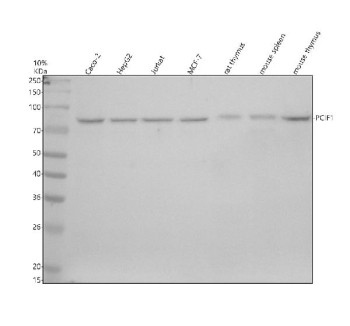
Adding 0.2 ml of distilled water will yield a concentration of 500 ug/ml. PCIF1 antibody detects Phosphorylated CTD-interacting factor 1, an mRNA cap-specific methyltransferase that modifies the first transcribed nucleotide at the 5' cap structure of mRNA. The UniProt recommended name is mRNA cap-specific adenosine N6 methyltransferase (PCIF1), also known as CAPAM or phosphorylated CTD-interacting factor 1. This enzyme catalyzes the methylation of N6-adenosine in the cap-adjacent nucleotide, creating the m6Am modification, a key regulator of mRNA stability and translation efficiency.Functionally, PCIF1 antibody identifies a 726-amino-acid nuclear protein that directly interacts with the C-terminal domain (CTD) of RNA polymerase II when it is phosphorylated on Ser5 residues. This interaction positions PCIF1 near nascent transcripts to catalyze co-transcriptional methylation. The resulting m6Am mark enhances mRNA translation efficiency and protects transcripts from decapping and degradation. Through this function, PCIF1 plays a central role in post-transcriptional gene regulation and RNA processing.The PCIF1 gene is located on chromosome 20q13.13 and encodes a methyltransferase that contains a SAM-dependent catalytic domain typical of N6-adenosine methyltransferases. Its activity is tightly linked to transcriptional elongation and is coordinated with other cap modifications such as m7G capping and 2'-O-methylation. PCIF1 also associates with components of the mRNA export machinery, suggesting a coupling between RNA methylation and nuclear export.Loss or dysregulation of PCIF1 affects global mRNA methylation profiles, leading to alterations in gene expression, differentiation, and stress response. Studies indicate that depletion of PCIF1 reduces m6Am abundance and decreases translation of specific mRNAs, particularly those involved in growth control and stress adaptation. Conversely, overexpression enhances translation of transcripts with cap-proximal adenosines, promoting cell survival under adverse conditions.PCIF1 antibody is widely used in research to examine RNA modification pathways, cap-binding protein interactions, and transcriptional regulation. It is valuable for immunoblotting, immunofluorescence, and co-immunoprecipitation assays to identify PCIF1 localization and activity. In cancer studies, aberrant PCIF1 expression correlates with altered methylation landscapes and tumor progression. PCIF1 has also been linked to viral RNA modification, influencing immune detection of viral transcripts.Through its role in mRNA cap regulation, PCIF1 coordinates multiple levels of gene expression control from transcription initiation to translation. NSJ Bioreagents provides PCIF1 antibody reagents validated for applications in RNA biology, epigenetic regulation, and transcriptional research.
| Keywords: | Anti-PCIF1, Anti-Phosphorylated CTD-interacting factor 1, Anti-Cap-specific adenosine methyltransferase, Anti-Protein phosphatase 1 regulatory subunit 121, Anti-mRNA (2'-O-methyladenosine-N(6)-)-methyltransferase, PCIF1 Antibody / Phosphorylated CTD-inter |
| Supplier: | NSJ Bioreagents |
| Supplier-Nr: | FY12949 |
Properties
| Application: | WB |
| Antibody Type: | Polyclonal |
| Conjugate: | No |
| Host: | Rabbit |
| Species reactivity: | human, mouse, rat |
| Immunogen: | A synthetic peptide corresponding to a sequence in the middle region of human PCIF1 |
| Format: | Purified |
Database Information
| KEGG ID : | K17584 | Matching products |
| UniProt ID : | Q9H4Z3 | Matching products |
| Gene ID : | GeneID 63935 | Matching products |
Handling & Safety
| Storage: | +4°C |
| Shipping: | +4°C (International: +4°C) |
Caution
Our products are for laboratory research use only: Not for administration to humans!
Our products are for laboratory research use only: Not for administration to humans!
Information about the product reference will follow.
more
You will get a certificate here
Viewed