
Cookie preferences
This website uses cookies, which are necessary for the technical operation of the website and are always set. Other cookies, which increase the comfort when using this website, are used for direct advertising or to facilitate interaction with other websites and social networks, are only set with your consent.
Configuration
Technically required
These cookies are necessary for the basic functions of the shop.
"Allow all cookies" cookie
"Decline all cookies" cookie
CSRF token
Cookie preferences
Currency change
Customer-specific caching
FACT-Finder tracking
Individual prices
Selected shop
Session
Comfort functions
These cookies are used to make the shopping experience even more appealing, for example for the recognition of the visitor.
Note
Show the facebook fanpage in the right blod sidebar
Statistics & Tracking
Affiliate program
Conversion and usertracking via Google Tag Manager
Track device being used

| Item number | Size | Datasheet | Manual | SDS | Delivery time | Quantity | Price |
|---|---|---|---|---|---|---|---|
| NSJ-FY12698 | 100 µg | - | - |
3 - 10 business days* |
790.00€
|
If you have any questions, please use our Contact Form.
You can also order by e-mail: info@biomol.com
Larger quantity required? Request bulk
You can also order by e-mail: info@biomol.com
Larger quantity required? Request bulk
Adding 0.2 ml of distilled water will yield a concentration of 500 ug/ml. PASK antibody detects... more
Product information "Anti-PASK / PAS kinase"
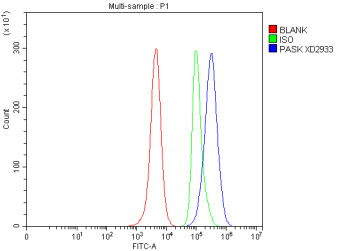
Adding 0.2 ml of distilled water will yield a concentration of 500 ug/ml. PASK antibody detects PAS domain-containing serine/threonine-protein kinase, an evolutionarily conserved enzyme that functions as a nutrient and energy sensor linking cellular metabolism with transcriptional control. Encoded by the PASK gene on chromosome 2q37.3, this kinase contains a C-terminal catalytic domain and N-terminal PAS (Per-Arnt-Sim) domains that sense changes in oxygen, redox potential, and small-molecule metabolites. PASK acts as a molecular integrator that coordinates energy homeostasis, glucose metabolism, and mitochondrial biogenesis in response to nutrient availability. The PAS domains enable regulation of its kinase activity through allosteric mechanisms, allowing PASK to respond dynamically to metabolic states.PASK is broadly expressed in liver, skeletal muscle, pancreatic islets, and the brain, tissues that exhibit strong metabolic plasticity. In hepatocytes, PASK influences glycogen synthesis and gluconeogenic pathways, while in pancreatic beta cells it modulates insulin secretion. Mice lacking PASK exhibit altered glucose tolerance, reduced hepatic glycogen storage, and impaired mitochondrial function, demonstrating its role in metabolic adaptation. PASK phosphorylates transcriptional coactivators such as PGC-1alpha and CREB-regulated transcriptional coactivator 2 (CRTC2), linking nutrient signaling with gene expression that governs oxidative metabolism.The PASK antibody is used in metabolic research to detect PASK expression and activation across tissues. Western blotting typically identifies a ~160 kilodalton band corresponding to the full-length kinase, while immunofluorescence localizes it to the cytoplasm and nucleus depending on cell type. In mammalian systems, PASK activity rises during fasting and decreases in nutrient-replete conditions, reflecting its regulatory role in energy balance. Because dysregulation of PASK signaling has been associated with diabetes, obesity, and mitochondrial dysfunction, this antibody provides an important tool for investigating metabolic signaling networks.Recent studies also implicate PASK in circadian rhythm regulation and differentiation of muscle and stem cells. Its PAS domains act as environmental sensors, adjusting transcriptional programs to oxygen and redox changes. PASK interacts with AMPK and mTOR pathways, highlighting its integration into major metabolic signaling circuits. The PASK antibody enables researchers to explore these regulatory interactions and to characterize PASK as a potential therapeutic target in metabolic disease and aging. NSJ Bioreagents provides this antibody validated for its applications, ensuring precise detection across human and model systems.
| Keywords: | Anti-PASK, Anti-PAS domain-containing serine/threonine-protein kinase, PASK Antibody / PAS kinase |
| Supplier: | NSJ Bioreagents |
| Supplier-Nr: | FY12698 |
Properties
| Application: | FC |
| Antibody Type: | Polyclonal |
| Conjugate: | No |
| Host: | Rabbit |
| Species reactivity: | human |
| Immunogen: | A synthetic peptide corresponding to a sequence at the C-terminus of human PASK |
| Format: | Purified |
Database Information
| KEGG ID : | K08801 | Matching products |
| UniProt ID : | Q96RG2 | Matching products |
| Gene ID : | GeneID 23178 | Matching products |
Handling & Safety
| Storage: | +4°C |
| Shipping: | +4°C (International: +4°C) |
Caution
Our products are for laboratory research use only: Not for administration to humans!
Our products are for laboratory research use only: Not for administration to humans!
Information about the product reference will follow.
more
You will get a certificate here
Viewed