
Cookie preferences
This website uses cookies, which are necessary for the technical operation of the website and are always set. Other cookies, which increase the comfort when using this website, are used for direct advertising or to facilitate interaction with other websites and social networks, are only set with your consent.
Configuration
Technically required
These cookies are necessary for the basic functions of the shop.
"Allow all cookies" cookie
"Decline all cookies" cookie
CSRF token
Cookie preferences
Currency change
Customer-specific caching
FACT-Finder tracking
Individual prices
Selected shop
Session
Comfort functions
These cookies are used to make the shopping experience even more appealing, for example for the recognition of the visitor.
Note
Show the facebook fanpage in the right blod sidebar
Statistics & Tracking
Affiliate program
Conversion and usertracking via Google Tag Manager
Track device being used



| Item number | Size | Datasheet | Manual | SDS | Delivery time | Quantity | Price |
|---|---|---|---|---|---|---|---|
| NSJ-V5845SAF-100UG | 100 µg | - | - |
7 - 12 business days* |
810.00€
|
If you have any questions, please use our Contact Form.
You can also order by e-mail: info@biomol.com
Larger quantity required? Request bulk
You can also order by e-mail: info@biomol.com
Larger quantity required? Request bulk
1 mg/ml in 1X PBS, BSA free, sodium azide free. CDH3 antibody targets Cadherin 3, also known as... more
Product information "Anti-P-Cadherin / CDH3, clone r56C1"
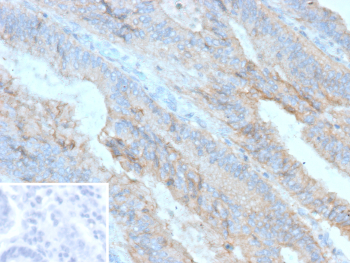
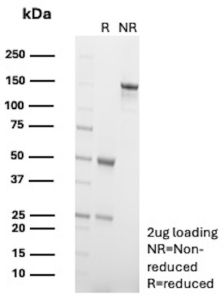
1 mg/ml in 1X PBS, BSA free, sodium azide free. CDH3 antibody targets Cadherin 3, also known as P-cadherin, a calcium-dependent cell adhesion protein encoded by the CDH3 gene and a member of the classical cadherin family. Cadherin 3 is a single-pass transmembrane glycoprotein predominantly localized to the plasma membrane at adherens junctions, where it mediates homophilic cell-cell adhesion. CDH3 is highly expressed in basal epithelial cell layers of stratified epithelia, including mammary gland, prostate, skin, and placenta, reflecting its role in tissue organization and epithelial integrity.Functionally, Cadherin 3 contributes to maintenance of epithelial architecture by linking neighboring cells through calcium-dependent interactions and coupling to the actin cytoskeleton via catenin complexes. A short functional summary is that CDH3 regulates cell adhesion, polarity, and tissue cohesion in epithelial compartments. Through these adhesive functions, Cadherin 3 influences epithelial differentiation, morphogenesis, and barrier formation.At the molecular level, Cadherin 3 contains multiple extracellular cadherin repeat domains responsible for calcium binding and adhesive interactions, a single transmembrane region, and a cytoplasmic tail that associates with catenins. These interactions anchor Cadherin 3 to the cytoskeleton and integrate adhesion with intracellular signaling pathways. CDH3 antibody reagents are therefore widely used to study adherens junction organization, epithelial cell behavior, and changes in cell-cell adhesion during development and disease. Clone r56C1 is designed to recognize Cadherin 3 and supports consistent detection of CDH3 expression in research applications.From a biological and disease relevance perspective, altered Cadherin 3 expression has been associated with cancer progression, invasion, and epithelial remodeling. Overexpression of CDH3 has been reported in several carcinomas, including breast, pancreatic, colorectal, and gastric cancers, where it may correlate with aggressive behavior and altered cell adhesion properties. Cadherin 3 is also used as a marker to distinguish epithelial subtypes and assess differentiation status in pathology studies. Clone r56C1 provides a reliable tool for investigating Cadherin 3 expression in studies of tumor biology, epithelial differentiation, and cell adhesion.Developmentally, CDH3 expression is tightly regulated and enriched in progenitor and basal epithelial populations. Its expression pattern reflects dynamic changes in epithelial structure during tissue development and regeneration. CDH3 antibodies from NSJ Bioreagents are supplied for research use to support investigations in epithelial biology, cancer research, and cell-cell adhesion studies.
| Keywords: | Anti-CDH3, Anti-Cadherin-3, Anti-Placental cadherin, P-Cadherin Antibody / CDH3 |
| Supplier: | NSJ Bioreagents |
| Supplier-Nr: | V5845SAF |
Properties
| Application: | IHC, WB |
| Antibody Type: | Monoclonal |
| Clone: | r56C1 |
| Conjugate: | No |
| Host: | Mouse |
| Species reactivity: | human |
| Immunogen: | Prokaryotic recombinant protein corresponding to a region of the external domain of the P-cadherin molecule was used as the immuongen for the CDH3/Cadherin 3 antibody |
| Format: | Purified |
Database Information
| KEGG ID : | K06796 | Matching products |
| UniProt ID : | P22223 | Matching products |
| Gene ID : | GeneID 1001 | Matching products |
Handling & Safety
| Storage: | -20°C |
| Shipping: | -20°C (International: -20°C) |
Caution
Our products are for laboratory research use only: Not for administration to humans!
Our products are for laboratory research use only: Not for administration to humans!
Information about the product reference will follow.
more
You will get a certificate here
Viewed