
Cookie preferences
This website uses cookies, which are necessary for the technical operation of the website and are always set. Other cookies, which increase the comfort when using this website, are used for direct advertising or to facilitate interaction with other websites and social networks, are only set with your consent.
Configuration
Technically required
These cookies are necessary for the basic functions of the shop.
"Allow all cookies" cookie
"Decline all cookies" cookie
CSRF token
Cookie preferences
Currency change
Customer-specific caching
FACT-Finder tracking
Individual prices
Selected shop
Session
Comfort functions
These cookies are used to make the shopping experience even more appealing, for example for the recognition of the visitor.
Note
Show the facebook fanpage in the right blod sidebar
Statistics & Tracking
Affiliate program
Conversion and usertracking via Google Tag Manager
Track device being used


| Item number | Size | Datasheet | Manual | SDS | Delivery time | Quantity | Price |
|---|---|---|---|---|---|---|---|
| NSJ-FY13392 | 100 µg | - | - |
3 - 10 business days* |
790.00€
|
If you have any questions, please use our Contact Form.
You can also order by e-mail: info@biomol.com
Larger quantity required? Request bulk
You can also order by e-mail: info@biomol.com
Larger quantity required? Request bulk
Adding 0.2 ml of distilled water will yield a concentration of 500 ug/ml. OTUD6B antibody detects... more
Product information "Anti-OTUD6B / OTU domain-containing deubiquitinase 6B"
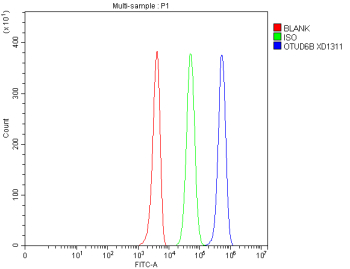
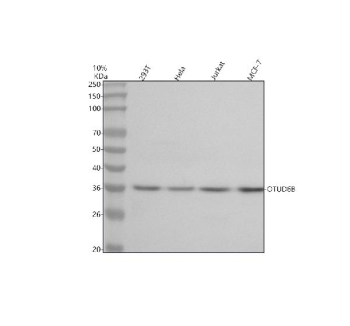
Adding 0.2 ml of distilled water will yield a concentration of 500 ug/ml. OTUD6B antibody detects OTU domain-containing deubiquitinase 6B, a cysteine protease encoded by the OTUD6B gene located on chromosome 8q21.3. OTUD6B belongs to the ovarian tumor (OTU) domain-containing deubiquitinase family, which removes ubiquitin moieties from target proteins to regulate their stability, localization, and signaling activity. OTUD6B plays an important role in cellular protein homeostasis, DNA damage repair, and immune signaling by fine-tuning ubiquitin-mediated pathways. It is expressed in most tissues, with highest levels in brain, liver, and testis, reflecting its broad regulatory functions.Structurally, OTUD6B contains an N-terminal OTU catalytic domain characterized by a conserved cysteine, histidine, and aspartate catalytic triad responsible for cleaving ubiquitin from substrates. It also includes regions for substrate recognition and potential regulatory phosphorylation sites. OTUD6B belongs to the OTU-type deubiquitinase family, which exhibits linkage-specific cleavage of polyubiquitin chains. Co-localization studies show OTUD6B primarily in the cytoplasm but also associated with the nucleus under stress conditions, suggesting roles in both cytosolic and nuclear signaling pathways.Functionally, OTUD6B regulates protein degradation and signaling by removing ubiquitin from specific substrates targeted for proteasomal or lysosomal turnover. It modulates the stability of signaling mediators such as AKT, p53, and components of the mTOR pathway. OTUD6B also contributes to endoplasmic reticulum stress responses and DNA damage repair by reversing ubiquitination on repair factors. In immune cells, OTUD6B helps maintain homeostasis by controlling NF-?B activation and cytokine signaling. Known biochemical activities include cleavage of Lys48- and Lys63-linked ubiquitin chains, thereby influencing protein degradation and signaling transduction.Deficiency or mutation of OTUD6B has been associated with intellectual developmental disorders, craniofacial abnormalities, and growth retardation, collectively known as OTUD6B-related neurodevelopmental syndrome. Dysregulation of OTUD6B expression has also been linked to tumor progression through effects on apoptosis and metabolic control. Pathway associations include ubiquitin-dependent protein catabolism, mTOR signaling, and cellular stress response. During development, OTUD6B supports cell growth and neuronal maturation by regulating key ubiquitinated targets involved in metabolism and transcription.The OTUD6B antibody from NSJ Bioreagents is an excellent reagent for research on deubiquitination mechanisms, proteostasis, and signal transduction regulation.
| Keywords: | Anti-OTUD6B, Anti-DUBA-5, Anti-Deubiquitinase OTUD6B, Anti-OTU domain-containing protein 6B, OTUD6B Antibody / OTU domain-containing deubiquitinase 6B |
| Supplier: | NSJ Bioreagents |
| Supplier-Nr: | FY13392 |
Properties
| Application: | WB, FC, ELISA |
| Antibody Type: | Polyclonal |
| Conjugate: | No |
| Host: | Rabbit |
| Species reactivity: | human |
| Immunogen: | E.coli-derived human OTUD6B recombinant protein (Position: E66-S293) |
| Format: | Purified |
Database Information
| KEGG ID : | K18342 | Matching products |
| UniProt ID : | Q8N6M0 | Matching products |
| Gene ID : | GeneID 51633 | Matching products |
Handling & Safety
| Storage: | +4°C |
| Shipping: | +4°C (International: +4°C) |
Caution
Our products are for laboratory research use only: Not for administration to humans!
Our products are for laboratory research use only: Not for administration to humans!
Information about the product reference will follow.
more
You will get a certificate here
Viewed