
Cookie preferences
This website uses cookies, which are necessary for the technical operation of the website and are always set. Other cookies, which increase the comfort when using this website, are used for direct advertising or to facilitate interaction with other websites and social networks, are only set with your consent.
Configuration
Technically required
These cookies are necessary for the basic functions of the shop.
"Allow all cookies" cookie
"Decline all cookies" cookie
CSRF token
Cookie preferences
Currency change
Customer-specific caching
FACT-Finder tracking
Individual prices
Selected shop
Session
Comfort functions
These cookies are used to make the shopping experience even more appealing, for example for the recognition of the visitor.
Note
Show the facebook fanpage in the right blod sidebar
Statistics & Tracking
Affiliate program
Conversion and usertracking via Google Tag Manager
Track device being used

| Item number | Size | Datasheet | Manual | SDS | Delivery time | Quantity | Price |
|---|---|---|---|---|---|---|---|
| NSJ-FY13253 | 100 µg | - | - |
7 - 12 business days* |
790.00€
|
If you have any questions, please use our Contact Form.
You can also order by e-mail: info@biomol.com
Larger quantity required? Request bulk
You can also order by e-mail: info@biomol.com
Larger quantity required? Request bulk
Adding 0.2 ml of distilled water will yield a concentration of 500 ug/ml. OSM antibody detects... more
Product information "Anti-Osm / Oncostatin M"
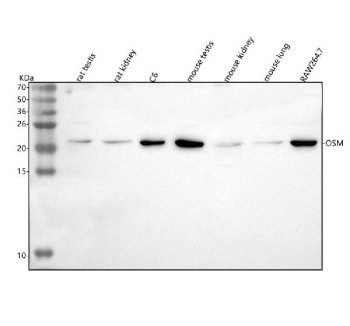
Adding 0.2 ml of distilled water will yield a concentration of 500 ug/ml. OSM antibody detects Oncostatin M, a multifunctional cytokine belonging to the interleukin 6 (IL6) family that regulates inflammation, hematopoiesis, and tissue remodeling. The UniProt recommended name is Oncostatin M (OSM). This secreted glycoprotein signals through type I and type II OSM receptors to activate the JAK/STAT, MAPK, and PI3K pathways, influencing diverse biological processes including immune regulation, bone metabolism, and liver regeneration.Functionally, OSM antibody identifies a 252-amino-acid cytokine produced primarily by activated T cells, macrophages, and monocytes. Upon secretion, OSM binds to receptor complexes composed of gp130 and OSMRbeta or LIFRbeta, initiating downstream phosphorylation of STAT3 and STAT5 transcription factors. These pathways promote expression of acute-phase proteins, matrix metalloproteinases, and cell differentiation genes. OSM plays critical roles in inflammation, angiogenesis, and wound repair by modulating fibroblast proliferation, endothelial activation, and extracellular matrix production.The OSM gene is located on chromosome 22q12.2 and is broadly expressed in immune, endothelial, and stromal cells under inflammatory or injury conditions. Expression increases in response to IL1beta, TNFalpha, and lipopolysaccharides, linking OSM production to innate and adaptive immune responses. OSM participates in crosstalk between immune cells and tissue-resident fibroblasts, coordinating local inflammatory responses and tissue regeneration.Pathologically, dysregulated OSM signaling contributes to chronic inflammation, fibrosis, and cancer. Elevated levels are associated with rheumatoid arthritis, atherosclerosis, and multiple sclerosis. In cancer, OSM exhibits context-dependent effects, acting as both a tumor suppressor and promoter by influencing cell proliferation and metastasis. Research using OSM antibody supports studies in cytokine signaling, inflammatory disease, and tumor biology.OSM antibody is validated for ELISA, western blotting, and immunohistochemistry to detect cytokines in immune and stromal contexts. NSJ Bioreagents provides OSM antibody reagents optimized for research in interleukin signaling, fibrosis, and inflammatory tissue response.Structurally, Oncostatin M contains a four-helix bundle cytokine fold stabilized by disulfide bridges and glycosylation sites essential for receptor binding and stability. The C-terminal domain interacts with gp130-containing receptor complexes to initiate signal transduction. This antibody enables detailed analysis of OSM's role in immune signaling, cytokine regulation, and tissue repair.
| Keywords: | Anti-Osm, Anti-Oncostatin-M, Osm Antibody / Oncostatin M |
| Supplier: | NSJ Bioreagents |
| Supplier-Nr: | FY13253 |
Properties
| Application: | WB, ELISA |
| Antibody Type: | Polyclonal |
| Conjugate: | No |
| Host: | Rabbit |
| Species reactivity: | mouse, rat |
| Immunogen: | E.coli-derived rat Osm recombinant protein (Position: E55-D158) |
| Format: | Purified |
Database Information
| KEGG ID : | K05418 | Matching products |
| UniProt ID : | Q65Z15 | Matching products |
| Gene ID : | GeneID 289747 | Matching products |
Handling & Safety
| Storage: | +4°C |
| Shipping: | +4°C (International: +4°C) |
Caution
Our products are for laboratory research use only: Not for administration to humans!
Our products are for laboratory research use only: Not for administration to humans!
Information about the product reference will follow.
more
You will get a certificate here
Viewed