
Cookie preferences
This website uses cookies, which are necessary for the technical operation of the website and are always set. Other cookies, which increase the comfort when using this website, are used for direct advertising or to facilitate interaction with other websites and social networks, are only set with your consent.
Configuration
Technically required
These cookies are necessary for the basic functions of the shop.
"Allow all cookies" cookie
"Decline all cookies" cookie
CSRF token
Cookie preferences
Currency change
Customer-specific caching
FACT-Finder tracking
Individual prices
Selected shop
Session
Comfort functions
These cookies are used to make the shopping experience even more appealing, for example for the recognition of the visitor.
Note
Show the facebook fanpage in the right blod sidebar
Statistics & Tracking
Affiliate program
Conversion and usertracking via Google Tag Manager
Track device being used


| Item number | Size | Datasheet | Manual | SDS | Delivery time | Quantity | Price |
|---|---|---|---|---|---|---|---|
| NSJ-V6057-20UG | 20 µg | - | - |
3 - 10 business days* |
684.00€
|
||
| NSJ-V6057-100UG | 100 µg | - | - |
3 - 10 business days* |
1,265.00€
|
If you have any questions, please use our Contact Form.
You can also order by e-mail: info@biomol.com
Larger quantity required? Request bulk
You can also order by e-mail: info@biomol.com
Larger quantity required? Request bulk
Antibody in 1X PBS with 0.05% BSA, 0.05% sodium azide. OCLN antibody recognizes Occludin, a... more
Product information "Anti-Occludin / OCLN, clone MSVA-415M"
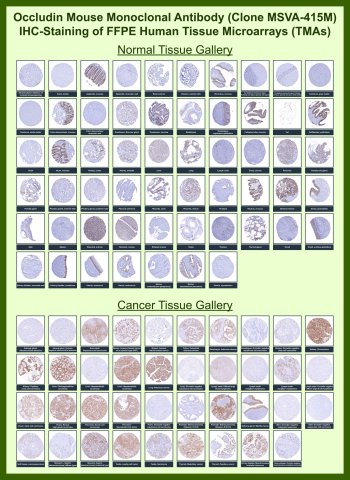
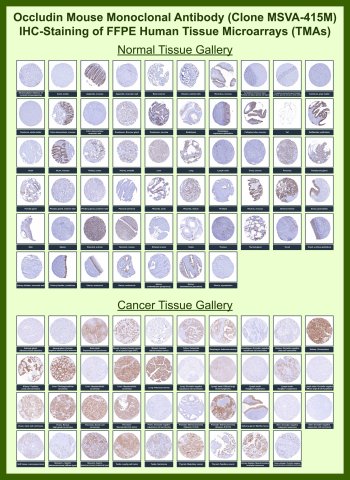
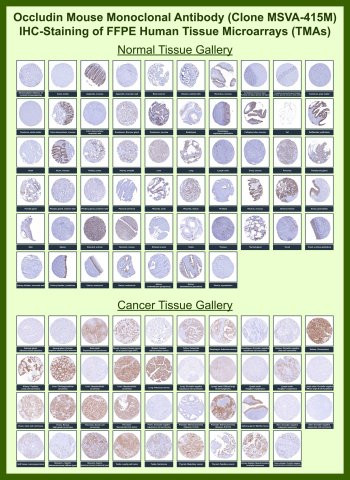
Antibody in 1X PBS with 0.05% BSA, 0.05% sodium azide. OCLN antibody recognizes Occludin, a four-pass transmembrane tight junction protein encoded by the OCLN gene that plays a central role in epithelial and endothelial barrier integrity. OCLN Antibody for IHC is optimized for detecting Occludin expression in formalin-fixed, paraffin-embedded tissue specimens used in histopathology and barrier biology research. Occludin localizes primarily to the plasma membrane at tight junction complexes, where it forms continuous belt-like structures at apical cell-cell borders and interacts with claudins, TJP1, and the actin cytoskeleton to regulate paracellular permeability.Occludin antibody, also referred to in the literature as OCLN antibody and tight junction Occludin antibody, targets a structural component widely expressed in epithelial tissues including kidney, intestine, lung, and liver, as well as in endothelial barriers such as the blood-brain barrier. In tissue sections, Occludin is typically observed along apical lateral membranes of epithelial cells, highlighting tight junction architecture. Disruption, redistribution, or reduced expression of Occludin is commonly associated with barrier dysfunction in inflammatory, ischemic, and neoplastic conditions.Structurally, Occludin contains four transmembrane domains, two extracellular loops, and cytoplasmic N-terminal and C-terminal domains. The C-terminal cytoplasmic region is critical for tight junction assembly and interaction with scaffolding proteins such as TJP1. Post-translational modifications including phosphorylation regulate Occludin trafficking and junctional stability. Altered phosphorylation can result in internalization or fragmentation of tight junction complexes, contributing to increased permeability and epithelial injury.Changes in OCLN expression have been implicated in inflammatory bowel disease, acute lung injury, renal ischemia-reperfusion injury, and blood-brain barrier disruption. In cancer biology, remodeling of tight junctions and altered Occludin expression can influence tumor cell polarity and invasion. Because tight junction integrity is essential for maintaining tissue homeostasis, OCLN antibody remains an important tool for evaluating epithelial organization and barrier status in research settings.This mouse monoclonal antibody clone MSVA-415M targets Occludin for tissue-based research applications. By enabling visualization of OCLN expression patterns in formalin-fixed specimens, this Occludin antibody supports investigations into tight junction biology and epithelial barrier regulation at NSJ Bioreagents.This antibody is also part of a broader collection of IHC antibodies validated by tissue microarray analysis, supporting consistent staining across normal and cancer tissues.
| Keywords: | Anti-OCLN, Anti-Occludin, Occludin Antibody / OCLN |
| Supplier: | NSJ Bioreagents |
| Supplier-Nr: | V6057 |
Properties
| Application: | IHC |
| Antibody Type: | Monoclonal |
| Clone: | MSVA-415M |
| Conjugate: | No |
| Host: | Mouse |
| Species reactivity: | human |
| Immunogen: | Recombinant fragment of human Occludin protein (around amino acids 282-415) (exact sequence is proprietary) |
| Format: | Purified |
Database Information
| KEGG ID : | K06088 | Matching products |
| UniProt ID : | Q16625 | Matching products |
| Gene ID : | GeneID 100506658 | Matching products |
Handling & Safety
| Storage: | -20°C |
| Shipping: | -20°C (International: -20°C) |
Caution
Our products are for laboratory research use only: Not for administration to humans!
Our products are for laboratory research use only: Not for administration to humans!
Information about the product reference will follow.
more
You will get a certificate here
Viewed