
Cookie preferences
This website uses cookies, which are necessary for the technical operation of the website and are always set. Other cookies, which increase the comfort when using this website, are used for direct advertising or to facilitate interaction with other websites and social networks, are only set with your consent.
Configuration
Technically required
These cookies are necessary for the basic functions of the shop.
"Allow all cookies" cookie
"Decline all cookies" cookie
CSRF token
Cookie preferences
Currency change
Customer-specific caching
FACT-Finder tracking
Individual prices
Selected shop
Session
Comfort functions
These cookies are used to make the shopping experience even more appealing, for example for the recognition of the visitor.
Note
Show the facebook fanpage in the right blod sidebar
Statistics & Tracking
Affiliate program
Conversion and usertracking via Google Tag Manager
Track device being used

| Item number | Size | Datasheet | Manual | SDS | Delivery time | Quantity | Price |
|---|---|---|---|---|---|---|---|
| NSJ-FY12756 | 100 µl | - | - |
3 - 10 business days* |
790.00€
|
If you have any questions, please use our Contact Form.
You can also order by e-mail: info@biomol.com
Larger quantity required? Request bulk
You can also order by e-mail: info@biomol.com
Larger quantity required? Request bulk
Rabbit IgG in phosphate buffered saline, pH 7.4, 150mM NaCl, 0.02% sodium azide and 50% glycerol,... more
Product information "Anti-NSDHL / NADP dependent steroid dehydrogenase like protein, clone 30N01"
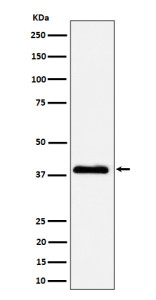
Rabbit IgG in phosphate buffered saline, pH 7.4, 150mM NaCl, 0.02% sodium azide and 50% glycerol, 0.4-0.5mg/ml BSA. NSDHL antibody detects NADP dependent steroid dehydrogenase like protein, encoded by the NSDHL gene. This protein is also known as sterol 4 alpha carboxylate 3 dehydrogenase decarboxylating, H105E3, and the human homolog of the mouse bare patches gene. NSDHL is an essential enzyme in the cholesterol biosynthetic pathway. It functions in the endoplasmic reticulum, catalyzing oxidative decarboxylation of C4 methylated sterol intermediates. These steps are necessary for the removal of methyl groups during the conversion of lanosterol to cholesterol. Because cholesterol is critical for membranes, steroid hormones, and signaling lipids, NSDHL plays a central role in both basic metabolism and developmental biology.NSDHL antibody is widely applied in studies of cholesterol metabolism, embryogenesis, dermatology, and disease research. Mutations in NSDHL cause CHILD syndrome, a rare X linked disorder that results in congenital hemidysplasia, ichthyosiform erythroderma, and limb defects. By detecting NSDHL, researchers can trace how mutations impair cholesterol synthesis and lead to toxic sterol accumulation. The protein is expressed in multiple tissues with high metabolic activity, including liver, brain, and skin, making it a valuable marker for sterol pathway integrity.Applications of NSDHL antibody include western blotting, immunohistochemistry, and immunofluorescence. Western blot assays identify NSDHL expression in tissue lysates, immunohistochemistry highlights spatial distribution in liver and epidermis, and immunofluorescence reveals its localization in the endoplasmic reticulum. These methods allow researchers to connect protein expression to sterol metabolism and developmental outcomes. Because cholesterol synthesis is fundamental across organisms, NSDHL antibody has relevance in both basic biology and translational studies.Biochemically, NSDHL functions alongside other C4 demethylation enzymes, including sterol C4 methyl oxidase and 3 beta hydroxysteroid dehydrogenase like proteins. Together they coordinate the removal of C4 methyl groups, ensuring accurate production of downstream sterols. Disruption of NSDHL activity interrupts this sequence, creating intermediates that impair membranes and signal transduction. By applying NSDHL antibody, scientists can evaluate enzyme function within the broader sterol demethylation complex.Beyond congenital syndromes, NSDHL is increasingly studied in oncology. Cancer cells reprogram metabolism to support proliferation, and cholesterol synthesis is frequently upregulated. NSDHL expression correlates with tumor growth and resistance to certain therapies. Inhibiting sterol biosynthetic enzymes, including NSDHL, is a promising therapeutic strategy under investigation. The antibody therefore has applications in cancer metabolism research, where monitoring NSDHL may reveal vulnerabilities to metabolic intervention.Cholesterol synthesis also intersects with neurobiology. The brain relies heavily on de novo cholesterol production, and NSDHL mutations or altered expression affect myelination and neuronal function. By detecting NSDHL with antibody based assays, researchers can study sterol metabolism in neurodevelopmental disorders and neurodegeneration. These insights extend to understanding how cholesterol imbalances influence synaptic function and cognition.NSDHL antibody from NSJ Bioreagents provides strong specificity for detecting this essential sterol dehydrogenase. Its validated performance across molecular and cellular assays ensures accurate measurement of NSDHL in cholesterol metabolism, development, cancer, and neurological research.
| Keywords: | Anti-NSDHL, Anti-Protein H105e3, Anti-Sterol-4-alpha-carboxylate 3-dehydrogenase, decarboxylating, NSDHL Antibody / NADP dependent steroid dehydrogenase like protein |
| Supplier: | NSJ Bioreagents |
| Supplier-Nr: | FY12756 |
Properties
| Application: | WB, IHC, ICC, IF |
| Antibody Type: | Monoclonal |
| Clone: | 30N01 |
| Conjugate: | No |
| Host: | Rabbit |
| Species reactivity: | human |
| Immunogen: | A synthesized peptide derived from human NSDHL |
| Format: | Affinity Purified |
Database Information
| KEGG ID : | K07748 | Matching products |
| UniProt ID : | Q15738 | Matching products |
| Gene ID : | GeneID 50814 | Matching products |
Handling & Safety
| Storage: | -20°C |
| Shipping: | -20°C (International: -20°C) |
Caution
Our products are for laboratory research use only: Not for administration to humans!
Our products are for laboratory research use only: Not for administration to humans!
Information about the product reference will follow.
more
You will get a certificate here
Viewed