
Cookie preferences
This website uses cookies, which are necessary for the technical operation of the website and are always set. Other cookies, which increase the comfort when using this website, are used for direct advertising or to facilitate interaction with other websites and social networks, are only set with your consent.
Configuration
Technically required
These cookies are necessary for the basic functions of the shop.
"Allow all cookies" cookie
"Decline all cookies" cookie
CSRF token
Cookie preferences
Currency change
Customer-specific caching
FACT-Finder tracking
Individual prices
Selected shop
Session
Comfort functions
These cookies are used to make the shopping experience even more appealing, for example for the recognition of the visitor.
Note
Show the facebook fanpage in the right blod sidebar
Statistics & Tracking
Affiliate program
Conversion and usertracking via Google Tag Manager
Track device being used


| Item number | Size | Datasheet | Manual | SDS | Delivery time | Quantity | Price |
|---|---|---|---|---|---|---|---|
| NSJ-FY13053 | 100 µg | - | - |
7 - 12 business days* |
790.00€
|
If you have any questions, please use our Contact Form.
You can also order by e-mail: info@biomol.com
Larger quantity required? Request bulk
You can also order by e-mail: info@biomol.com
Larger quantity required? Request bulk
Adding 0.2 ml of distilled water will yield a concentration of 500 ug/ml. NPW antibody detects... more
Product information "Anti-NPW / Neuropeptide W"
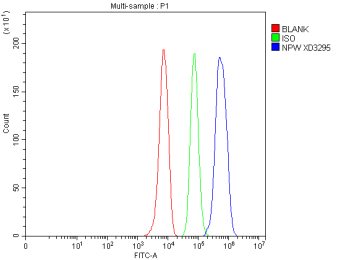
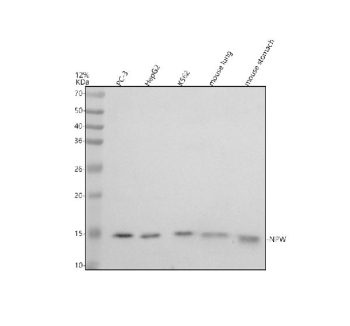
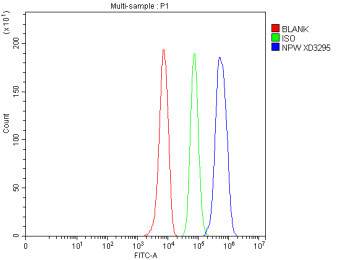
Adding 0.2 ml of distilled water will yield a concentration of 500 ug/ml. NPW antibody detects Neuropeptide W, a bioactive peptide involved in energy homeostasis, stress response, and neuroendocrine regulation. The UniProt recommended name is Neuropeptide W (NPW). This neuropeptide exerts its physiological effects by binding to G protein-coupled receptors NPBWR1 and NPBWR2, activating downstream intracellular signaling cascades that regulate feeding, hormone secretion, and cardiovascular activity.Functionally, NPW antibody identifies a 69-amino-acid precursor protein that is processed into two active peptides, NPW-23 and NPW-30, differing by their C-terminal truncation. These peptides are expressed in specific regions of the hypothalamus, brainstem, and peripheral tissues such as adrenal gland and stomach. NPW acts as an endogenous ligand for NPBWR1/2, coupling primarily to Galphai/o proteins and modulating cyclic AMP levels and calcium flux.The NPW gene is located on chromosome 17p13.1 and encodes a prepropeptide that undergoes proteolytic processing and amidation to generate mature NPW peptides. In the central nervous system, NPW contributes to the regulation of feeding behavior, energy expenditure, and stress hormone release. It acts synergistically with leptin and insulin pathways to balance energy intake and expenditure. NPW also modulates arousal, locomotion, and nociceptive processing through brainstem circuits.In peripheral tissues, NPW influences cardiovascular tone, adrenal steroidogenesis, and glucose metabolism. Its expression is regulated by nutritional state and stress exposure, reflecting its role in maintaining physiological equilibrium. In metabolic research, NPW is recognized as a peptide integrating hypothalamic signaling with peripheral energy regulation. Dysregulated NPW expression has been associated with obesity, stress-related disorders, and endocrine dysfunction.NPW antibody is widely used in neuroendocrinology, metabolism, and behavioral neuroscience research. It is suitable for immunohistochemistry, ELISA, and western blotting to detect NPW peptide distribution in brain and peripheral tissues. This antibody supports studies of neuropeptide signaling, hypothalamic regulation, and energy balance. In translational research, NPW serves as a potential biomarker for metabolic and stress-related conditions.Structurally, NPW peptides adopt flexible conformations stabilized by amidation and hydrophobic residues, allowing receptor binding with high affinity. NSJ Bioreagents provides NPW antibody reagents validated for use in neuropeptide signaling, hypothalamic regulation, and metabolic research.
| Keywords: | Anti-NPW, Anti-Neuropeptide W, Anti-Preproprotein L8, NPW Antibody / Neuropeptide W |
| Supplier: | NSJ Bioreagents |
| Supplier-Nr: | FY13053 |
Properties
| Application: | WB, FC |
| Antibody Type: | Polyclonal |
| Conjugate: | No |
| Host: | Rabbit |
| Species reactivity: | human, mouse |
| Immunogen: | A synthetic peptide corresponding to a sequence at the N-terminus of human NPW |
| Format: | Purified |
Database Information
| KEGG ID : | K23141 | Matching products |
| UniProt ID : | Q8N729 | Matching products |
| Gene ID : | GeneID 283869 | Matching products |
Handling & Safety
| Storage: | +4°C |
| Shipping: | +4°C (International: +4°C) |
Caution
Our products are for laboratory research use only: Not for administration to humans!
Our products are for laboratory research use only: Not for administration to humans!
Information about the product reference will follow.
more
You will get a certificate here
Viewed