
Cookie preferences
This website uses cookies, which are necessary for the technical operation of the website and are always set. Other cookies, which increase the comfort when using this website, are used for direct advertising or to facilitate interaction with other websites and social networks, are only set with your consent.
Configuration
Technically required
These cookies are necessary for the basic functions of the shop.
"Allow all cookies" cookie
"Decline all cookies" cookie
CSRF token
Cookie preferences
Currency change
Customer-specific caching
FACT-Finder tracking
Individual prices
Selected shop
Session
Comfort functions
These cookies are used to make the shopping experience even more appealing, for example for the recognition of the visitor.
Note
Show the facebook fanpage in the right blod sidebar
Statistics & Tracking
Affiliate program
Conversion and usertracking via Google Tag Manager
Track device being used

| Item number | Size | Datasheet | Manual | SDS | Delivery time | Quantity | Price |
|---|---|---|---|---|---|---|---|
| NSJ-FY13023 | 100 µl | - | - |
7 - 12 business days* |
790.00€
|
If you have any questions, please use our Contact Form.
You can also order by e-mail: info@biomol.com
Larger quantity required? Request bulk
You can also order by e-mail: info@biomol.com
Larger quantity required? Request bulk
Rabbit IgG in phosphate buffered saline, pH 7.4, 150mM NaCl, 0.02% sodium azide and 50% glycerol,... more
Product information "Anti-NDUFB4 / NADH dehydrogenase ubiquinone 1 beta subcomplex subunit 4, clone 30N45"
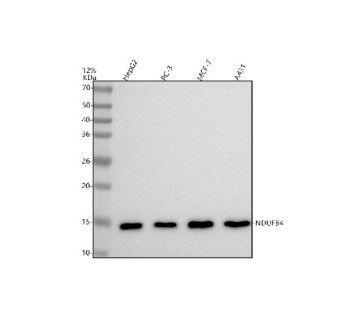
Rabbit IgG in phosphate buffered saline, pH 7.4, 150mM NaCl, 0.02% sodium azide and 50% glycerol, 0.4-0.5mg/ml BSA. NDUFB4 antibody detects NADH dehydrogenase [ubiquinone] 1 beta subcomplex subunit 4, encoded by the NDUFB4 gene. This protein is a non catalytic accessory subunit of mitochondrial Complex I, the first enzyme complex of the oxidative phosphorylation system. Complex I catalyzes the transfer of electrons from NADH to ubiquinone, coupled with proton translocation across the inner mitochondrial membrane. NDUFB4 antibody provides researchers with an essential reagent for studying mitochondrial respiratory function, bioenergetics, and disease mechanisms.Although NDUFB4 does not directly participate in electron transfer, it contributes to the structural stability and assembly of Complex I. Research using NDUFB4 antibody has shown that accessory subunits help maintain the integrity of the complex, ensuring efficient electron flow and proton pumping. Loss or dysfunction of accessory proteins like NDUFB4 destabilizes Complex I, leading to reduced oxidative phosphorylation and ATP production. This highlights the importance of even non catalytic subunits in respiratory chain function.Mutations and defects in Complex I subunits, including NDUFB4, are associated with mitochondrial diseases such as Leigh syndrome, encephalopathy, and mitochondrial myopathy. Research using NDUFB4 antibody has demonstrated that absence or reduction of NDUFB4 impairs assembly of Complex I, leading to decreased activity and energy deficiency. Such dysfunctions contribute to neuromuscular symptoms, developmental delays, and metabolic acidosis. Because mitochondrial disease mechanisms are complex, NDUFB4 antibody serves as an important tool for dissecting assembly defects and functional outcomes.In cancer, altered expression of Complex I subunits including NDUFB4 has been observed. Tumor cells often exhibit metabolic reprogramming, favoring glycolysis over oxidative phosphorylation. However, subsets of tumors rely on intact mitochondrial respiration, making Complex I subunits potential biomarkers and therapeutic targets. Studies with NDUFB4 antibody have shown correlations between expression levels and tumor progression, underscoring its relevance in oncology. Beyond cancer, mitochondrial dysfunction involving NDUFB4 contributes to neurodegenerative diseases, metabolic disorders, and aging related decline.NDUFB4 antibody is applied in western blotting, immunohistochemistry, and immunofluorescence. Western blotting confirms protein abundance in mitochondria rich tissues such as brain, heart, and muscle. Immunohistochemistry highlights tissue distribution, while immunofluorescence demonstrates mitochondrial localization using colocalization with markers such as COX IV. These approaches ensure that NDUFB4 antibody is useful in both clinical and basic mitochondrial research.By supplying validated NDUFB4 antibody reagents, NSJ Bioreagents supports research into oxidative phosphorylation, mitochondrial disease, and cancer biology. Detection of NADH dehydrogenase [ubiquinone] 1 beta subcomplex subunit 4 enables researchers to explore how Complex I subunits maintain cellular energy production and contribute to disease when impaired.
| Keywords: | Anti-NDUFB4, Anti-Complex I-B15, Anti-NADH-ubiquinone oxidoreductase B15 subunit, Anti-NADH dehydrogenase [ubiquinone] 1 beta subcomplex subunit 4, NDUFB4 Antibody / NADH dehydrogenase ubiquinone 1 beta subcomplex subunit 4 |
| Supplier: | NSJ Bioreagents |
| Supplier-Nr: | FY13023 |
Properties
| Application: | WB, IHC, ICC, IF |
| Antibody Type: | Monoclonal |
| Clone: | 30N45 |
| Conjugate: | No |
| Host: | Rabbit |
| Species reactivity: | human, mouse, rat |
| Immunogen: | A synthesized peptide derived from human NDUFB4 |
| Format: | Affinity Purified |
Database Information
| KEGG ID : | K03960 | Matching products |
| UniProt ID : | O95168 | Matching products |
| Gene ID : | GeneID 4710 | Matching products |
Handling & Safety
| Storage: | -20°C |
| Shipping: | -20°C (International: -20°C) |
Caution
Our products are for laboratory research use only: Not for administration to humans!
Our products are for laboratory research use only: Not for administration to humans!
Information about the product reference will follow.
more
You will get a certificate here
Viewed