
Cookie preferences
This website uses cookies, which are necessary for the technical operation of the website and are always set. Other cookies, which increase the comfort when using this website, are used for direct advertising or to facilitate interaction with other websites and social networks, are only set with your consent.
Configuration
Technically required
These cookies are necessary for the basic functions of the shop.
"Allow all cookies" cookie
"Decline all cookies" cookie
CSRF token
Cookie preferences
Currency change
Customer-specific caching
FACT-Finder tracking
Individual prices
Selected shop
Session
Comfort functions
These cookies are used to make the shopping experience even more appealing, for example for the recognition of the visitor.
Note
Show the facebook fanpage in the right blod sidebar
Statistics & Tracking
Affiliate program
Conversion and usertracking via Google Tag Manager
Track device being used



| Item number | Size | Datasheet | Manual | SDS | Delivery time | Quantity | Price |
|---|---|---|---|---|---|---|---|
| NSJ-FY13424 | 100 µl | - | - |
3 - 10 business days* |
790.00€
|
If you have any questions, please use our Contact Form.
You can also order by e-mail: info@biomol.com
Larger quantity required? Request bulk
You can also order by e-mail: info@biomol.com
Larger quantity required? Request bulk
Rabbit IgG in phosphate buffered saline, pH 7.4, 150mM NaCl, 0.02% sodium azide and 50% glycerol,... more
Product information "Anti-NCR2 / Natural cytotoxicity triggering receptor 2, clone 27N49"
Rabbit IgG in phosphate buffered saline, pH 7.4, 150mM NaCl, 0.02% sodium azide and 50% glycerol, 0.4-0.5mg/ml BSA. NCR2 antibody targets Natural cytotoxicity triggering receptor 2 (NCR2), also widely known as NKp44 and CD336, an activating receptor expressed on natural killer (NK) cells that contributes to immune surveillance against infected and transformed cells. NCR2 is a type I transmembrane glycoprotein and a member of the natural cytotoxicity receptor family. It is primarily localized at the cell surface plasma membrane, where it participates in recognition events that stimulate NK cell effector functions. NCR2 expression is typically induced upon NK cell activation, making it a useful marker for activated NK cell populations in immunology research.Functionally, NCR2 acts as an activating receptor that helps trigger NK cell responses following engagement with ligands presented on target cells. Signaling is mediated through association with adaptor proteins containing immunoreceptor tyrosine-based activation motifs, leading to intracellular cascades that promote cytotoxic granule release and cytokine production. Through this mechanism, NCR2 contributes to the elimination of virus-infected cells and tumor cells, and it can influence the broader immune response by shaping cytokine-driven communication with other immune cell types. An NCR2 antibody supports studies focused on NK cell activation and immune effector mechanisms.NCR2 is expressed predominantly by NK cells and can also be detected in certain innate lymphoid cell subsets depending on activation state and tissue context. Because NCR2 levels change with activation and microenvironmental cues, monitoring NCR2 expression provides insight into NK cell functional status. NCR2 localization at the cell surface also makes it relevant for studies of receptor clustering, immune synapse formation, and ligand-dependent signaling dynamics during NK cell interactions with target cells.From a biological and disease-relevance perspective, NCR2 has been widely studied in cancer immunology and viral immunity. Altered NCR2 expression or signaling has been associated with differences in NK cell anti-tumor activity and immune evasion mechanisms within the tumor microenvironment. NCR2 is also relevant in studies of chronic infection and inflammation, where sustained immune activation can reshape receptor expression patterns and NK cell function. Because NCR2 is an inducible activation marker, it is frequently examined in research focused on immune regulation, immunotherapy response, and NK cell biology.At the molecular level, NCR2 is encoded by the NCR2 gene and produces a protein with an expected core size that can migrate variably on SDS-PAGE due to glycosylation, a common feature of cell surface receptors. The extracellular domain mediates ligand interactions, while the transmembrane region supports association with signaling adaptors. NCR2 function depends on proper membrane localization and receptor-proximal signaling assembly. An NCR2 antibody supports research applications focused on profiling activated NK cells and investigating NK cell receptor signaling, with NSJ Bioreagents providing reagents intended for research use.
| Keywords: | Anti-NCR2, Anti-NK cell-activating receptor, Anti-Lymphocyte antigen 95 homolog, Anti-Natural killer cell p44-related protein, Anti-Natural cytotoxicity triggering receptor 2, NCR2 Antibody / Natural cytotoxicity triggering receptor 2 |
| Supplier: | NSJ Bioreagents |
| Supplier-Nr: | FY13424 |
Properties
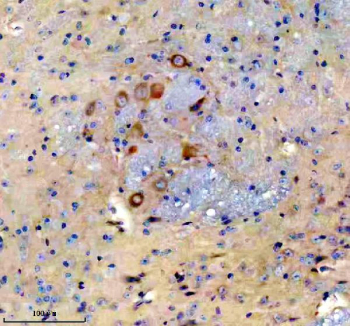
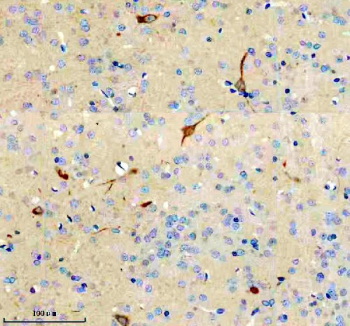
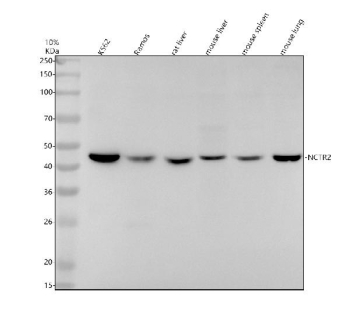
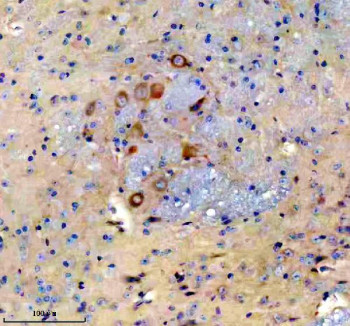
| Application: | WB, IHC |
| Antibody Type: | Monoclonal |
| Clone: | 27N49 |
| Conjugate: | No |
| Host: | Rabbit |
| Species reactivity: | human, mouse, rat |
| Immunogen: | Synthesized peptide derived from human Natural cytotoxicity triggering receptor 2 protein |
| Format: | Affinity Purified |
Database Information
| KEGG ID : | K06742 | Matching products |
| UniProt ID : | O95944 | Matching products |
| Gene ID : | GeneID 9436 | Matching products |
Handling & Safety
| Storage: | -20°C |
| Shipping: | -20°C (International: -20°C) |
Caution
Our products are for laboratory research use only: Not for administration to humans!
Our products are for laboratory research use only: Not for administration to humans!
Information about the product reference will follow.
more
You will get a certificate here
Viewed