
Cookie preferences
This website uses cookies, which are necessary for the technical operation of the website and are always set. Other cookies, which increase the comfort when using this website, are used for direct advertising or to facilitate interaction with other websites and social networks, are only set with your consent.
Configuration
Technically required
These cookies are necessary for the basic functions of the shop.
"Allow all cookies" cookie
"Decline all cookies" cookie
CSRF token
Cookie preferences
Currency change
Customer-specific caching
FACT-Finder tracking
Individual prices
Selected shop
Session
Comfort functions
These cookies are used to make the shopping experience even more appealing, for example for the recognition of the visitor.
Note
Show the facebook fanpage in the right blod sidebar
Statistics & Tracking
Affiliate program
Conversion and usertracking via Google Tag Manager
Track device being used


| Item number | Size | Datasheet | Manual | SDS | Delivery time | Quantity | Price |
|---|---|---|---|---|---|---|---|
| NSJ-V6101-20UG | 20 µg | - | - |
3 - 10 business days* |
684.00€
|
||
| NSJ-V6101-100UG | 100 µg | - | - |
3 - 10 business days* |
1,265.00€
|
If you have any questions, please use our Contact Form.
You can also order by e-mail: info@biomol.com
Larger quantity required? Request bulk
You can also order by e-mail: info@biomol.com
Larger quantity required? Request bulk
Antibody in 1X PBS with 0.05% BSA, 0.05% sodium azide. Nucleolin (NCL) is a multifunctional... more
Product information "Anti-NCL / Nucleolin, clone MSVA-623R"
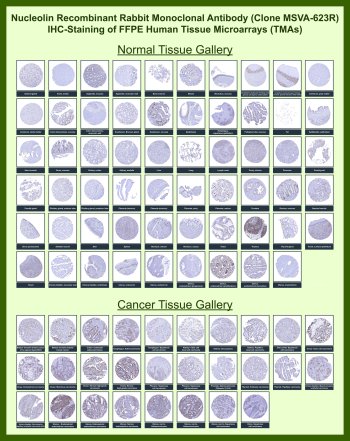
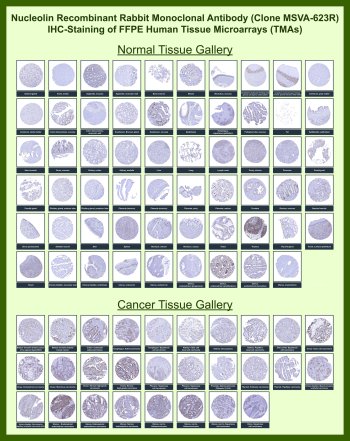
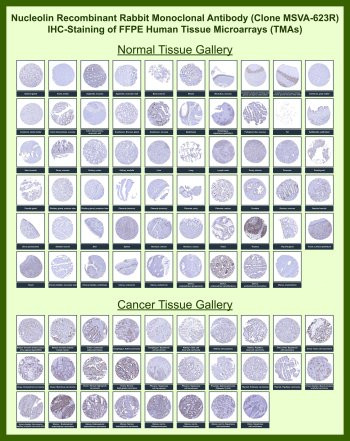
Antibody in 1X PBS with 0.05% BSA, 0.05% sodium azide. Nucleolin (NCL) is a multifunctional nucleolar phosphoprotein involved in ribosome biogenesis, ribosomal RNA transcription, and regulation of nucleolar structure. The protein is encoded by the NCL gene on chromosome 2q37 and is strongly expressed in proliferating cells where ribosome production is active. The Nucleolin Antibody for IHC clone MSVA-623R is a recombinant rabbit monoclonal antibody developed for immunohistochemistry detection of nucleolin in formalin-fixed paraffin-embedded tissue sections.Nucleolin is primarily localized to the nucleus and nucleolus, where it participates in ribosomal RNA synthesis and ribonucleoprotein complex assembly. In immunohistochemistry staining, NCL antibodies typically produce strong nuclear staining with nucleolar enrichment in cells that are actively engaged in protein synthesis. This nuclear localization pattern allows Nucleolin Antibody for IHC reagents to clearly highlight proliferative epithelial cells, lymphoid cells, and other metabolically active cell populations within tissue sections.Immunohistochemistry analysis of NCL expression is commonly performed on formalin-fixed paraffin-embedded tissues to evaluate nucleolin distribution across different organs and tumor types. Nuclear staining patterns can be readily visualized in tissue microarrays and surgical pathology specimens, allowing researchers to examine nucleolin expression in both normal and malignant tissues. Because nucleolin expression correlates with cellular proliferation and nucleolar activity, immunohistochemistry staining frequently reveals increased nuclear signal in rapidly dividing tumor cells.Nucleolin contains several structural domains that support its diverse biological functions. The N-terminal acidic domain interacts with chromatin and ribosomal RNA transcription complexes. Four RNA recognition motifs in the central region bind ribosomal RNA and other RNA molecules, while the glycine- and arginine-rich C-terminal domain mediates interactions with nucleic acids and nucleolar proteins. Through these structural regions nucleolin coordinates ribosomal RNA transcription, RNA processing, and ribonucleoprotein assembly, processes that are tightly linked to cell growth and protein synthesis.NCL antibody reagents are commonly referenced in the literature using several established synonyms for the protein. NCL antibody, nucleolin antibody, C23 nucleolin antibody, and nucleolar protein nucleolin antibody all refer to the same nucleolar phosphoprotein originally described during nucleolar protein fractionation experiments. The historical C23 designation remains widely used in studies examining ribosome biogenesis and nucleolar organization.Because nucleolin displays a characteristic nuclear and nucleolar staining pattern in tissue sections, antibodies targeting NCL are widely used in immunohistochemistry studies of tissue microarrays, tumor samples, and normal organs. A recombinant rabbit monoclonal Nucleolin Antibody for IHC such as clone MSVA-623R provides a reliable reagent for visualizing nucleolin expression in FFPE tissues and for examining nuclear nucleolin distribution across diverse human tissue types.This antibody is also part of a broader collection of IHC antibodies validated by tissue microarray analysis, supporting consistent staining across normal and cancer tissues.
| Keywords: | Anti-NCL, Anti-Nucleolin, Anti-Protein C23, NCL Antibody / Nucleolin |
| Supplier: | NSJ Bioreagents |
| Supplier-Nr: | V6101 |
Properties
| Application: | IHC |
| Antibody Type: | Monoclonal |
| Clone: | MSVA-623R |
| Conjugate: | No |
| Host: | Rabbit |
| Species reactivity: | human |
| Immunogen: | Recombinant full-length human NCL protein |
| Format: | Purified |
Database Information
| KEGG ID : | K11294 | Matching products |
| UniProt ID : | P19338 | Matching products |
| Gene ID : | GeneID 4691 | Matching products |
Handling & Safety
| Storage: | -20°C |
| Shipping: | -20°C (International: -20°C) |
Caution
Our products are for laboratory research use only: Not for administration to humans!
Our products are for laboratory research use only: Not for administration to humans!
Information about the product reference will follow.
more
You will get a certificate here
Viewed