
Cookie preferences
This website uses cookies, which are necessary for the technical operation of the website and are always set. Other cookies, which increase the comfort when using this website, are used for direct advertising or to facilitate interaction with other websites and social networks, are only set with your consent.
Configuration
Technically required
These cookies are necessary for the basic functions of the shop.
"Allow all cookies" cookie
"Decline all cookies" cookie
CSRF token
Cookie preferences
Currency change
Customer-specific caching
FACT-Finder tracking
Individual prices
Selected shop
Session
Comfort functions
These cookies are used to make the shopping experience even more appealing, for example for the recognition of the visitor.
Note
Show the facebook fanpage in the right blod sidebar
Statistics & Tracking
Affiliate program
Conversion and usertracking via Google Tag Manager
Track device being used



| Item number | Size | Datasheet | Manual | SDS | Delivery time | Quantity | Price |
|---|---|---|---|---|---|---|---|
| NSJ-FY12342 | 100 µg | - | - |
7 - 12 business days* |
790.00€
|
If you have any questions, please use our Contact Form.
You can also order by e-mail: info@biomol.com
Larger quantity required? Request bulk
You can also order by e-mail: info@biomol.com
Larger quantity required? Request bulk
Adding 0.2 ml of distilled water will yield a concentration of 500 ug/ml. The NCF1 antibody... more
Product information "Anti-NCF1 / Neutrophil cytosolic factor 1 / p47phox"
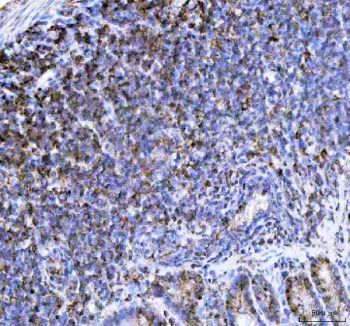
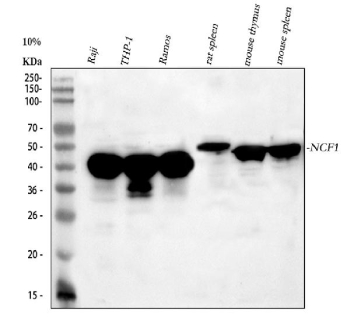
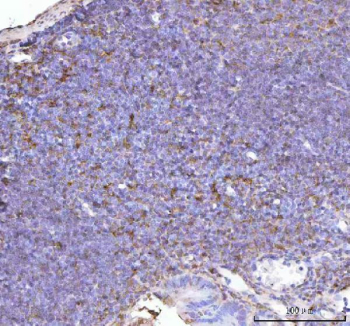
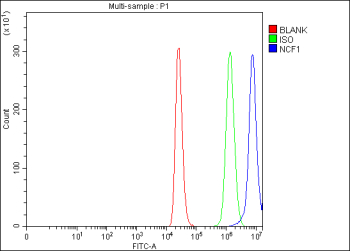
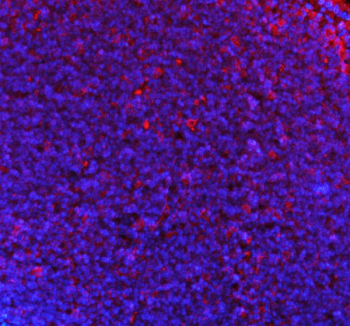
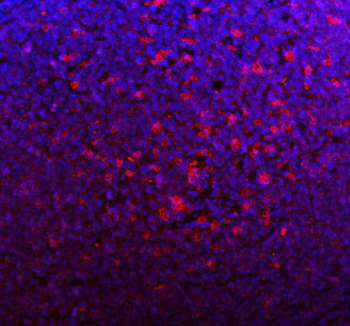
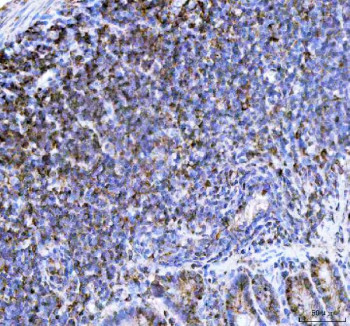
Adding 0.2 ml of distilled water will yield a concentration of 500 ug/ml. The NCF1 antibody targets Neutrophil cytosolic factor 1, a cytoplasmic component of the NADPH oxidase complex responsible for generating reactive oxygen species (ROS) during immune responses. Encoded by the NCF1 gene, this protein, also known as p47phox, acts as an organizer subunit that bridges cytosolic oxidase components with the membrane-bound catalytic core. The NCF1 antibody is a vital reagent for understanding how oxidative bursts are initiated in phagocytes and how these processes regulate host defense, inflammation, and redox signaling.Neutrophil cytosolic factor 1 becomes phosphorylated upon cellular activation, prompting its translocation to the plasma membrane where it associates with p22phox, gp91phox (CYBB), and other subunits to assemble the active NADPH oxidase complex. This enzymatic system produces superoxide radicals essential for microbial killing. The NCF1 antibody enables detection of this phosphorylation-dependent activation and helps identify conditions that modulate oxidase assembly.Genetic defects in NCF1 lead to chronic granulomatous disease (CGD), a primary immunodeficiency characterized by recurrent infections due to defective superoxide generation. In such patients, mutations often cause reduced or absent p47phox expression. Using the NCF1 antibody, researchers can distinguish functional versus nonfunctional protein forms, aiding in diagnostic and mechanistic studies of CGD. Beyond innate immunity, Neutrophil cytosolic factor 1 also contributes to redox-dependent signaling in endothelial and neuronal cells, highlighting its importance beyond phagocytes.The NCF1 antibody is suitable for western blotting, immunoprecipitation, and flow cytometry, where it detects both total and phosphorylated protein forms. Its applications extend to studies examining oxidative stress, cell signaling cascades, and inflammatory pathway regulation. Because NADPH oxidase activity affects vascular tone, apoptosis, and cytokine production, NCF1 has broad physiological relevance. The antibody provides a reliable means to quantify expression changes under oxidative or inflammatory stress.In oncology and cardiovascular research, aberrant activation of NCF1-containing complexes has been associated with chronic inflammation and tissue damage. Elevated expression may amplify ROS production, promoting DNA damage and tumorigenesis. Conversely, impaired function can weaken immune defense and tissue repair. The NCF1 antibody offered by NSJ Bioreagents supports detailed exploration of these opposing roles, helping define how redox balance influences health and disease.By providing consistent detection across multiple platforms, the NCF1 antibody remains an essential reagent for studying oxidative metabolism and immune cell function. Its use continues to expand from immunology into neurobiology and cancer biology, where understanding reactive oxygen mechanisms is increasingly central to therapeutic innovation.
| Keywords: | Anti-NCF1, Anti-NCF-47K, Anti-p47-phox, Anti-Nox organizer 2, Anti-Nox-organizing protein 2, Anti-Neutrophil cytosol factor 1, Anti-47 kDa neutrophil oxidase factor, Anti-Neutrophil NADPH oxidase factor 1, Anti-SH3 and PX domain-containing protein 1A, Ant |
| Supplier: | NSJ Bioreagents |
| Supplier-Nr: | FY12342 |
Properties
| Application: | ELISA, FC, IF, IHC, WB |
| Antibody Type: | Polyclonal |
| Conjugate: | No |
| Host: | Rabbit |
| Species reactivity: | human, mouse, rat |
| Immunogen: | E.coli-derived human p47 phox/NCF1 recombinant protein (Position: Q22-R384) |
| Format: | Purified |
Database Information
| KEGG ID : | K08011 | Matching products |
| UniProt ID : | P14598 | Matching products |
| Gene ID : | GeneID 653361 | Matching products |
Handling & Safety
| Storage: | +4°C |
| Shipping: | +4°C (International: +4°C) |
Caution
Our products are for laboratory research use only: Not for administration to humans!
Our products are for laboratory research use only: Not for administration to humans!
Information about the product reference will follow.
more
You will get a certificate here
Viewed