
Cookie preferences
This website uses cookies, which are necessary for the technical operation of the website and are always set. Other cookies, which increase the comfort when using this website, are used for direct advertising or to facilitate interaction with other websites and social networks, are only set with your consent.
Configuration
Technically required
These cookies are necessary for the basic functions of the shop.
"Allow all cookies" cookie
"Decline all cookies" cookie
CSRF token
Cookie preferences
Currency change
Customer-specific caching
FACT-Finder tracking
Individual prices
Selected shop
Session
Comfort functions
These cookies are used to make the shopping experience even more appealing, for example for the recognition of the visitor.
Note
Show the facebook fanpage in the right blod sidebar
Statistics & Tracking
Affiliate program
Conversion and usertracking via Google Tag Manager
Track device being used



| Item number | Size | Datasheet | Manual | SDS | Delivery time | Quantity | Price |
|---|---|---|---|---|---|---|---|
| NSJ-FY13028 | 100 µg | - | - |
3 - 10 business days* |
790.00€
|
If you have any questions, please use our Contact Form.
You can also order by e-mail: info@biomol.com
Larger quantity required? Request bulk
You can also order by e-mail: info@biomol.com
Larger quantity required? Request bulk
Adding 0.2 ml of distilled water will yield a concentration of 500 ug/ml. MX1 antibody detects... more
Product information "Anti-MX1 / MxA / Myxovirus resistance protein 1"
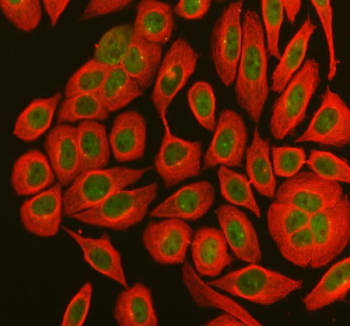
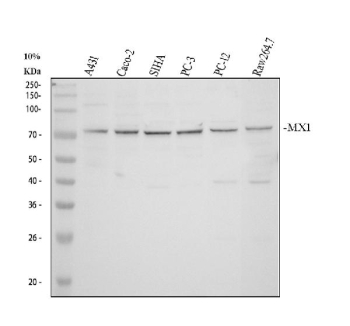
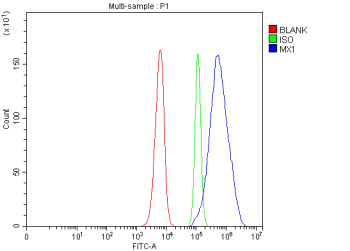
Adding 0.2 ml of distilled water will yield a concentration of 500 ug/ml. MX1 antibody detects Myxovirus resistance protein 1, a dynamin-like GTPase that mediates antiviral defense against a wide range of RNA and DNA viruses. The UniProt recommended name is Interferon-induced GTP-binding protein Mx1 (MX1). Also known as MxA in humans, this protein is one of the best-characterized interferon-stimulated genes (ISGs) and represents a central effector of type I and type III interferon antiviral activity.Functionally, MX1 antibody identifies a 662-amino-acid cytoplasmic GTPase that self-assembles into oligomeric rings and tubular structures upon activation. MX1 binds and traps viral nucleocapsids and replication complexes, blocking viral genome transcription and replication. Its antiviral spectrum includes orthomyxoviruses (such as influenza A), paramyxoviruses, bunyaviruses, and other RNA viruses, as well as certain DNA viruses. MX1 activity is GTP-dependent and requires oligomerization for full antiviral efficacy.The MX1 gene is located on chromosome 21q22.3 and is transcriptionally induced by type I interferons (IFN-alpha and IFN-beta) and type III interferons (IFN-lambda). MX1 localizes to the cytoplasm and associates with intracellular membranes where viral replication occurs. Upon interferon stimulation, MX1 accumulates rapidly and remains active for several hours, providing a robust first-line defense during viral infection. Its antiviral mechanism includes sequestering viral nucleoproteins, blocking uncoating, and preventing the assembly of viral polymerase complexes.In immunology, MX1 serves as a molecular signature of interferon pathway activation and is frequently used as a biomarker for assessing antiviral or autoimmune responses. Elevated MX1 expression is characteristic of viral infections, systemic lupus erythematosus, and interferonopathies. In contrast, genetic polymorphisms affecting MX1 activity can reduce viral resistance and modulate disease susceptibility. MX1 also contributes to innate immunity in epithelial barriers, liver, and lung tissues, providing localized protection against viral entry and replication.MX1 antibody is widely used in virology, immunology, and interferon signaling research. It is suitable for western blotting, immunofluorescence, and immunohistochemistry to detect MX1 expression following viral infection or interferon treatment. This antibody enables monitoring of innate immune activation and evaluation of interferon pathway modulators. In pathology, MX1 staining is used to confirm interferon signature activation in autoimmune and inflammatory diseases.Structurally, MX1 belongs to the dynamin superfamily of large GTPases, with conserved GTP-binding, stalk, and oligomerization domains. The protein hydrolyzes GTP to induce conformational changes required for viral entrapment. NSJ Bioreagents provides MX1 antibody reagents validated for use in antiviral signaling, innate immunity, and interferon response research.
| Keywords: | Anti-MX1, Anti-Myxoma resistance protein 1, Anti-Myxovirus resistance protein 1, Anti-Interferon-induced protein p78, Anti-Interferon-induced GTP-binding protein Mx1, Anti-Interferon-regulated resistance GTP-binding protein MxA, MX1 Antibody / MxA / Myxov |
| Supplier: | NSJ Bioreagents |
| Supplier-Nr: | FY13028 |
Properties
| Application: | WB, ICC/IF, FC, ELISA |
| Antibody Type: | Polyclonal |
| Conjugate: | No |
| Host: | Rabbit |
| Species reactivity: | human, mouse, rat |
| Immunogen: | E.coli-derived human MX1 recombinant protein (Position: E315G-662) |
| Format: | Purified |
Database Information
| KEGG ID : | K14754 | Matching products |
| UniProt ID : | P20591 | Matching products |
| Gene ID : | GeneID 4599 | Matching products |
Handling & Safety
| Storage: | +4°C |
| Shipping: | +4°C (International: +4°C) |
Caution
Our products are for laboratory research use only: Not for administration to humans!
Our products are for laboratory research use only: Not for administration to humans!
Information about the product reference will follow.
more
You will get a certificate here
Viewed