
Cookie preferences
This website uses cookies, which are necessary for the technical operation of the website and are always set. Other cookies, which increase the comfort when using this website, are used for direct advertising or to facilitate interaction with other websites and social networks, are only set with your consent.
Configuration
Technically required
These cookies are necessary for the basic functions of the shop.
"Allow all cookies" cookie
"Decline all cookies" cookie
CSRF token
Cookie preferences
Currency change
Customer-specific caching
FACT-Finder tracking
Individual prices
Selected shop
Session
Comfort functions
These cookies are used to make the shopping experience even more appealing, for example for the recognition of the visitor.
Note
Show the facebook fanpage in the right blod sidebar
Statistics & Tracking
Affiliate program
Conversion and usertracking via Google Tag Manager
Track device being used




| Item number | Size | Datasheet | Manual | SDS | Delivery time | Quantity | Price |
|---|---|---|---|---|---|---|---|
| Cay42843-100 | 100 µl | - |
6 - 10 business days* |
554.00€
|
If you have any questions, please use our Contact Form.
You can also order by e-mail: info@biomol.com
Larger quantity required? Request bulk
You can also order by e-mail: info@biomol.com
Larger quantity required? Request bulk
Mucin 1 (MUC1) is a member of the mucin family. It is expressed as a proprotein that is cleaved... more
Product information "Anti-MUC1 Rabbit (Clone RM489)"
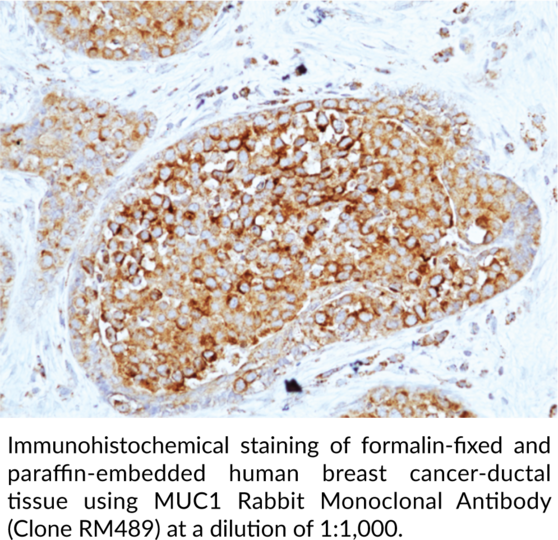
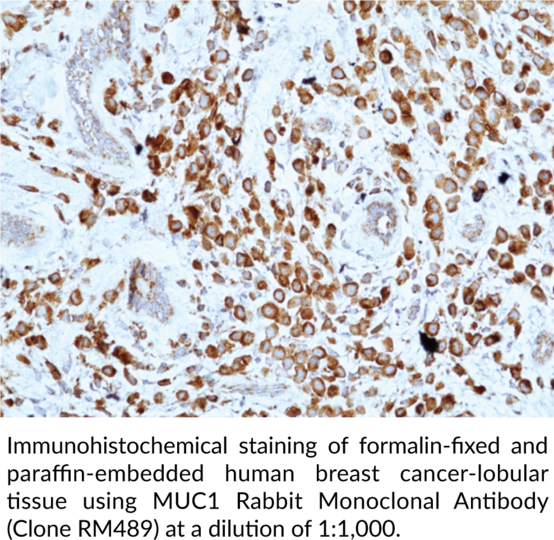
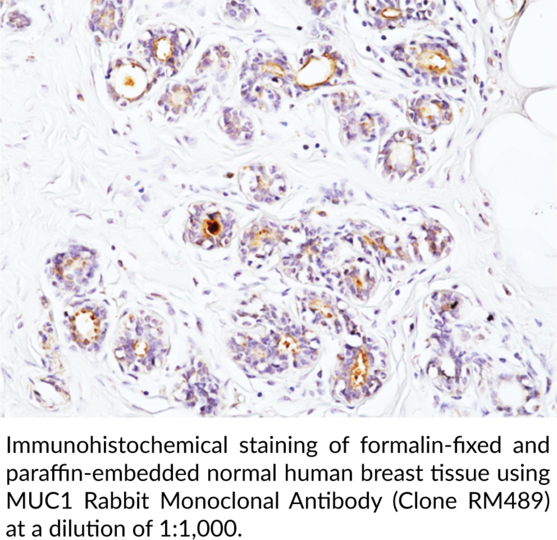
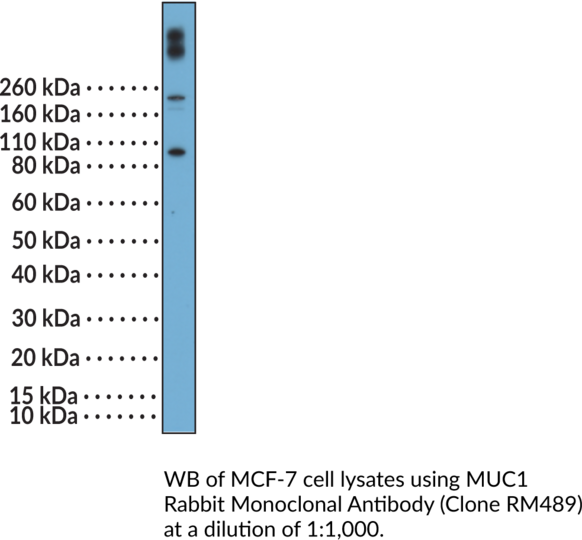
Mucin 1 (MUC1) is a member of the mucin family. It is expressed as a proprotein that is cleaved into extracellular and transmembrane polypeptides. The extracellular polypeptide is composed of a tandem repeat domain, which contains O- and N-linked glycosylation sites, and is attached non-covalently to the transmembrane polypeptide, which is composed of a juxtamembrane region, a transmembrane domain, and a C-terminal cytoplasmic tail. MUC1 is ubiquitously expressed in tissues, such as stomach peptic cells, organ endothelium and epithelium, and liver bile ducts, and functions as an extracellular barrier, serves as an anchor for intercellular proteins, such as intercellular adhesion molecule-1 (ICAM-1), or associates with other receptors, such as EGFR, to assist in signal transduction. MUC1 can undergo alternative splicing to produce secreted or intracellular MUC1 isoforms. In tumors, MUC1 prevents immune cell recognition and engagement, increases metastatic potential, and is frequently overexpressed in cancers. Serum and tumor levels of MUC1 are increased in patients with breast cancer. Cayman's MUC1 Rabbit Monoclonal Antibody (Clone RM489) can be used for immunohistochemistry (IHC) and Western blot (WB) applications.. Cross reactivity: (+) MUC1: . (+) Human: .. Protein function: The alpha subunit has cell adhesive properties. Can act both as an adhesion and an anti-adhesion protein. May provide a protective layer on epithelial cells against bacterial and enzyme attack. [The UniProt Consortium]
| Keywords: | BM7, Breast Carcinoma-associated Antigen DF3, CA 15-3, Cancer Antigen 15-3, KL-6, Mucin 1, PEM, Polymorphic Epithelial Mucin |
| Supplier: | Cayman Chemical |
| Supplier-Nr: | 42843 |
Properties
| Application: | IHC, WB |
| Antibody Type: | Monoclonal |
| Clone: | RM489 |
| Conjugate: | No |
| Host: | Rabbit |
| Species reactivity: | human |
| Immunogen: | Peptide corresponding to the cytoplasmic domain of human MUC1 |
| Format: | Purified |
Database Information
| KEGG ID : | K06568 | Matching products |
| UniProt ID : | P15941 | Matching products |
| Gene ID : | GeneID 4582 | Matching products |
Handling & Safety
| Storage: | -20°C |
| Shipping: | +20°C (International: -20°C) |
Caution
Our products are for laboratory research use only: Not for administration to humans!
Our products are for laboratory research use only: Not for administration to humans!
Information about the product reference will follow.
more
You will get a certificate here
Viewed