
Cookie preferences
This website uses cookies, which are necessary for the technical operation of the website and are always set. Other cookies, which increase the comfort when using this website, are used for direct advertising or to facilitate interaction with other websites and social networks, are only set with your consent.
Configuration
Technically required
These cookies are necessary for the basic functions of the shop.
"Allow all cookies" cookie
"Decline all cookies" cookie
CSRF token
Cookie preferences
Currency change
Customer-specific caching
FACT-Finder tracking
Individual prices
Selected shop
Session
Comfort functions
These cookies are used to make the shopping experience even more appealing, for example for the recognition of the visitor.
Note
Show the facebook fanpage in the right blod sidebar
Statistics & Tracking
Affiliate program
Conversion and usertracking via Google Tag Manager
Track device being used

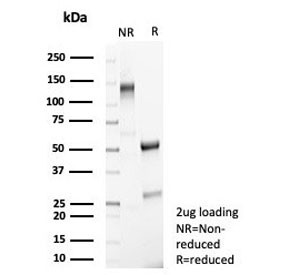
| Item number | Size | Datasheet | Manual | SDS | Delivery time | Quantity | Price |
|---|---|---|---|---|---|---|---|
| NSJ-V4756SAF-100UG | 100 µg | - | - |
3 - 10 business days* |
810.00€
|
If you have any questions, please use our Contact Form.
You can also order by e-mail: info@biomol.com
Larger quantity required? Request bulk
You can also order by e-mail: info@biomol.com
Larger quantity required? Request bulk
1 mg/ml in 1X PBS, BSA free, sodium azide free. MR1 (major histocompatibility complex, class... more
Product information "Anti-MR1 / MHC class I related protein 1, clone MR1/7577"
1 mg/ml in 1X PBS, BSA free, sodium azide free. MR1 (major histocompatibility complex, class I-related), also known as HLALS, is a 341 amino acid single-pass membrane protein that localizes to the endoplasmic reticulum, as well as to the extracellular side of the cell membrane, and contains one Ig-like C1-type domain. Expressed ubiquitously, MR1 exists as a heterodimer with b-2-Microglobulin and plays an important role in antigen presentation, specifically in the development and expansion of mucosalassociated invariant T cells (MAITs). MAITs are located in the gut and are involved in monitoring flora levels, as well as in conveying distress signals to other areas of the body, indicating a role for MR1 in proper digestion and immune system function. MR1 exists as four alternatively spliced isoforms and is encoded by a gene which maps to human chromosome 1. Protein function: Antigen-presenting molecule specialized in displaying microbial pyrimidine-based metabolites to alpha-beta T cell receptors (TCR) on innate-type mucosal-associated invariant T (MAIT) cells (PubMed:23051753, PubMed:26795251, PubMed:12794138, PubMed:19416870, PubMed:22692454, PubMed:23846752). In complex with B2M preferentially presents riboflavin-derived metabolites to semi-invariant TRAV1-2 TCRs on MAIT cells, guiding immune surveillance of the microbial metabolome at mucosal epithelial barriers (PubMed:26795251, PubMed:24695216, PubMed:20581831). Signature pyrimidine-based microbial antigens are generated via non-enzymatic condensation of metabolite intermediates of the riboflavin pathway with by-products arising from other metabolic pathways such as glycolysis. Typical potent antigenic metabolites are 5-(2-oxoethylideneamino)-6-D-ribitylaminouracil (5-OE-RU) and 5-(2- oxopropylideneamino)-6-D-ribitylaminouracil (5-OP-RU), products of condensation of 5-amino-6-D-ribityaminouracil (5-A-RU) with glyoxal or methylglyoxal by-products, respectively (PubMed:24695216). May present microbial antigens to various TRAV1-2-negative MAIT cell subsets, providing for unique recognition of diverse microbes, including pathogens that do not synthesize riboflavin (PubMed:27527800, PubMed:31113973). Upon antigen recognition, elicits rapid innate-type MAIT cell activation to eliminate pathogenic microbes by directly killing infected cells (PubMed:24695216, PubMed:27527800, PubMed:23846752). During T cell development, drives thymic selection and post-thymic terminal differentiation of MAIT cells in a process dependent on commensal microflora. Acts as an immune sensor of cancer cell metabolome (PubMed:31959982). May present a tumor-specific or -associated metabolite essential for cancer cell survival to a pan-cancer TCR consisting of TRAV38.2-DV8*TRAJ31 alpha chain paired with a TRBV25.1*TRBJ2.3 beta chain on a non-MAIT CD8- positive T cell clone (MC.7.G5), triggering T cell-mediated killing of a wide range of cancer cell types (PubMed:31959982). [The UniProt Consortium]
| Keywords: | Anti-MR1, Anti-MHC class I-related gene protein, Anti-Class I histocompatibility antigen-like protein, Anti-Major histocompatibility complex class I-related gene protein, MR1 Antibody / MHC class I related protein 1 |
| Supplier: | NSJ Bioreagents |
| Supplier-Nr: | V4756SAF |
Properties
| Application: | IHC (paraffin) |
| Antibody Type: | Monoclonal |
| Clone: | MR1/7577 |
| Conjugate: | No |
| Host: | Mouse |
| Species reactivity: | human |
| Immunogen: | A recombinant partial protein sequence (within amino acids 50-250) from the human protein |
| Format: | Antigen Presentation |
Database Information
| KEGG ID : | K26411 | Matching products |
| UniProt ID : | Q95460 | Matching products |
| Gene ID : | GeneID 3140 | Matching products |
Handling & Safety
| Storage: | -20°C |
| Shipping: | -20°C (International: -20°C) |
Caution
Our products are for laboratory research use only: Not for administration to humans!
Our products are for laboratory research use only: Not for administration to humans!
Information about the product reference will follow.
more
You will get a certificate here
Viewed