
Cookie preferences
This website uses cookies, which are necessary for the technical operation of the website and are always set. Other cookies, which increase the comfort when using this website, are used for direct advertising or to facilitate interaction with other websites and social networks, are only set with your consent.
Configuration
Technically required
These cookies are necessary for the basic functions of the shop.
"Allow all cookies" cookie
"Decline all cookies" cookie
CSRF token
Cookie preferences
Currency change
Customer-specific caching
FACT-Finder tracking
Individual prices
Selected shop
Session
Comfort functions
These cookies are used to make the shopping experience even more appealing, for example for the recognition of the visitor.
Note
Show the facebook fanpage in the right blod sidebar
Statistics & Tracking
Affiliate program
Conversion and usertracking via Google Tag Manager
Track device being used

| Item number | Size | Datasheet | Manual | SDS | Delivery time | Quantity | Price |
|---|---|---|---|---|---|---|---|
| Cay44096-100 | 100 µg | - |
6 - 10 business days* |
472.00€
|
If you have any questions, please use our Contact Form.
You can also order by e-mail: info@biomol.com
Larger quantity required? Request bulk
You can also order by e-mail: info@biomol.com
Larger quantity required? Request bulk
Microsomal epoxide hydrolase (mEH) is a member of the alpha/beta-hydrolase family that catalyzes... more
Product information "Anti-Microsomal Epoxide Hydrolase (Clone 1H9)"
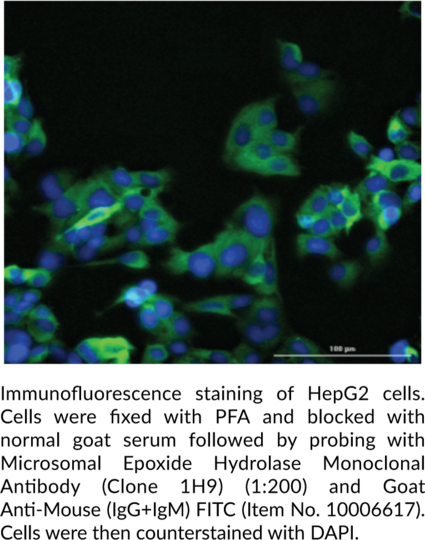
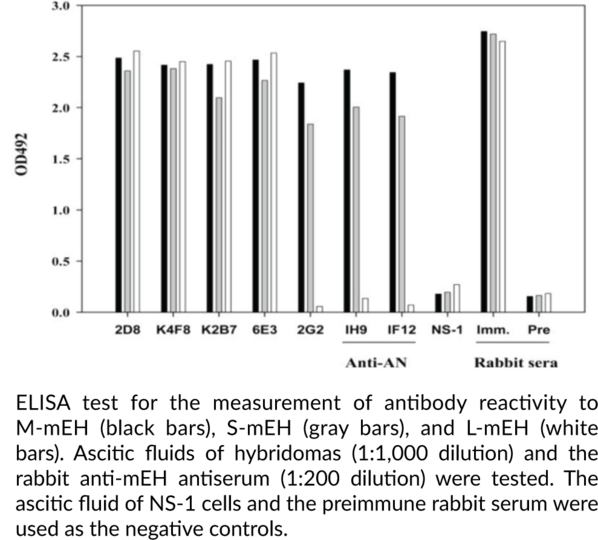
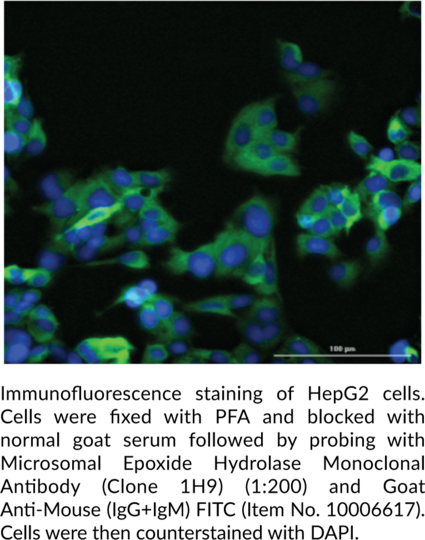
Microsomal epoxide hydrolase (mEH) is a member of the alpha/beta-hydrolase family that catalyzes the hydrolysis of xenobiotic and endogenous epoxides to diols. It is a single polypeptide chain with the N-terminal region functioning as a membrane anchor and the C-terminus containing the catalytic residues. mEH is localized to the endoplasmic reticulum and ubiquitously expressed, but becomes pseudo-soluble under a variety of pathological conditions. mEH dissociates from the endoplasmic reticulum in neoplastic and preneoplastic liver cells and plasma levels of mEH are positively correlated with the metastasis of Kaposi's sarcoma to the liver. Viral infection by hepatitis C or hepatitis A also induces pseudo-solubilization of mEH and the development of autoantibodies against mEH, which are associated with liver damage and disease progression. Cayman's Microsomal Epoxide Hydrolase Monoclonal Antibody (Clone 1H9) can be used for immunofluorescence (IF) applications. Synonyms: EPHX1 Epoxide Hydratase Epoxide Hydrolase 1 mEH. Immunogen: Recombinant human mEH. Clone Designation: 1H9. Formulation (Request formulation change): 100 µg protein G-purified monoclonal antibody. Storage Buffer: PBS, pH 7.2, with 50% glycerol and 0.02% sodium. Host: Mouse. Isotype: IgG1K. Applications: IF. Cross Reactivity: (+) mEH (native protein). Species Reactivity: (+) Human. UniProt Accession No: P07099. Storage: -20°C. Stability: > 3 years.
| Keywords: | Anti-EPHX, Anti-Epoxide hydratase, Anti-mEH {ECO:0000305}, Anti-Epoxide hydratase, Anti-mEH {ECO:0000305}, Anti-Microsomal epoxide hydrolase, Anti-Microsomal epoxide hydrolase, Anti-Epoxide hydrolase 1 {ECO:0000305}, Anti-Epoxide hydrolase 1 {ECO:0000305} |
| Supplier: | Cayman Chemical |
| Supplier-Nr: | 44096 |
Properties
| Application: | IF |
| Antibody Type: | Monoclonal |
| Clone: | 1H9 |
| Conjugate: | No |
| Host: | Mouse |
| Species reactivity: | human |
| Immunogen: | recombinant human mEH |
| Format: | Purified |
Database Information
| KEGG ID : | K01253 | Matching products |
| UniProt ID : | P07099 | Matching products |
| Gene ID : | GeneID 2052 | Matching products |
Handling & Safety
| Storage: | -20°C |
| Shipping: | -20°C (International: -20°C) |
Caution
Our products are for laboratory research use only: Not for administration to humans!
Our products are for laboratory research use only: Not for administration to humans!
Information about the product reference will follow.
more
You will get a certificate here
Viewed