
Cookie preferences
This website uses cookies, which are necessary for the technical operation of the website and are always set. Other cookies, which increase the comfort when using this website, are used for direct advertising or to facilitate interaction with other websites and social networks, are only set with your consent.
Configuration
Technically required
These cookies are necessary for the basic functions of the shop.
"Allow all cookies" cookie
"Decline all cookies" cookie
CSRF token
Cookie preferences
Currency change
Customer-specific caching
FACT-Finder tracking
Individual prices
Selected shop
Session
Comfort functions
These cookies are used to make the shopping experience even more appealing, for example for the recognition of the visitor.
Note
Show the facebook fanpage in the right blod sidebar
Statistics & Tracking
Affiliate program
Conversion and usertracking via Google Tag Manager
Track device being used

| Item number | Size | Datasheet | Manual | SDS | Delivery time | Quantity | Price |
|---|---|---|---|---|---|---|---|
| NSJ-FY12477 | 100 µg | - | - |
7 - 12 business days* |
790.00€
|
If you have any questions, please use our Contact Form.
You can also order by e-mail: info@biomol.com
Larger quantity required? Request bulk
You can also order by e-mail: info@biomol.com
Larger quantity required? Request bulk
Adding 0.2 ml of distilled water will yield a concentration of 500 ug/ml. MGARP antibody detects... more
Product information "Anti-MGARP / Mitochondria-localized glutamic acid-rich protein"
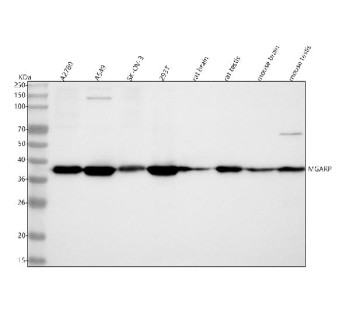
Adding 0.2 ml of distilled water will yield a concentration of 500 ug/ml. MGARP antibody detects Mitochondria-localized glutamic acid-rich protein, a mitochondrial membrane-associated protein that regulates organelle dynamics, energy metabolism, and neuronal development. MGARP functions as an adaptor involved in mitochondrial transport, positioning, and biogenesis, particularly in highly active tissues such as brain and retina. The MGARP antibody is widely used in studies of mitochondrial biology, neurodevelopment, and metabolic regulation, offering insight into mechanisms that control cellular energy distribution and organelle communication.MGARP is encoded by the MGARP gene located on human chromosome 4q28.1. The protein is approximately 25 kilodaltons in size and characterized by an N-terminal mitochondrial targeting sequence and two C-terminal transmembrane domains that anchor it to the outer mitochondrial membrane. It interacts with proteins involved in mitochondrial motility and positioning, including Miro, TRAK1, and kinesin motor complexes. Through these interactions, MGARP mediates mitochondrial trafficking along microtubules and maintains energy homeostasis in neurons and photoreceptors.The MGARP antibody is typically used to identify mitochondrial localization via immunofluorescence microscopy, where it produces a distinct punctate pattern consistent with the mitochondrial network. Western blot analysis detects a band near 38 kilodaltons. MGARP expression is enriched in neural tissues, endocrine organs, and energy-demanding cell types. Experimental evidence shows that it modulates mitochondrial fission and fusion dynamics, contributing to the distribution of mitochondria within axons and synaptic terminals. Loss or dysregulation of MGARP disrupts mitochondrial motility and impairs neuronal differentiation, emphasizing its importance in developmental neurobiology.Beyond neuronal systems, MGARP has been implicated in steroid hormone biosynthesis and cellular stress adaptation. In steroidogenic cells, MGARP expression is upregulated by cAMP signaling and may influence mitochondrial cholesterol import. Its expression is responsive to hypoxia, oxidative stress, and glucose deprivation, indicating a role in cellular adaptation to metabolic stress. NSJ Bioreagents offers a validated MGARP antibody optimized for western blot, immunofluorescence, and immunohistochemistry, supporting research into mitochondrial dynamics, intracellular transport, and neuroendocrine function.
| Keywords: | Anti-MGARP, Anti-Protein MGARP, Anti-Ovary-specific acidic protein, Anti-Corneal endothelium-specific protein 1, Anti-Mitochondria-localized glutamic acid-rich protein, Anti-Hypoxia up-regulated mitochondrial movement regulator protein, MGARP Antibody / M |
| Supplier: | NSJ Bioreagents |
| Supplier-Nr: | FY12477 |
Properties
| Application: | WB, ELISA |
| Antibody Type: | Polyclonal |
| Conjugate: | No |
| Host: | Rabbit |
| Species reactivity: | human, mouse, rat |
| Immunogen: | E.coli-derived human C4orf49/MGARP recombinant protein (Position: M1-E155) |
| Format: | Purified |
Database Information
| UniProt ID : | Q8TDB4 | Matching products |
| Gene ID : | GeneID 84709 | Matching products |
Handling & Safety
| Storage: | +4°C |
| Shipping: | +4°C (International: +4°C) |
Caution
Our products are for laboratory research use only: Not for administration to humans!
Our products are for laboratory research use only: Not for administration to humans!
Information about the product reference will follow.
more
You will get a certificate here
Viewed