
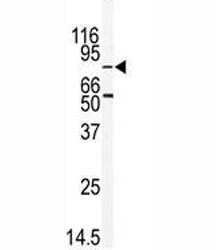
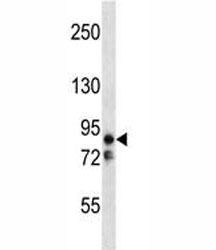
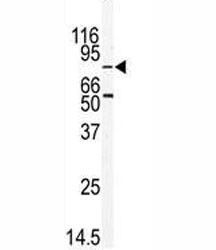
Anti-MARK2

Item number Size Datasheet Manual SDS Delivery time Quantity Price
NSJ-F40167-0.08ML 80 µl - -

3 - 10 business days*

361.00€
NSJ-F40167-0.4ML 400 µl - -

3 - 10 business days*

772.00€
 
In 1X PBS, pH 7.4, with 0.09% sodium azide. Protein kinases are enzymes that transfer a phosphate... more
Product information "Anti-MARK2"
In 1X PBS, pH 7.4, with 0.09% sodium azide. Protein kinases are enzymes that transfer a phosphate group from a phosphate donor, generally the g phosphate of ATP, onto an acceptor amino acid in a substrate protein. By this basic mechanism, protein kinases mediate most of the signal transduction in eukaryotic cells, regulating cellular metabolism, transcription, cell cycle progression, cytoskeletal rearrangement and cell movement, apoptosis, and differentiation. With more than 500 gene products, the protein kinase family is one of the largest families of proteins in eukaryotes. The family has been classified in 8 major groups based on sequence comparison of their tyrosine (PTK) or serine/threonine (STK) kinase catalytic domains. Protein function: Serine/threonine-protein kinase involved in cell polarity and microtubule dynamics regulation. Phosphorylates CRTC2/TORC2, DCX, HDAC7, KIF13B, MAP2, MAP4, MAPT/TAU, and RAB11FIP2. Plays a key role in cell polarity by phosphorylating the microtubule-associated proteins MAP2, MAP4 and MAPT/TAU at KXGS motifs, causing detachment from microtubules, and their disassembly. Regulates epithelial cell polarity by phosphorylating RAB11FIP2. Involved in the regulation of neuronal migration through its dual activities in regulating cellular polarity and microtubule dynamics, possibly by phosphorylating and regulating DCX. Regulates axogenesis by phosphorylating KIF13B, promoting interaction between KIF13B and 14-3-3 and inhibiting microtubule- dependent accumulation of KIF13B. Also required for neurite outgrowth and establishment of neuronal polarity. Regulates localization and activity of some histone deacetylases by mediating phosphorylation of HDAC7, promoting subsequent interaction between HDAC7 and 14-3-3 and export from the nucleus. Also acts as a positive regulator of the Wnt signaling pathway, probably by mediating phosphorylation of dishevelled proteins (DVL1, DVL2 and/or DVL3). Modulates the developmental decision to build a columnar versus a hepatic epithelial cell apparently by promoting a switch from a direct to a transcytotic mode of apical protein delivery. Essential for the asymmetric development of membrane domains of polarized epithelial cells. [The UniProt Consortium]
Keywords: Anti-EMK1, Anti-EMK-1, Anti-Par1b, Anti-Par-1b, EC=2.7.11.1, EC=2.7.11.26, Anti-PAR1 homolog, Anti-PAR1 homolog b, Anti-ELKL motif kinase 1, Anti-Serine/threonine-protein kinase MARK2, Anti-MAP/microtubule affinity-regulating kinase 2, MARK2 Antibody
Supplier: NSJ Bioreagents
Supplier-Nr: F40167

Properties

Application: WB, IHC, ELISA
Antibody Type: Polyclonal
Conjugate: No
Host: Rabbit
Species reactivity: human, mouse
Immunogen: A portion of amino acids 600-630 from the human protein was used as the immunogen for this MARK2 antibody.
Format: Purified

Handling & Safety

Storage: -20°C
Shipping: +4°C (International: +4°C)
Caution
Our products are for laboratory research use only: Not for administration to humans!
You will get a certificate here
or to request a certificate of analysis.
Read, write and discuss reviews... more
Customer review for "Anti-MARK2"
Write a review
or to review a product.
Viewed