
Cookie preferences
This website uses cookies, which are necessary for the technical operation of the website and are always set. Other cookies, which increase the comfort when using this website, are used for direct advertising or to facilitate interaction with other websites and social networks, are only set with your consent.
Configuration
Technically required
These cookies are necessary for the basic functions of the shop.
"Allow all cookies" cookie
"Decline all cookies" cookie
CSRF token
Cookie preferences
Currency change
Customer-specific caching
FACT-Finder tracking
Individual prices
Selected shop
Session
Comfort functions
These cookies are used to make the shopping experience even more appealing, for example for the recognition of the visitor.
Note
Show the facebook fanpage in the right blod sidebar
Statistics & Tracking
Affiliate program
Conversion and usertracking via Google Tag Manager
Track device being used


| Item number | Size | Datasheet | Manual | SDS | Delivery time | Quantity | Price |
|---|---|---|---|---|---|---|---|
| NSJ-FY13302 | 100 µg | - | - |
3 - 10 business days* |
790.00€
|
If you have any questions, please use our Contact Form.
You can also order by e-mail: info@biomol.com
Larger quantity required? Request bulk
You can also order by e-mail: info@biomol.com
Larger quantity required? Request bulk
Adding 0.2 ml of distilled water will yield a concentration of 500 ug/ml. MARCO antibody detects... more
Product information "Anti-MARCO / Macrophage receptor with collagenous structure"
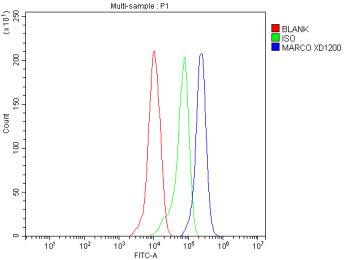
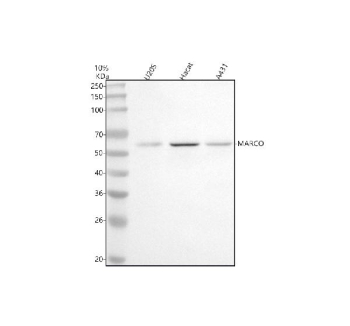
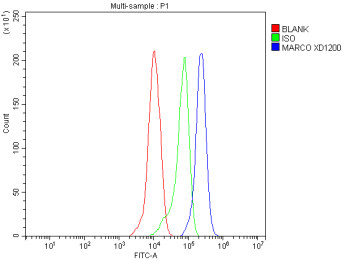
Adding 0.2 ml of distilled water will yield a concentration of 500 ug/ml. MARCO antibody detects the Macrophage receptor with collagenous structure, a class A scavenger receptor encoded by the MARCO gene located on chromosome 2q14.2. MARCO is a type II membrane glycoprotein primarily expressed on macrophages, especially in the spleen, lymph nodes, and alveolar tissues. Structurally, the receptor contains a short cytoplasmic tail, a transmembrane domain, a coiled-coil stalk, and a large extracellular collagenous domain ending with a scavenger receptor cysteine-rich (SRCR) domain. These structural regions enable MARCO to bind and internalize a wide variety of microbial ligands, apoptotic debris, and environmental particles, making it a critical component of innate immunity.As a pattern recognition receptor (PRR), MARCO recognizes both Gram-positive and Gram-negative bacterial components, including lipopolysaccharides, lipoteichoic acids, and bacterial DNA. Through its SRCR domain, MARCO antibody detects the receptor?s role in phagocytosis and immune surveillance. Upon ligand binding, MARCO facilitates pathogen uptake and triggers downstream signaling pathways that regulate inflammation and macrophage activation. It cooperates with other receptors such as TLR2, TLR4, and CD14 to enhance recognition and clearance of pathogens. Functionally, MARCO acts as both a scavenger and adhesion molecule, mediating macrophage binding to microbial surfaces and extracellular matrix components.MARCO expression is inducible by inflammatory stimuli such as lipopolysaccharide (LPS), interferon gamma, and bacterial infection. In the lung, alveolar macrophages expressing MARCO are essential for clearance of inhaled pathogens and environmental particulates, protecting against infection and tissue damage. Experimental models show that MARCO-deficient mice have impaired clearance of Streptococcus pneumoniae, Listeria monocytogenes, and Mycobacterium tuberculosis, emphasizing its importance in pulmonary immunity. The receptor also binds oxidized lipids and apoptotic cells, participating in tissue remodeling and atherosclerosis prevention.MARCO is part of the macrophage scavenger receptor family that includes SR-A1 (MSR1) and SCARA5. Among these, MARCO is distinguished by its extended collagenous domain and unique ligand specificity. Structurally, the SRCR domain coordinates divalent metal ions required for ligand interaction and receptor clustering on the cell surface. The receptor forms trimers stabilized by disulfide bonds, allowing it to crosslink and internalize large particles. In addition to macrophages, MARCO can be transiently expressed on dendritic cells and certain epithelial cells under inflammatory conditions.Disease associations highlight MARCO's dual role in host defense and inflammation. Variants in the MARCO gene have been linked to increased susceptibility to pulmonary tuberculosis and chronic obstructive pulmonary disease (COPD). Dysregulated MARCO expression contributes to granulomatous inflammation and altered immune responses in respiratory disorders. In neuroinflammation, microglial MARCO participates in clearance of amyloid-beta aggregates, suggesting a role in Alzheimer?s disease pathology. Moreover, tumor-associated macrophages expressing MARCO promote immunosuppression in certain cancers, making the receptor a target of emerging cancer immunotherapies aimed at reprogramming macrophage activity.Immunohistochemical staining using MARCO antibody reveals strong membrane and cytoplasmic localization in splenic red pulp macrophages, alveolar macrophages, and Kupffer cells of the liver. This antibody serves as a key reagent in studying macrophage differentiation, pathogen-host interaction, and innate immune mechanisms. MARCO antibody from NSJ Bioreagents provides reliable detection for use in immunology, toxicology, and infectious disease research.
| Keywords: | Anti-MARCO, Anti-Macrophage receptor MARCO, Anti-Scavenger receptor class A member 2, Anti-Macrophage receptor with collagenous structure, MARCO Antibody / Macrophage receptor with collagenous structure |
| Supplier: | NSJ Bioreagents |
| Supplier-Nr: | FY13302 |
Properties
| Application: | WB, FC, ELISA |
| Antibody Type: | Polyclonal |
| Conjugate: | No |
| Host: | Rabbit |
| Species reactivity: | human |
| Immunogen: | E.coli-derived human MARCO recombinant protein (Position: M1-R489) |
| Format: | Purified |
Database Information
| KEGG ID : | K13884 | Matching products |
| UniProt ID : | Q9UEW3 | Matching products |
| Gene ID : | GeneID 8685 | Matching products |
Handling & Safety
| Storage: | +4°C |
| Shipping: | +4°C (International: +4°C) |
Caution
Our products are for laboratory research use only: Not for administration to humans!
Our products are for laboratory research use only: Not for administration to humans!
Information about the product reference will follow.
more
You will get a certificate here
Viewed