
Cookie preferences
This website uses cookies, which are necessary for the technical operation of the website and are always set. Other cookies, which increase the comfort when using this website, are used for direct advertising or to facilitate interaction with other websites and social networks, are only set with your consent.
Configuration
Technically required
These cookies are necessary for the basic functions of the shop.
"Allow all cookies" cookie
"Decline all cookies" cookie
CSRF token
Cookie preferences
Currency change
Customer-specific caching
FACT-Finder tracking
Individual prices
Selected shop
Session
Comfort functions
These cookies are used to make the shopping experience even more appealing, for example for the recognition of the visitor.
Note
Show the facebook fanpage in the right blod sidebar
Statistics & Tracking
Affiliate program
Conversion and usertracking via Google Tag Manager
Track device being used


| Item number | Size | Datasheet | Manual | SDS | Delivery time | Quantity | Price |
|---|---|---|---|---|---|---|---|
| NSJ-FY13396 | 100 µg | - | - |
3 - 10 business days* |
790.00€
|
If you have any questions, please use our Contact Form.
You can also order by e-mail: info@biomol.com
Larger quantity required? Request bulk
You can also order by e-mail: info@biomol.com
Larger quantity required? Request bulk
Adding 0.2 ml of distilled water will yield a concentration of 500 ug/ml. c-Maf antibody detects... more
Product information "Anti-MAF / c-Maf"
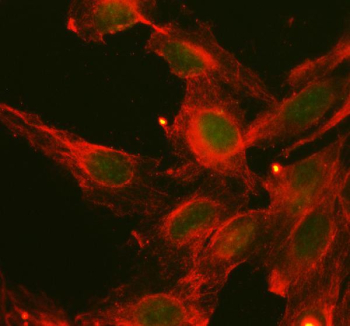
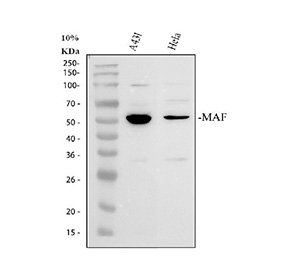
Adding 0.2 ml of distilled water will yield a concentration of 500 ug/ml. c-Maf antibody detects MAF, also known as c-Maf, a transcription factor belonging to the large Maf family of basic leucine zipper proteins. The UniProt recommended name is Transcription factor Maf. MAF functions as a key regulator of lineage differentiation, cellular maturation, immune cell specialization, neural development, and tissue specific gene expression. Through its DNA binding domain and leucine zipper mediated dimerization, MAF interacts with Maf recognition elements to activate or repress target genes that shape cellular identity across multiple organ systems.MAF is a nuclear protein of approximately 373 amino acids containing a basic region required for DNA recognition and a leucine zipper motif that enables homodimer or heterodimer formation with other Maf family proteins. These structural features allow MAF to influence transcriptional networks that are critical during development and in mature tissues. MAF can function as either an activator or repressor depending on the promoter environment, cell type, and availability of cofactors. Its transcriptional influence spans metabolic pathways, immune regulation, neuronal identity, and tissue remodeling responses.The MAF gene is located on chromosome 16q23.2 and exhibits highly regulated expression across many tissues including immune cells, pancreas, eye, kidney, brain, muscle, and developing embryonic structures. In the immune system, MAF plays a crucial role in shaping T cell and B cell specialization. In T cells, MAF participates in differentiation programs that support T helper 2 and T follicular helper cell lineages by regulating cytokines such as IL4 and IL21 along with costimulatory and germinal center associated genes. In B cells, MAF contributes to plasma cell maturation and antibody secreting cell identity, influencing transcriptional circuits shared with other differentiation factors. These immunologic roles make MAF a major target of study in adaptive immunity.In neural development, MAF contributes to sensory neuron specification and axonal patterning. It influences the formation of mechanoreceptors in the peripheral nervous system and participates in the transcriptional programs required for maintaining specialized sensory neuron identity. In the eye, MAF plays a critical role in lens fiber differentiation, where it regulates crystallin gene expression and contributes to proper lens formation. Mutations that disrupt MAF function have been associated with congenital cataracts and developmental abnormalities of the eye.MAF also plays major roles in metabolic tissues. In pancreatic islets, MAF is required for beta cell maturation and for maintaining transcriptional programs that control insulin production, glucose sensing, and metabolic homeostasis. Loss of MAF function in pancreatic tissue can impair insulin secretion and disrupt glucose metabolism. These metabolic roles have positioned MAF as an important transcriptional regulator in studies of endocrine pancreas development, diabetes, and metabolic stress adaptation.Beyond baseline developmental functions, MAF participates in pathways associated with inflammation, oxidative stress responses, and tissue remodeling. MAF can regulate gene expression downstream of cytokine signaling and contributes to transcriptional adaptation during inflammatory or metabolic challenges. In fibroblasts, macrophages, and endothelial cells, MAF influences growth factor responses, extracellular matrix regulation, and cellular adaptation to stress signals.Pathologically, dysregulation of MAF expression or activity has been linked to a range of human diseases. Overexpression of MAF has been identified in certain plasma cell neoplasms, particularly subsets of multiple myeloma, where MAF target genes contribute to proliferation, adhesion, and survival signaling. Altered MAF function has also been implicated in autoimmune disease, allergic inflammation, diabetes, congenital cataracts, and neurological disorders. Because MAF influences transcriptional networks central to cell identity, even modest changes in its levels can exert broad physiological effects.In research settings, c-Maf antibody supports investigation into transcriptional regulation, immune differentiation, pancreatic development, neuronal identity, and metabolic control. MAF is widely studied in adaptive immunity for its roles in coordinating T helper lineage specialization and germinal center formation. It is also a major regulatory factor in studies of islet biology, sensory neuron development, and transcription factor driven disease states. c-Maf antibody enables detection of MAF expression patterns and supports studies aiming to understand how transcriptional programs adapt during development, inflammation, stress, or disease progression.c-Maf antibody is validated for use in relevant research applications to detect MAF expression in cells and tissues. NSJ Bioreagents provides c-Maf antibody reagents suitable for immunology, developmental biology, neuroscience, metabolic research, and transcription factor signaling studies.
| Keywords: | Anti-MAF, Anti-Proto-oncogene c-Maf, Anti-Transcription factor Maf, Anti-V-maf musculoaponeurotic fibrosarcoma oncogene homolog, MAF Antibody / c-Maf |
| Supplier: | NSJ Bioreagents |
| Supplier-Nr: | FY13396 |
Properties
| Application: | WB, ICC/IF |
| Antibody Type: | Polyclonal |
| Conjugate: | No |
| Host: | Rabbit |
| Species reactivity: | human |
| Immunogen: | Synthetic peptide corresponding to a sequence at the N-terminus of human c-Maf/MAF, identical to the related mouse and rat sequences, |
| Format: | Purified |
Database Information
| KEGG ID : | K09035 | Matching products |
| UniProt ID : | O75444 | Matching products |
| Gene ID : | GeneID 4094 | Matching products |
Handling & Safety
| Storage: | +4°C |
| Shipping: | +4°C (International: +4°C) |
Caution
Our products are for laboratory research use only: Not for administration to humans!
Our products are for laboratory research use only: Not for administration to humans!
Information about the product reference will follow.
more
You will get a certificate here
Viewed