
Cookie preferences
This website uses cookies, which are necessary for the technical operation of the website and are always set. Other cookies, which increase the comfort when using this website, are used for direct advertising or to facilitate interaction with other websites and social networks, are only set with your consent.
Configuration
Technically required
These cookies are necessary for the basic functions of the shop.
"Allow all cookies" cookie
"Decline all cookies" cookie
CSRF token
Cookie preferences
Currency change
Customer-specific caching
FACT-Finder tracking
Individual prices
Selected shop
Session
Comfort functions
These cookies are used to make the shopping experience even more appealing, for example for the recognition of the visitor.
Note
Show the facebook fanpage in the right blod sidebar
Statistics & Tracking
Affiliate program
Conversion and usertracking via Google Tag Manager
Track device being used

| Item number | Size | Datasheet | Manual | SDS | Delivery time | Quantity | Price |
|---|---|---|---|---|---|---|---|
| NSJ-V2685-20UG | 20 µg | - | - |
3 - 10 business days* |
375.00€
|
||
| NSJ-V2685-100UG | 100 µg | - | - |
3 - 10 business days* |
810.00€
|
If you have any questions, please use our Contact Form.
You can also order by e-mail: info@biomol.com
Larger quantity required? Request bulk
You can also order by e-mail: info@biomol.com
Larger quantity required? Request bulk
0.2 mg/ml with 0.1 mg/ml BSA (US sourced), 0.05% sodium azide. Luteinizing hormone (LH) is a... more
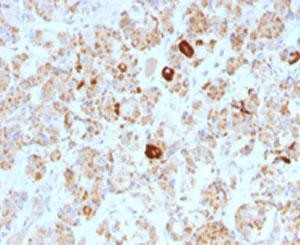
Product information "Anti-Luteinizing Hormone beta, clone SPM103"
0.2 mg/ml with 0.1 mg/ml BSA (US sourced), 0.05% sodium azide. Luteinizing hormone (LH) is a glycoprotein. Each monomeric unit is a sugar-like protein molecule, two of these make the full, functional protein. Its structure is similar to the other glycoproteins, follicle-stimulating hormone (FSH), thyroid-stimulating hormone (TSH), and human chorionic gonadotropin (hCG). The protein dimer contains 2 polypeptide units, labeled alpha and beta subunits that are connected by two bridges. The alpha subunits of LH, FSH, TSH, and hCG are identical, and contain 92 amino acids. The beta subunits vary. LH has a beta subunit of 121 amino acids (LHB) that confers its specific biologic action and is responsible for interaction with the LH receptor. This beta subunit contains the same amino acids in sequence as the beta subunit of hCG and both stimulate the same receptor, however, the hCG beta subunit contains an additional 24 amino acids and the hormones differ in the composition of their sugar moieties. LH is synthesized and secreted by gonadotrophs in the anterior lobe of the pituitary gland. In concert with the other pituitary gonadotropin follicle-stimulating hormone (FSH), it is necessary for proper reproductive function. In the female, an acute rise of LH levels triggers ovulation. In the male, where LH has also been called Interstitial Cell-Stimulating Hormone (ICSH), it stimulates Leydig cell production of testosterone. LH is a useful marker in classification of pituitary tumors and the study of pituitary disease. Protein function: Promotes spermatogenesis and ovulation by stimulating the testes and ovaries to synthesize steroids. [The UniProt Consortium]
| Keywords: | Anti-LHB, Anti-LH-B, Anti-LSH-B, Anti-LSH-beta, Anti-Lutropin beta chain, Anti-Lutropin subunit beta, Anti-Luteinizing hormone subunit beta, Luteinizing Hormone beta Antibody |
| Supplier: | NSJ Bioreagents |
| Supplier-Nr: | V2685 |
Properties
| Application: | FC, IF, IHC (paraffin) |
| Antibody Type: | Monoclonal |
| Clone: | SPM103 |
| Conjugate: | No |
| Host: | Mouse |
| Species reactivity: | human |
| Immunogen: | Recombinant beta sub-unit of human Luteinizing Hormone |
| Format: | Purified |
Database Information
| KEGG ID : | K08521 | Matching products |
| UniProt ID : | P01229 | Matching products |
| Gene ID : | GeneID 3972 | Matching products |
Handling & Safety
| Storage: | +4°C |
| Shipping: | +4°C (International: +4°C) |
Caution
Our products are for laboratory research use only: Not for administration to humans!
Our products are for laboratory research use only: Not for administration to humans!
Information about the product reference will follow.
more
You will get a certificate here

Viewed