
Cookie preferences
This website uses cookies, which are necessary for the technical operation of the website and are always set. Other cookies, which increase the comfort when using this website, are used for direct advertising or to facilitate interaction with other websites and social networks, are only set with your consent.
Configuration
Technically required
These cookies are necessary for the basic functions of the shop.
"Allow all cookies" cookie
"Decline all cookies" cookie
CSRF token
Cookie preferences
Currency change
Customer-specific caching
FACT-Finder tracking
Individual prices
Selected shop
Session
Comfort functions
These cookies are used to make the shopping experience even more appealing, for example for the recognition of the visitor.
Note
Show the facebook fanpage in the right blod sidebar
Statistics & Tracking
Affiliate program
Conversion and usertracking via Google Tag Manager
Track device being used

| Item number | Size | Datasheet | Manual | SDS | Delivery time | Quantity | Price |
|---|---|---|---|---|---|---|---|
| NSJ-FY13221 | 100 µg | - | - |
3 - 10 business days* |
790.00€
|
If you have any questions, please use our Contact Form.
You can also order by e-mail: info@biomol.com
Larger quantity required? Request bulk
You can also order by e-mail: info@biomol.com
Larger quantity required? Request bulk
Adding 0.2 ml of distilled water will yield a concentration of 500 ug/ml. LTBR antibody detects... more
Product information "Anti-LTBR / Lymphotoxin-beta receptor"
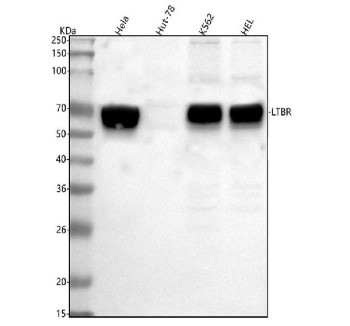
Adding 0.2 ml of distilled water will yield a concentration of 500 ug/ml. LTBR antibody detects Lymphotoxin-beta receptor, a cell surface receptor belonging to the tumor necrosis factor receptor (TNFR) superfamily that mediates immune signaling, inflammation, and lymphoid tissue organization. The UniProt recommended name is Lymphotoxin-beta receptor (LTBR). This receptor binds the lymphotoxin-alpha1/beta2 heterotrimer and LIGHT (TNFSF14), activating downstream pathways that regulate immune homeostasis and cell survival.Functionally, LTBR antibody identifies a 435-amino-acid type I transmembrane receptor expressed on epithelial cells, stromal cells, and endothelial cells but absent from most hematopoietic cells. Upon ligand binding, LTBR triggers activation of NF-kappaB, JNK, and MAPK signaling pathways, leading to expression of cytokines, chemokines, and adhesion molecules. These signals promote lymphoid organogenesis, maintenance of high endothelial venules, and antiviral defense. LTBR signaling also induces controlled apoptosis during immune regulation and tissue remodeling.The LTBR gene is located on chromosome 12p13.31 and is expressed in lymphoid tissues, intestinal epithelium, and vascular endothelium. It plays a central role in secondary lymphoid organ development, including the formation of lymph nodes and Peyer?s patches, as well as in maintaining immune compartmentalization within mucosal barriers.Pathologically, dysregulation of LTBR contributes to autoimmune diseases, chronic inflammation, and tumor immunity. Hyperactivation promotes lymphoid neogenesis and ectopic germinal center formation in autoimmune conditions such as rheumatoid arthritis and multiple sclerosis, whereas impaired signaling weakens antiviral responses. In cancer, LTBR signaling can either promote tumor cell survival or enhance immune-mediated tumor clearance depending on context. Research using LTBR antibody supports studies in immunology, inflammation, and cancer biology.LTBR antibody is validated for flow cytometry, western blotting, and immunohistochemistry to detect TNF receptor family proteins. NSJ Bioreagents provides LTBR antibody reagents optimized for immune regulation, receptor signaling, and inflammation research.Structurally, Lymphotoxin-beta receptor contains four extracellular cysteine-rich domains for ligand binding and a cytoplasmic tail with TRAF-binding motifs that mediate signal transduction. Its modular design allows recruitment of adaptor proteins that determine specific pathway activation. This antibody facilitates detailed analysis of LTBR's roles in cytokine signaling, immune structure formation, and tissue homeostasis.
| Keywords: | Anti-LTBR, Anti-Lymphotoxin-beta receptor, Anti-Tumor necrosis factor C receptor, Anti-Tumor necrosis factor receptor type III, Anti-Tumor necrosis factor receptor 2-related protein, Anti-Tumor necrosis factor receptor superfamily member 3, LTBR Antibody |
| Supplier: | NSJ Bioreagents |
| Supplier-Nr: | FY13221 |
Properties
| Application: | WB, ELISA |
| Antibody Type: | Polyclonal |
| Conjugate: | No |
| Host: | Rabbit |
| Species reactivity: | human |
| Immunogen: | E.coli-derived human LTBR recombinant protein (Position: Q31-Q404) |
| Format: | Purified |
Database Information
| KEGG ID : | K03159 | Matching products |
| UniProt ID : | P36941 | Matching products |
| Gene ID : | GeneID 4055 | Matching products |
Handling & Safety
| Storage: | +4°C |
| Shipping: | +4°C (International: +4°C) |
Caution
Our products are for laboratory research use only: Not for administration to humans!
Our products are for laboratory research use only: Not for administration to humans!
Information about the product reference will follow.
more
You will get a certificate here
Viewed