
Cookie preferences
This website uses cookies, which are necessary for the technical operation of the website and are always set. Other cookies, which increase the comfort when using this website, are used for direct advertising or to facilitate interaction with other websites and social networks, are only set with your consent.
Configuration
Technically required
These cookies are necessary for the basic functions of the shop.
"Allow all cookies" cookie
"Decline all cookies" cookie
CSRF token
Cookie preferences
Currency change
Customer-specific caching
FACT-Finder tracking
Individual prices
Selected shop
Session
Comfort functions
These cookies are used to make the shopping experience even more appealing, for example for the recognition of the visitor.
Note
Show the facebook fanpage in the right blod sidebar
Statistics & Tracking
Affiliate program
Conversion and usertracking via Google Tag Manager
Track device being used


| Item number | Size | Datasheet | Manual | SDS | Delivery time | Quantity | Price |
|---|---|---|---|---|---|---|---|
| NSJ-FY12469 | 100 µg | - | - |
3 - 10 business days* |
790.00€
|
If you have any questions, please use our Contact Form.
You can also order by e-mail: info@biomol.com
Larger quantity required? Request bulk
You can also order by e-mail: info@biomol.com
Larger quantity required? Request bulk
Adding 0.2 ml of distilled water will yield a concentration of 500 ug/ml. LGALS3 antibody detects... more
Product information "Anti-LGALS3 / Galectin 3 / GAL3"
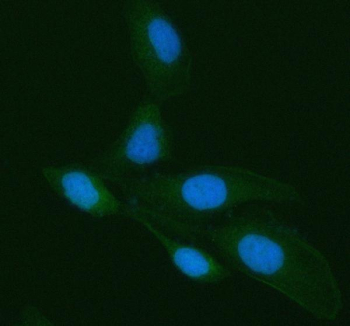
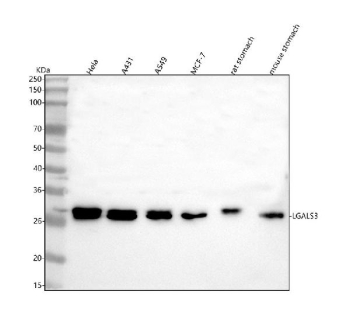
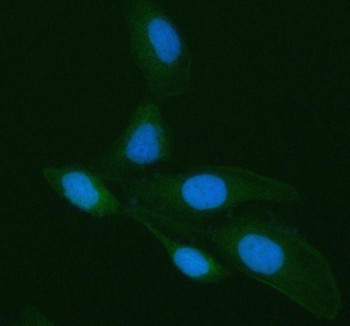
Adding 0.2 ml of distilled water will yield a concentration of 500 ug/ml. LGALS3 antibody detects Galectin-3, a beta-galactoside-binding lectin involved in cell adhesion, immune modulation, apoptosis regulation, fibrosis, and tumor progression. Galectin-3 functions as both an intracellular regulator and an extracellular signaling molecule, mediating diverse processes such as inflammation, angiogenesis, and cell-matrix interaction. The LGALS3 antibody is extensively used in studies of cancer, cardiovascular disease, and immune disorders where Galectin-3 serves as a biomarker and functional effector in pathological remodeling.Galectin-3 is encoded by the LGALS3 gene located on human chromosome 14q22.3. The protein contains a carbohydrate recognition domain that binds beta-galactoside residues on glycoproteins and an N-terminal domain enabling oligomerization. This structure allows Galectin-3 to form lattices at the cell surface, influencing receptor clustering and signaling. It is expressed in epithelial cells, macrophages, fibroblasts, and endothelial cells, and can be secreted via a non-classical pathway into the extracellular space. Once outside the cell, it modulates adhesion and migration, contributing to wound healing and fibrosis.The LGALS3 antibody is particularly useful for detecting Galectin-3 expression in tumor and fibrotic tissues. Western blot typically shows an ~26 kilodalton band, while immunostaining reveals cytoplasmic, nuclear, or membrane-associated localization depending on cellular context. Overexpression of Galectin-3 is associated with aggressive tumor phenotypes, including resistance to apoptosis and enhanced metastasis. Mechanistically, Galectin-3 interacts with cell-surface receptors such as integrins and growth factor receptors, amplifying signaling through the phosphoinositide 3-kinase/AKT and transforming growth factor beta (TGF-beta) pathways. This dual role in intracellular survival signaling and extracellular communication underscores its complexity as a therapeutic target.Beyond oncology, Galectin-3 contributes to fibrotic progression in the heart, kidneys, and liver. It promotes fibroblast activation, collagen deposition, and tissue stiffening, leading to organ dysfunction. Elevated plasma Galectin-3 levels are now used clinically as a prognostic biomarker for heart failure. In immune regulation, Galectin-3 modulates macrophage polarization, promotes neutrophil adhesion, and suppresses T-cell receptor signaling, linking innate and adaptive immune responses. NSJ Bioreagents offers a validated LGALS3 antibody optimized for western blot, ELISA, flow cytometry, and immunohistochemistry, providing reliable detection of Galectin-3 for applications across cancer, inflammation, and fibrotic disease research.
| Keywords: | Anti-L-31, Anti-LGALS3, Anti-Galectin-3, Anti-Lectin L-29, Anti-35 kDa lectin, Anti-Mac-2 antigen, Anti-IgE-binding protein, Anti-Laminin-binding protein, Anti-Galactose-specific lectin 3, Anti-Galactoside-binding protein, Anti-Carbohydrate-binding protei |
| Supplier: | NSJ Bioreagents |
| Supplier-Nr: | FY12469 |
Properties
| Application: | WB, ICC, IF, ELISA |
| Antibody Type: | Polyclonal |
| Conjugate: | No |
| Host: | Rabbit |
| Species reactivity: | human, mouse, rat |
| Immunogen: | E.coli-derived human Galectin-3/LGALS3 recombinant protein (Position: R129-I250) |
| Format: | Purified |
Database Information
| KEGG ID : | K06831 | Matching products |
| UniProt ID : | P17931 | Matching products |
| Gene ID : | GeneID 3958 | Matching products |
Handling & Safety
| Storage: | +4°C |
| Shipping: | +4°C (International: +4°C) |
Caution
Our products are for laboratory research use only: Not for administration to humans!
Our products are for laboratory research use only: Not for administration to humans!
Information about the product reference will follow.
more
You will get a certificate here
Viewed