
Cookie preferences
This website uses cookies, which are necessary for the technical operation of the website and are always set. Other cookies, which increase the comfort when using this website, are used for direct advertising or to facilitate interaction with other websites and social networks, are only set with your consent.
Configuration
Technically required
These cookies are necessary for the basic functions of the shop.
"Allow all cookies" cookie
"Decline all cookies" cookie
CSRF token
Cookie preferences
Currency change
Customer-specific caching
FACT-Finder tracking
Individual prices
Selected shop
Session
Comfort functions
These cookies are used to make the shopping experience even more appealing, for example for the recognition of the visitor.
Note
Show the facebook fanpage in the right blod sidebar
Statistics & Tracking
Affiliate program
Conversion and usertracking via Google Tag Manager
Track device being used



| Item number | Size | Datasheet | Manual | SDS | Delivery time | Quantity | Price |
|---|---|---|---|---|---|---|---|
| NSJ-FY13410 | 100 µl | - | - |
7 - 12 business days* |
790.00€
|
If you have any questions, please use our Contact Form.
You can also order by e-mail: info@biomol.com
Larger quantity required? Request bulk
You can also order by e-mail: info@biomol.com
Larger quantity required? Request bulk
Rabbit IgG in phosphate buffered saline, pH 7.4, 150mM NaCl, 0.02% sodium azide and 50% glycerol,... more
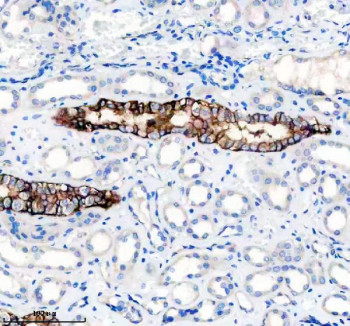
Product information "Anti-L1CAM / NCAM-L1 / CD171, clone AAFD-12"
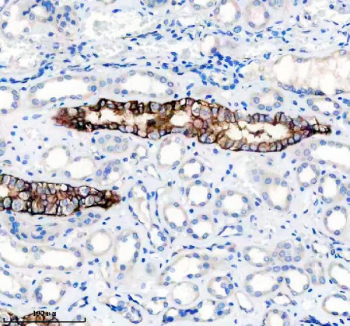
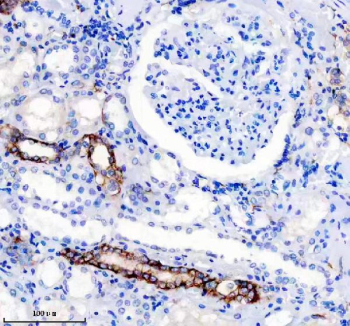
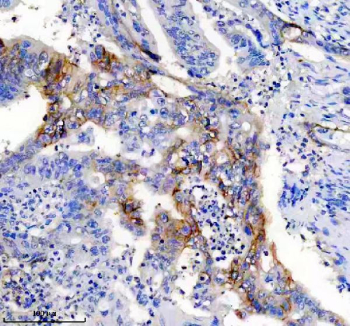
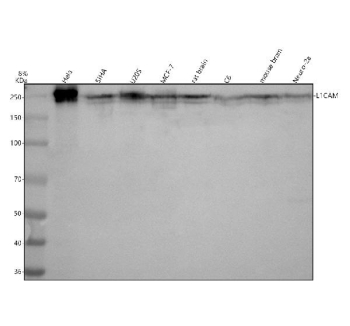
Rabbit IgG in phosphate buffered saline, pH 7.4, 150mM NaCl, 0.02% sodium azide and 50% glycerol, 0.4-0.5mg/ml BSA. NCAM-L1 antibody targets Neural cell adhesion molecule L1 (NCAM-L1), also known as L1CAM and CD171, a transmembrane glycoprotein belonging to the immunoglobulin superfamily of cell adhesion molecules. NCAM-L1 is predominantly localized to the plasma membrane, where it mediates calcium-independent cell-cell interactions that are essential for nervous system development and tissue organization. The extracellular region of NCAM-L1 contains multiple immunoglobulin-like and fibronectin type III domains that enable both homophilic binding between adjacent cells and heterophilic interactions with extracellular matrix components and receptors. These structural features position NCAM-L1 as a key organizer of cell surface architecture in developing and mature tissues.Functionally, Neural cell adhesion molecule L1 plays a central role in neuronal migration, axon guidance, axon fasciculation, and synaptic organization. Through its adhesive properties and associated signaling functions, NCAM-L1 coordinates directional cell movement and neurite outgrowth during neural circuit formation. The cytoplasmic domain of NCAM-L1 interacts with adaptor proteins and cytoskeletal elements, linking extracellular adhesion events to intracellular signaling pathways that regulate cell shape, motility, and polarity. An NCAM-L1 antibody supports studies examining how adhesion molecules integrate structural and signaling roles during development.Expression of NCAM-L1 is highest in the developing nervous system, where it is detected in neurons and certain glial populations, but it is also present in selected non-neural tissues where cell migration and dynamic tissue remodeling occur. NCAM-L1 expression is tightly regulated in both spatial and temporal patterns, reflecting its importance in guiding cells through complex microenvironments. Analysis of NCAM-L1 localization and abundance provides insight into mechanisms that govern tissue patterning, connectivity, and structural integrity.From a biological and disease-relevance perspective, NCAM-L1 has been extensively studied in neurodevelopmental disorders, where altered expression or function can disrupt neuronal connectivity and migration. NCAM-L1 is also investigated in cancer biology, as its expression has been associated with increased cell motility, invasiveness, and metastatic potential in certain tumor types. These observations highlight the broader relevance of NCAM-L1 beyond normal development and underscore its value as a marker of cellular plasticity and migratory behavior.At the molecular level, NCAM-L1 is encoded by the L1CAM gene and produces a heavily glycosylated protein that typically migrates at approximately 200 to 220 kDa on SDS-PAGE, depending on glycosylation state and proteolytic processing. Multiple molecular forms may be detected due to post-translational modification and cleavage events. Regulation of NCAM-L1 function depends on expression level, membrane distribution, and interaction with binding partners. An NCAM-L1 antibody supports research applications focused on cell adhesion, neural development, and migration-related signaling pathways, with NSJ Bioreagents providing reagents intended for research use.
| Keywords: | Anti-L1CAM, Anti-Neural cell adhesion molecule L1, L1CAM Antibody / NCAM-L1 / CD171 |
| Supplier: | NSJ Bioreagents |
| Supplier-Nr: | FY13410 |
Properties
| Application: | WB, IHC |
| Antibody Type: | Monoclonal |
| Clone: | AAFD-12 |
| Conjugate: | No |
| Host: | Rabbit |
| Species reactivity: | human, mouse, rat |
| Immunogen: | Synthesized peptide derived from human Neural cell adhesion molecule L1 protein |
| Format: | Affinity Purified |
Database Information
| KEGG ID : | K06550 | Matching products |
| UniProt ID : | P32004 | Matching products |
| Gene ID : | GeneID 3897 | Matching products |
Handling & Safety
| Storage: | -20°C |
| Shipping: | -20°C (International: -20°C) |
Caution
Our products are for laboratory research use only: Not for administration to humans!
Our products are for laboratory research use only: Not for administration to humans!
Information about the product reference will follow.
more
You will get a certificate here
Viewed