
Cookie preferences
This website uses cookies, which are necessary for the technical operation of the website and are always set. Other cookies, which increase the comfort when using this website, are used for direct advertising or to facilitate interaction with other websites and social networks, are only set with your consent.
Configuration
Technically required
These cookies are necessary for the basic functions of the shop.
"Allow all cookies" cookie
"Decline all cookies" cookie
CSRF token
Cookie preferences
Currency change
Customer-specific caching
FACT-Finder tracking
Individual prices
Selected shop
Session
Comfort functions
These cookies are used to make the shopping experience even more appealing, for example for the recognition of the visitor.
Note
Show the facebook fanpage in the right blod sidebar
Statistics & Tracking
Affiliate program
Conversion and usertracking via Google Tag Manager
Track device being used



| Item number | Size | Datasheet | Manual | SDS | Delivery time | Quantity | Price |
|---|---|---|---|---|---|---|---|
| ATA-HPA048553.25 | 25 µl | - |
3 - 8 business days* |
330.00€
|
|||
| ATA-HPA048553.100 | 100 µl | - |
3 - 8 business days* |
463.00€
|
If you have any questions, please use our Contact Form.
You can also order by e-mail: info@biomol.com
Larger quantity required? Request bulk
You can also order by e-mail: info@biomol.com
Larger quantity required? Request bulk
Protein function: Potassium channel that plays an important role in a number of tissues,... more
Product information "Anti-KCNQ1"
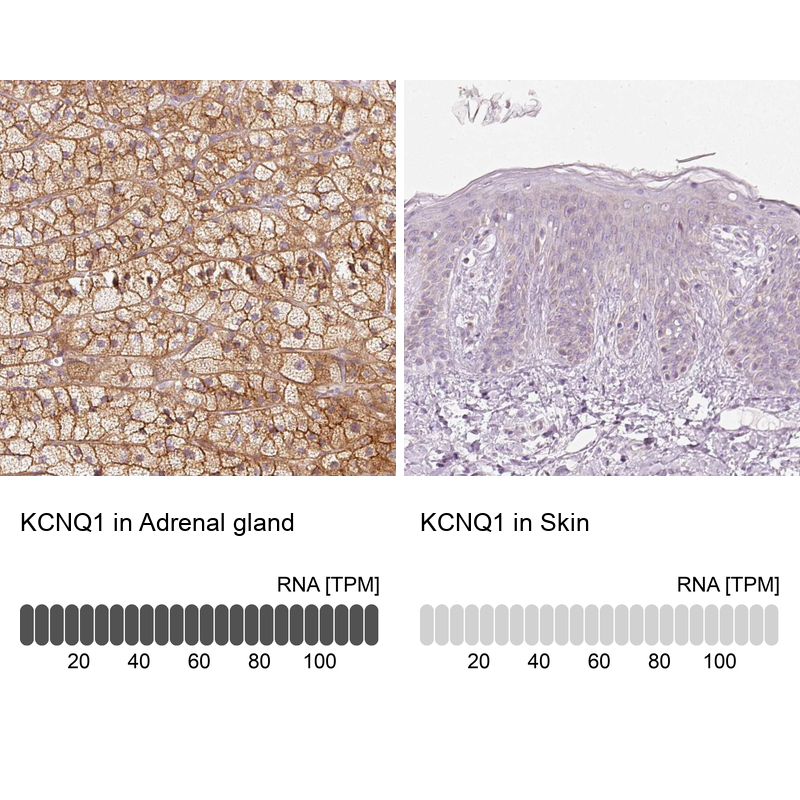
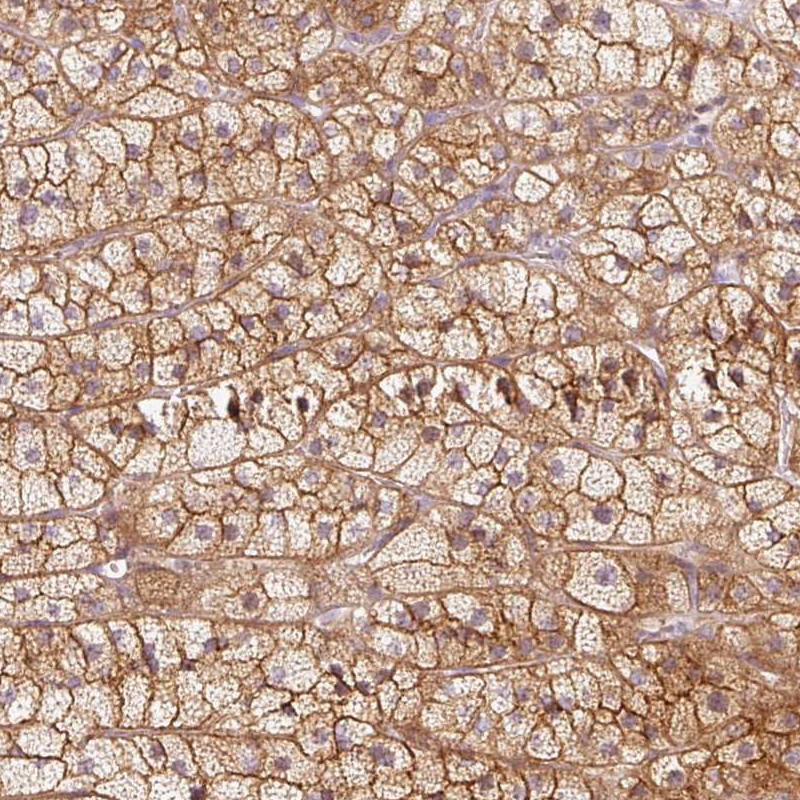
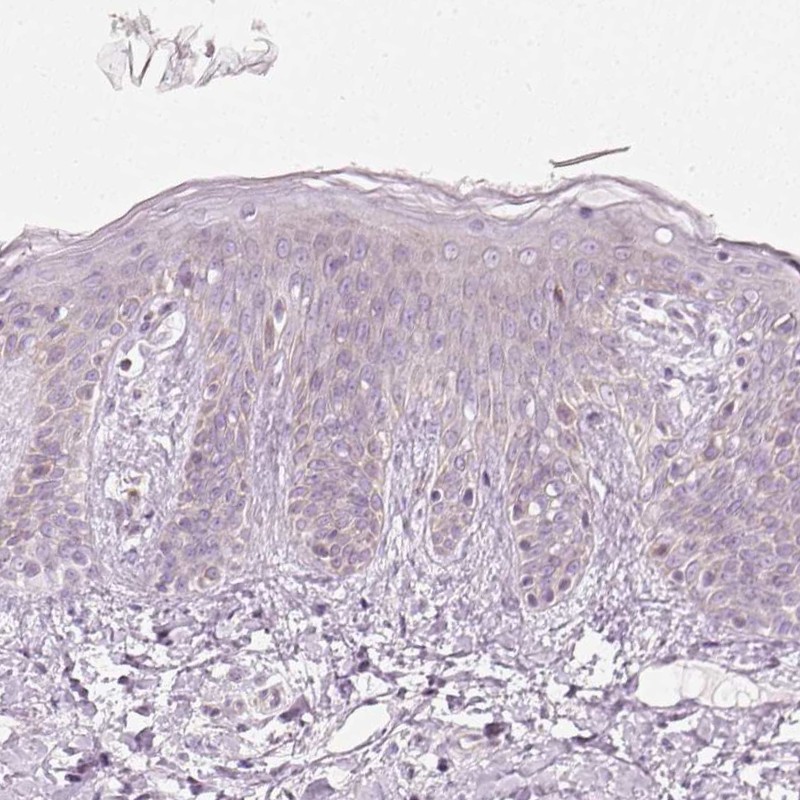
Protein function: Potassium channel that plays an important role in a number of tissues, including heart, inner ear, stomach and colon (PubMed:10646604, PubMed:25441029). Associates with KCNE beta subunits that modulates current kinetics (PubMed:9312006, PubMed:9108097, PubMed:8900283, PubMed:10646604, PubMed:11101505, PubMed:19687231). Induces a voltage-dependent current by rapidly activating and slowly deactivating potassium-selective outward current (PubMed:9312006, PubMed:9108097, PubMed:8900283, PubMed:10646604, PubMed:11101505, PubMed:25441029). Promotes also a delayed voltage activated potassium current showing outward rectification characteristic. During beta-adrenergic receptor stimulation participates in cardiac repolarization by associating with KCNE1 to form the I(Ks) cardiac potassium current that increases the amplitude and slows down the activation kinetics of outward potassium current I(Ks) (PubMed:9312006, PubMed:9108097, PubMed:8900283, PubMed:10646604, PubMed:11101505). Muscarinic agonist oxotremorine-M strongly suppresses KCNQ1/KCNE1 current (PubMed:10713961). When associated with KCNE3, forms the potassium channel that is important for cyclic AMP-stimulated intestinal secretion of chloride ions (PubMed:10646604). This interaction with KCNE3 is reduced by 17beta-estradiol, resulting in the reduction of currents. During conditions of increased substrate load, maintains the driving force for proximal tubular and intestinal sodium ions absorption, gastric acid secretion, and cAMP- induced jejunal chloride ions secretion. Allows the provision of potassium ions to the luminal membrane of the secretory canaliculus in the resting state as well as during stimulated acid secretion. When associated with KCNE2, forms a heterooligomer complex leading to currents with an apparently instantaneous activation, a rapid deactivation process and a linear current-voltage relationship and decreases the amplitude of the outward current (PubMed:11101505). When associated with KCNE4, inhibits voltage-gated potassium channel activity (PubMed:19687231). When associated with KCNE5, this complex only conducts current upon strong and continued depolarization (PubMed:12324418). Also forms a heterotetramer with KCNQ5, has a voltage-gated potassium channel activity (PubMed:24855057). Binds with phosphatidylinositol 4,5- bisphosphate (PubMed:25037568). [The UniProt Consortium] Buffer: 40% glycerol and PBS (pH 7.2). 0.02% sodium azide is added as preservative. Highest antigen sequence identity to mouse: 88% and to rat: 88%
| Keywords: | Anti-KQT-like 1, Anti-Voltage-gated potassium channel subunit Kv7.1, Anti-Potassium voltage-gated channel subfamily KQT member 1, Anti-IKs producing slow voltage-gated potassium channel subunit alpha KvLQT1 |
| Supplier: | Atlas Antibodies |
| Supplier-Nr: | HPA048553 |
Properties
| Application: | IHC |
| Antibody Type: | Polyclonal |
| Conjugate: | No |
| Host: | Rabbit |
| Species reactivity: | human |
| Immunogen: | Recombinant Protein Epitope Signature Tag (PrEST) antigen sequence: PRSHTLLSPS PKPKKSVVVK KKKFKLDKDN GVTPGEKMLT VPHITCDPPE ERRLDHFSVD GYDSSVRKSP TLLEVSMPHF MRTNSFAEDL DLEGETLLTP ITHISQLREH HRATIKVIRR (ATA-APrEST71251) |
Database Information
| KEGG ID : | K04926 | Matching products |
| UniProt ID : | P51787 | Matching products |
| Gene ID : | GeneID 3784 | Matching products |
| Protein Atlas Nr. : | ENSG00000053918 |
Handling & Safety
| Storage: | -20°C |
| Shipping: | +20°C (International: +20°C) |
Caution
Our products are for laboratory research use only: Not for administration to humans!
Our products are for laboratory research use only: Not for administration to humans!
Information about the product reference will follow.
more
You will get a certificate here
Viewed