Cookie preferences
This website uses cookies, which are necessary for the technical operation of the website and are always set. Other cookies, which increase the comfort when using this website, are used for direct advertising or to facilitate interaction with other websites and social networks, are only set with your consent.
Configuration
Technically required
These cookies are necessary for the basic functions of the shop.
"Allow all cookies" cookie
"Decline all cookies" cookie
CSRF token
Cookie preferences
Currency change
Customer-specific caching
FACT-Finder tracking
Individual prices
Selected shop
Session
Comfort functions
These cookies are used to make the shopping experience even more appealing, for example for the recognition of the visitor.
Note
Show the facebook fanpage in the right blod sidebar
Statistics & Tracking
Affiliate program
Conversion and usertracking via Google Tag Manager
Track device being used
If you have any questions, please use our Contact Form.
You can also order by e-mail: info@biomol.com
Larger quantity required? Request bulk
You can also order by e-mail: info@biomol.com
Larger quantity required? Request bulk
Potassium channels represent the most complex class of voltage-gated ino channels from both... more
Product information "Anti-KCNA5"
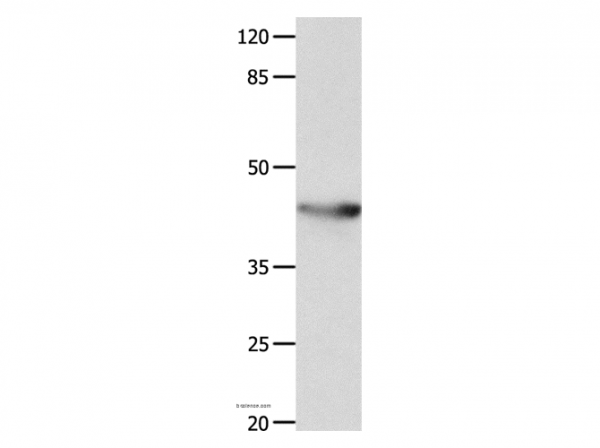
Potassium channels represent the most complex class of voltage-gated ino channels from both functional and structural standpoints. Their diverse functions include regulating neurotransmitter release, heart rate, insulin secretion, neuronal excitability, epithelial electrolyte transport, smooth muscle contraction, and cell volume. Four sequence-related potassium channel genes - shaker, shaw, shab, and shal - have been identified in Drosophila, and each has been shown to have human homolog(s). This gene encodes a member of the potassium channel, voltage-gated, shaker-related subfamily. This member contains six membrane-spanning domains with a shaker-type repeat in the fourth segment. It belongs to the delayed rectifier class, the function of which could restore the resting membrane potential of beta cells after depolarization and thereby contribute to the regulation of insulin secretion. This gene is intronless, and the gene is clustered with genes KCNA1 and KCNA6 on chromosome 12. Defects in this gene are a cause of familial atrial fibrillation type 7 (ATFB7). Protein function: Voltage-gated potassium channel that mediates transmembrane potassium transport in excitable membranes. Forms tetrameric potassium-selective channels through which potassium ions pass in accordance with their electrochemical gradient. The channel alternates between opened and closed conformations in response to the voltage difference across the membrane. Can form functional homotetrameric channels and heterotetrameric channels that contain variable proportions of KCNA1, KCNA2, KCNA4, KCNA5, and possibly other family members as well, channel properties depend on the type of alpha subunits that are part of the channel (PubMed:12130714). Channel properties are modulated by cytoplasmic beta subunits that regulate the subcellular location of the alpha subunits and promote rapid inactivation (PubMed:12130714). Homotetrameric channels display rapid activation and slow inactivation (PubMed:8505626, PubMed:12130714). May play a role in regulating the secretion of insulin in normal pancreatic islets. Isoform 2 exhibits a voltage-dependent recovery from inactivation and an excessive cumulative inactivation (PubMed:11524461). [The UniProt Consortium]
| Keywords: | Anti-HPCN1, Anti-KCNA5, Anti-Voltage-gated potassium channel HK2, Anti-Voltage-gated potassium channel subunit Kv1.5, Anti-Potassium voltage-gated channel subfamily A member 5, KCNA5 Polyclonal Antibody |
| Supplier: | Elabscience |
| Supplier-Nr: | E-AB-14174 |
Properties
| Application: | WB, ELISA |
| Antibody Type: | Polyclonal |
| Conjugate: | No |
| Host: | Rabbit |
| Species reactivity: | human, mouse, rat |
| Immunogen: | Recombinant protein of human KCNA5 |
| Format: | Purified |
Database Information
| KEGG ID : | K04878 | Matching products |
| UniProt ID : | P22460 | Matching products |
| Gene ID : | GeneID 3741 | Matching products |
Handling & Safety
| Storage: | -20°C |
| Shipping: | 4°C (International: -20°C) |
Caution
Our products are for laboratory research use only: Not for administration to humans!
Information about the product reference will follow.
more
You will get a certificate here
Viewed