
Cookie preferences
This website uses cookies, which are necessary for the technical operation of the website and are always set. Other cookies, which increase the comfort when using this website, are used for direct advertising or to facilitate interaction with other websites and social networks, are only set with your consent.
Configuration
Technically required
These cookies are necessary for the basic functions of the shop.
"Allow all cookies" cookie
"Decline all cookies" cookie
CSRF token
Cookie preferences
Currency change
Customer-specific caching
FACT-Finder tracking
Individual prices
Selected shop
Session
Comfort functions
These cookies are used to make the shopping experience even more appealing, for example for the recognition of the visitor.
Note
Show the facebook fanpage in the right blod sidebar
Statistics & Tracking
Affiliate program
Conversion and usertracking via Google Tag Manager
Track device being used


| Item number | Size | Datasheet | Manual | SDS | Delivery time | Quantity | Price |
|---|---|---|---|---|---|---|---|
| NSJ-RQ5339 | 100 µl | - | - |
3 - 10 business days* |
790.00€
|
If you have any questions, please use our Contact Form.
You can also order by e-mail: info@biomol.com
Larger quantity required? Request bulk
You can also order by e-mail: info@biomol.com
Larger quantity required? Request bulk
Antibody in PBS with 0.02% sodium azide, 50% glycerol and 0.4-0.5mg/ml BSA. The protein encoded... more
Product information "Anti-IRF1, clone DHE-9"
Antibody in PBS with 0.02% sodium azide, 50% glycerol and 0.4-0.5mg/ml BSA. The protein encoded by the IRF1 gene is a transcriptional regulator and tumor suppressor, serving as an activator of genes involved in both innate and acquired immune responses. The encoded protein activates the transcription of genes involved in the body's response to viruses and bacteria, playing a role in cell proliferation, apoptosis, the immune response, and DNA damage response. This protein represses the transcription of several other genes. As a tumor suppressor, it both suppresses tumor cell growth and stimulates an immune response against tumor cells. Defects in this gene have been associated with gastric cancer, myelogenous leukemia, and lung cancer. [RefSeq] Protein function: Transcriptional regulator which displays a remarkable functional diversity in the regulation of cellular responses (PubMed:15226432, PubMed:15509808, PubMed:17516545, PubMed:17942705, PubMed:18497060, PubMed:19404407, PubMed:19851330, PubMed:22367195, PubMed:32385160). Regulates transcription of IFN and IFN-inducible genes, host response to viral and bacterial infections, regulation of many genes expressed during hematopoiesis, inflammation, immune responses and cell proliferation and differentiation, regulation of the cell cycle and induction of growth arrest and programmed cell death following DNA damage (PubMed:15226432, PubMed:15509808, PubMed:17516545, PubMed:17942705, PubMed:18497060, PubMed:19404407, PubMed:19851330, PubMed:22367195). Stimulates both innate and acquired immune responses through the activation of specific target genes and can act as a transcriptional activator and repressor regulating target genes by binding to an interferon-stimulated response element (ISRE) in their promoters (PubMed:15226432, PubMed:15509808, PubMed:17516545, PubMed:17942705, PubMed:18497060, PubMed:19404407, PubMed:19851330, PubMed:21389130, PubMed:22367195). Competes with the transcriptional repressor ZBED2 for binding to a common consensus sequence in gene promoters (PubMed:32385160). Its target genes for transcriptional activation activity include: genes involved in anti-viral response, such as IFN-alpha/beta, RIGI, TNFSF10/TRAIL, ZBP1, OAS1/2, PIAS1/GBP, EIF2AK2/PKR and RSAD2/viperin, antibacterial response, such as GBP2, GBP5 and NOS2/INOS, anti-proliferative response, such as p53/TP53, LOX and CDKN1A, apoptosis, such as BBC3/PUMA, CASP1, CASP7 and CASP8, immune response, such as IL7, IL12A/B and IL15, PTGS2/COX2 and CYBB, DNA damage responses and DNA repair, such as POLQ/POLH, MHC class I expression, such as TAP1, PSMB9/LMP2, PSME1/PA28A, PSME2/PA28B and B2M and MHC class II expression, such as CIITA, metabolic enzymes, such as ACOD1/IRG1 (PubMed:15226432, PubMed:15509808, PubMed:17516545, PubMed:17942705, PubMed:18497060, PubMed:19404407, PubMed:19851330, PubMed:22367195). Represses genes involved in anti-proliferative response, such as BIRC5/survivin, CCNB1, CCNE1, CDK1, CDK2 and CDK4 and in immune response, such as FOXP3, IL4, ANXA2 and TLR4 (PubMed:18641303, PubMed:22200613). Stimulates p53/TP53-dependent transcription through enhanced recruitment of EP300 leading to increased acetylation of p53/TP53 (PubMed:15509808, PubMed:18084608). Plays an important role in immune response directly affecting NK maturation and activity, macrophage production of IL12, Th1 development and maturation of CD8+ T-cells (PubMed:11244049, PubMed:11846971, PubMed:11846974, PubMed:16932750). Also implicated in the differentiation and maturation of dendritic cells and in the suppression of regulatory T (Treg) cells development (PubMed:11244049, PubMed:11846971, PubMed:11846974, PubMed:16932750). Acts as a tumor suppressor and plays a role not only in antagonism of tumor cell growth but also in stimulating an immune response against tumor cells (PubMed:20049431). [The UniProt Consortium]
| Keywords: | Anti-IRF1, Anti-IRF-1, Anti-Interferon regulatory factor 1, IRF1 Antibody |
| Supplier: | NSJ Bioreagents |
| Supplier-Nr: | RQ5339 |
Properties
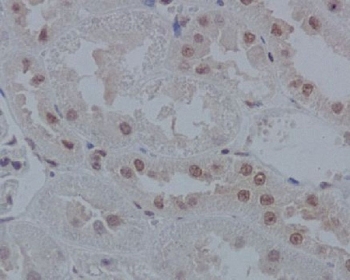
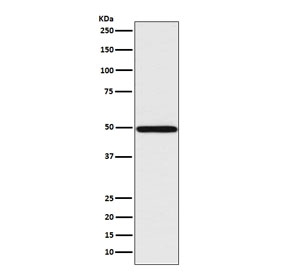
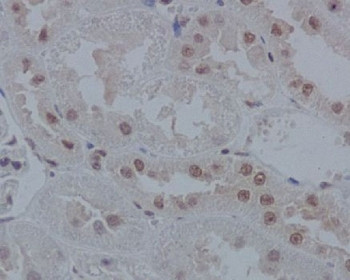
| Application: | IHC (paraffin), WB |
| Antibody Type: | Monoclonal |
| Clone: | DHE-9 |
| Conjugate: | No |
| Host: | Rabbit |
| Species reactivity: | human, rat |
| Immunogen: | A synthetic peptide specific to human Interferon regulatory factor 1 |
| Format: | Purified |
Database Information
| KEGG ID : | K09444 | Matching products |
| UniProt ID : | P10914 | Matching products |
| Gene ID : | GeneID 3659 | Matching products |
Handling & Safety
| Storage: | -20°C |
| Shipping: | -20°C (International: -20°C) |
Caution
Our products are for laboratory research use only: Not for administration to humans!
Our products are for laboratory research use only: Not for administration to humans!
Information about the product reference will follow.
more
You will get a certificate here


Viewed