
Cookie preferences
This website uses cookies, which are necessary for the technical operation of the website and are always set. Other cookies, which increase the comfort when using this website, are used for direct advertising or to facilitate interaction with other websites and social networks, are only set with your consent.
Configuration
Technically required
These cookies are necessary for the basic functions of the shop.
"Allow all cookies" cookie
"Decline all cookies" cookie
CSRF token
Cookie preferences
Currency change
Customer-specific caching
FACT-Finder tracking
Individual prices
Selected shop
Session
Comfort functions
These cookies are used to make the shopping experience even more appealing, for example for the recognition of the visitor.
Note
Show the facebook fanpage in the right blod sidebar
Statistics & Tracking
Affiliate program
Conversion and usertracking via Google Tag Manager
Track device being used



| Item number | Size | Datasheet | Manual | SDS | Delivery time | Quantity | Price |
|---|---|---|---|---|---|---|---|
| NSJ-FY13287 | 100 µg | - | - |
7 - 12 business days* |
790.00€
|
If you have any questions, please use our Contact Form.
You can also order by e-mail: info@biomol.com
Larger quantity required? Request bulk
You can also order by e-mail: info@biomol.com
Larger quantity required? Request bulk
Adding 0.2 ml of distilled water will yield a concentration of 500 ug/ml. IMPA1 antibody... more
Product information "Anti-IMPA1 / Inositol monophosphatase 1"
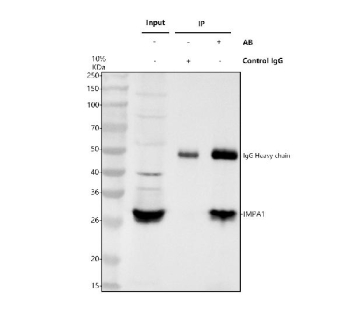
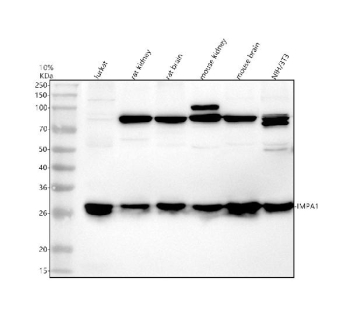
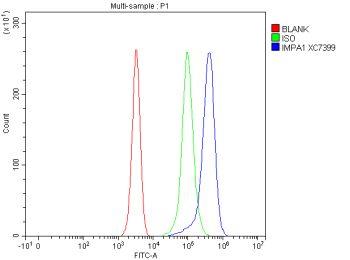
Adding 0.2 ml of distilled water will yield a concentration of 500 ug/ml. IMPA1 antibody recognizes Inositol monophosphatase 1, a magnesium-dependent enzyme that catalyzes the dephosphorylation of inositol monophosphate to free inositol, a crucial step in the phosphatidylinositol signaling pathway. The IMPA1 gene encodes a cytosolic enzyme essential for recycling inositol phosphates derived from the hydrolysis of phosphatidylinositol 4,5-bisphosphate (PIP2). This reaction is critical for maintaining inositol supply for the synthesis of phosphoinositides, which regulate intracellular signaling, neurotransmission, and osmoregulation.IMPA1 is expressed abundantly in brain, kidney, and liver, reflecting its central role in inositol metabolism. In neurons, IMPA1 supports the phosphoinositide cycle, enabling sustained neurotransmitter signaling via inositol trisphosphate and diacylglycerol pathways. Pharmacologically, IMPA1 is a well-known molecular target of lithium, a mood-stabilizing drug used in the treatment of bipolar disorder. Lithium inhibits IMPA1 activity, leading to inositol depletion and modulation of neuronal signaling, supporting the ?inositol depletion hypothesis? for mood stabilization.The human IMPA1 gene is located on chromosome 8q21.13 and encodes a 277-amino acid protein that functions as a homodimer. The enzyme binds magnesium ions within its active site to hydrolyze phosphate from a range of inositol monophosphate substrates. Structural studies have revealed conserved residues critical for catalysis and lithium binding. Genetic or functional alterations in IMPA1 have been associated with neurological disorders, cognitive deficits, and certain metabolic diseases. Experimental evidence also implicates IMPA1 in maintaining cellular osmotic balance, particularly in renal epithelial cells where inositol acts as a compatible osmolyte.Immunohistochemical analysis using IMPA1 antibody shows strong cytoplasmic staining in neurons, glial cells, renal tubules, and hepatocytes. The antibody is useful for studying inositol phosphate metabolism, lithium pharmacology, and neuronal signaling pathways. IMPA1 antibody from NSJ Bioreagents supports research into inositol-dependent biochemical networks and the molecular mechanisms underlying psychiatric and neurological disease.
| Keywords: | Anti-IMPA1, Anti-Inositol monophosphatase 1, Anti-Inositol-1(or 4)-monophosphatase 1, Anti-D-galactose 1-phosphate phosphatase, Anti-Lithium-sensitive myo-inositol monophosphatase A1, IMPA1 Antibody / Inositol monophosphatase 1 |
| Supplier: | NSJ Bioreagents |
| Supplier-Nr: | FY13287 |
Properties
| Application: | WB, IP, FC, ELISA |
| Antibody Type: | Polyclonal |
| Conjugate: | No |
| Host: | Rabbit |
| Species reactivity: | human, mouse, rat |
| Immunogen: | E.coli-derived human IMPA1 recombinant protein (Position: M1-D277) |
| Format: | Purified |
Database Information
| KEGG ID : | K01092 | Matching products |
| UniProt ID : | P29218 | Matching products |
| Gene ID : | GeneID 3612 | Matching products |
Handling & Safety
| Storage: | +4°C |
| Shipping: | +4°C (International: +4°C) |
Caution
Our products are for laboratory research use only: Not for administration to humans!
Our products are for laboratory research use only: Not for administration to humans!
Information about the product reference will follow.
more
You will get a certificate here
Viewed