
Cookie preferences
This website uses cookies, which are necessary for the technical operation of the website and are always set. Other cookies, which increase the comfort when using this website, are used for direct advertising or to facilitate interaction with other websites and social networks, are only set with your consent.
Configuration
Technically required
These cookies are necessary for the basic functions of the shop.
"Allow all cookies" cookie
"Decline all cookies" cookie
CSRF token
Cookie preferences
Currency change
Customer-specific caching
FACT-Finder tracking
Individual prices
Selected shop
Session
Comfort functions
These cookies are used to make the shopping experience even more appealing, for example for the recognition of the visitor.
Note
Show the facebook fanpage in the right blod sidebar
Statistics & Tracking
Affiliate program
Conversion and usertracking via Google Tag Manager
Track device being used

| Item number | Size | Datasheet | Manual | SDS | Delivery time | Quantity | Price |
|---|---|---|---|---|---|---|---|
| NSJ-FY13087 | 100 µl | - | - |
3 - 10 business days* |
790.00€
|
If you have any questions, please use our Contact Form.
You can also order by e-mail: info@biomol.com
Larger quantity required? Request bulk
You can also order by e-mail: info@biomol.com
Larger quantity required? Request bulk
Rabbit IgG in phosphate buffered saline, pH 7.4, 150mM NaCl, 0.02% sodium azide and 50% glycerol,... more
Product information "Anti-HTRA1 / HtrA serine peptidase 1, clone 31H06"
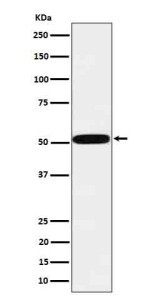
Rabbit IgG in phosphate buffered saline, pH 7.4, 150mM NaCl, 0.02% sodium azide and 50% glycerol, 0.4-0.5mg/ml BSA. HTRA1 antibody detects HtrA serine peptidase 1, encoded by the HTRA1 gene. This protein is a member of the HtrA family of serine proteases that regulate extracellular matrix remodeling, growth factor signaling, and stress responses. HtrA serine peptidase 1 is secreted and functions as a regulator of transforming growth factor beta signaling by degrading extracellular matrix proteins and growth factors. HTRA1 antibody provides researchers with a valuable reagent to study cell signaling, angiogenesis, and disease mechanisms.HtrA serine peptidase 1 has been implicated in cancer, age related macular degeneration, and arthritis. Research with HTRA1 antibody has shown that increased expression suppresses transforming growth factor beta signaling, influencing proliferation and differentiation. In tumors, HTRA1 can act as a tumor suppressor by promoting degradation of pro survival factors, but in other contexts it may enhance invasion by degrading extracellular matrix components. This dual role underscores its complex function in tissue homeostasis and pathology.In ophthalmology, polymorphisms in the HTRA1 gene are strongly associated with risk of age related macular degeneration. Studies with HTRA1 antibody have demonstrated elevated expression in retinal tissues from affected individuals, suggesting a role in disease pathogenesis through dysregulation of extracellular remodeling and angiogenesis. This makes HtrA serine peptidase 1 an important biomarker and potential therapeutic target in retinal disease.HTRA1 also contributes to osteoarthritis and inflammatory joint disease. By degrading matrix proteins such as fibronectin and aggrecan, it influences cartilage turnover and inflammation. Research with HTRA1 antibody has confirmed its presence in synovial tissue and joint fluid, where it participates in matrix breakdown. Targeting HTRA1 activity is being investigated as a strategy to slow joint degeneration.HTRA1 antibody is applied in western blotting, immunohistochemistry, and ELISA. Western blotting reveals multiple processed forms of the protein, immunohistochemistry shows localization in extracellular and pericellular spaces, and ELISA quantifies soluble levels in fluids. These applications make HTRA1 antibody essential in studies of extracellular proteases and disease.By supplying validated HTRA1 antibody reagents, NSJ Bioreagents supports research into matrix biology, angiogenesis, and disease. Detection of HtrA serine peptidase 1 provides researchers with a means to explore how protease activity regulates signaling, remodeling, and pathology.
| Keywords: | Anti-L56, Anti-HTRA1, Anti-Serine protease 11, Anti-Serine protease HTRA1, Anti-High-temperature requirement A serine peptidase 1, HTRA1 Antibody / HtrA serine peptidase 1 |
| Supplier: | NSJ Bioreagents |
| Supplier-Nr: | FY13087 |
Properties
| Application: | WB, ICC, IF |
| Antibody Type: | Monoclonal |
| Clone: | 31H06 |
| Conjugate: | No |
| Host: | Rabbit |
| Species reactivity: | human |
| Immunogen: | A synthesized peptide derived from human htrA1 |
| Format: | Affinity Purified |
Database Information
| KEGG ID : | K08784 | Matching products |
| UniProt ID : | Q92743 | Matching products |
| Gene ID : | GeneID 5654 | Matching products |
Handling & Safety
| Storage: | -20°C |
| Shipping: | -20°C (International: -20°C) |
Caution
Our products are for laboratory research use only: Not for administration to humans!
Our products are for laboratory research use only: Not for administration to humans!
Information about the product reference will follow.
more
You will get a certificate here
Viewed