
Cookie preferences
This website uses cookies, which are necessary for the technical operation of the website and are always set. Other cookies, which increase the comfort when using this website, are used for direct advertising or to facilitate interaction with other websites and social networks, are only set with your consent.
Configuration
Technically required
These cookies are necessary for the basic functions of the shop.
"Allow all cookies" cookie
"Decline all cookies" cookie
CSRF token
Cookie preferences
Currency change
Customer-specific caching
FACT-Finder tracking
Individual prices
Selected shop
Session
Comfort functions
These cookies are used to make the shopping experience even more appealing, for example for the recognition of the visitor.
Note
Show the facebook fanpage in the right blod sidebar
Statistics & Tracking
Affiliate program
Conversion and usertracking via Google Tag Manager
Track device being used



| Item number | Size | Datasheet | Manual | SDS | Delivery time | Quantity | Price |
|---|---|---|---|---|---|---|---|
| NSJ-V5913SAF-100UG | 100 µg | - | - |
7 - 12 business days* |
810.00€
|
If you have any questions, please use our Contact Form.
You can also order by e-mail: info@biomol.com
Larger quantity required? Request bulk
You can also order by e-mail: info@biomol.com
Larger quantity required? Request bulk
1 mg/ml in 1X PBS, BSA free, sodium azide free. HSPB1 antibody targets Heat shock protein beta 1,... more
Product information "Anti-HSP27 / HSPB1, clone r2B4"
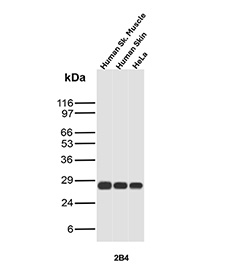
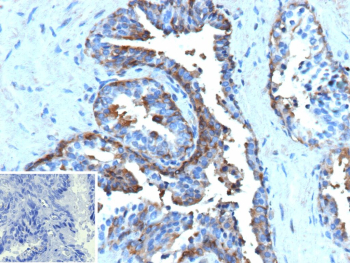
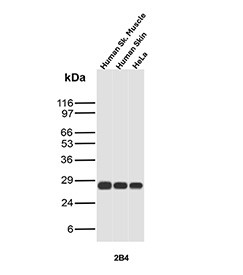
1 mg/ml in 1X PBS, BSA free, sodium azide free. HSPB1 antibody targets Heat shock protein beta 1, a small heat shock protein encoded by the HSPB1 gene that functions as a molecular chaperone involved in cellular stress responses. Heat shock protein beta 1 is primarily localized in the cytoplasm but can dynamically redistribute to the nucleus or associate with cytoskeletal structures depending on cellular conditions. It plays a critical role in protecting cells from stress-induced damage by preventing protein aggregation, stabilizing unfolded proteins, and supporting protein refolding processes. As a result, an HSPB1 antibody is widely used in studies of cellular stress, apoptosis, and proteostasis.Heat shock protein beta 1 is also commonly referred to as Hsp27 and is a member of the small heat shock protein family. These proteins share a conserved alpha-crystallin domain that mediates oligomerization and chaperone activity. HSPB1 forms dynamic oligomeric complexes whose size and function are regulated by phosphorylation at multiple serine residues. These phosphorylation-dependent changes influence its interactions with client proteins, cytoskeletal elements, and signaling molecules. Use of an HSPB1 antibody enables investigation of stress-induced signaling pathways and chaperone-mediated protein regulation.Beyond its role in protein quality control, Heat shock protein beta 1 contributes to regulation of apoptosis, actin cytoskeleton dynamics, and cellular motility. HSPB1 interacts with actin filaments and intermediate filaments, helping maintain cytoskeletal integrity during stress conditions such as heat shock, oxidative stress, and inflammation. By modulating apoptotic signaling cascades, HSPB1 can promote cell survival under adverse conditions. An HSPB1 antibody is therefore valuable for studies examining cell survival mechanisms and stress adaptation.Altered expression of Heat shock protein beta 1 has been reported in numerous diseases, including cancer, neurodegenerative disorders, and cardiovascular disease. In many tumor types, elevated HSPB1 expression correlates with increased resistance to apoptosis, enhanced metastatic potential, and reduced sensitivity to chemotherapy. Conversely, dysregulation of HSPB1 in neurons has been linked to impaired protein homeostasis and neurodegeneration. Antibody-based detection of HSPB1 supports research into disease mechanisms, biomarker discovery, and therapeutic resistance.Heat shock protein beta 1 is broadly expressed across tissues, with expression levels increasing in response to cellular stress. Because HSPB1 integrates stress signaling, cytoskeletal regulation, and cell survival pathways, it serves as a key indicator of cellular stress status. Clone r2B4 is designed to recognize Heat shock protein beta 1 and supports detection of HSPB1 expression in research applications. NSJ Bioreagents offers this HSPB1 antibody to support investigations into stress response pathways, cancer biology, and cell survival mechanisms.
| Keywords: | Anti-HSPB1, Anti-28 kDa heat shock protein, Anti-Heat shock protein beta-1, Anti-Heat shock 27 kDa protein, Anti-Stress-responsive protein 27, Anti-Estrogen-regulated 24 kDa protein, Anti-Heat shock protein family B member 1, HSP27 Antibody / HSPB1 |
| Supplier: | NSJ Bioreagents |
| Supplier-Nr: | V5913SAF |
Properties
| Application: | IHC, WB |
| Antibody Type: | Monoclonal |
| Clone: | r2B4 |
| Conjugate: | No |
| Host: | Mouse |
| Species reactivity: | human |
| Immunogen: | Prokaryotic recombinant protein corresponding to the full length human heat shock protein 27 molecule |
| Format: | Purified |
Database Information
| KEGG ID : | K04455 | Matching products |
| UniProt ID : | P04792 | Matching products |
| Gene ID : | GeneID 3315 | Matching products |
Handling & Safety
| Storage: | -20°C |
| Shipping: | -20°C (International: -20°C) |
Caution
Our products are for laboratory research use only: Not for administration to humans!
Our products are for laboratory research use only: Not for administration to humans!
Information about the product reference will follow.
more
You will get a certificate here
Viewed