
Cookie preferences
This website uses cookies, which are necessary for the technical operation of the website and are always set. Other cookies, which increase the comfort when using this website, are used for direct advertising or to facilitate interaction with other websites and social networks, are only set with your consent.
Configuration
Technically required
These cookies are necessary for the basic functions of the shop.
"Allow all cookies" cookie
"Decline all cookies" cookie
CSRF token
Cookie preferences
Currency change
Customer-specific caching
FACT-Finder tracking
Individual prices
Selected shop
Session
Comfort functions
These cookies are used to make the shopping experience even more appealing, for example for the recognition of the visitor.
Note
Show the facebook fanpage in the right blod sidebar
Statistics & Tracking
Affiliate program
Conversion and usertracking via Google Tag Manager
Track device being used

| Item number | Size | Datasheet | Manual | SDS | Delivery time | Quantity | Price |
|---|---|---|---|---|---|---|---|
| NSJ-FY12310 | 100 µl | - | - |
3 - 10 business days* |
790.00€
|
If you have any questions, please use our Contact Form.
You can also order by e-mail: info@biomol.com
Larger quantity required? Request bulk
You can also order by e-mail: info@biomol.com
Larger quantity required? Request bulk
Rabbit IgG in phosphate buffered saline, pH 7.4, 150mM NaCl, 0.02% sodium azide and 50% glycerol,... more
Product information "Anti-Histone H3 (mono methyl K36) / HIST1H3A, clone DEG-8"
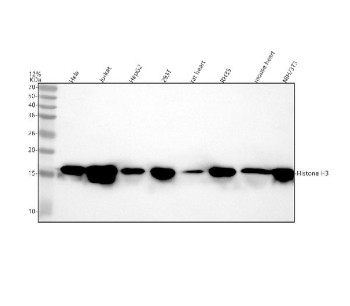
Rabbit IgG in phosphate buffered saline, pH 7.4, 150mM NaCl, 0.02% sodium azide and 50% glycerol, 0.4-0.5mg/ml BSA. Histone H3 (mono methyl K36) antibody detects a specific histone modification in histone H3, encoded by the HIST1H3A gene on chromosome 6p22.2. Histone H3 (mono methyl K36) antibody is widely used in epigenetics, chromatin biology, and transcriptional regulation research. Histone H3 is a core histone protein that forms the nucleosome with H2A, H2B, and H4, packaging DNA into chromatin. Post-translational modifications of histone H3, such as methylation, acetylation, and phosphorylation, regulate gene expression and chromatin structure. Mono methylation at lysine 36 (H3K36me1) is a specific epigenetic mark linked to transcriptional regulation and chromatin remodeling.Structurally, Histone H3 is a ~15 kDa protein with a histone fold domain that supports nucleosome assembly and an N-terminal tail that undergoes diverse modifications. Lysine 36 lies within the core domain, and its methylation is catalyzed by SETD2 and other histone methyltransferases. H3K36me1 provides a platform for recruitment of chromatin-associated proteins that regulate transcription elongation and DNA repair.Functionally, mono methylation of H3K36 is associated with transcription initiation, splicing regulation, and suppression of cryptic transcription. It also coordinates DNA damage repair by recruiting chromatin modifiers and repair enzymes. Researchers use Histone H3 (mono methyl K36) antibody to investigate transcriptional regulation, chromatin dynamics, and epigenetic mechanisms in normal and disease states.Clinically, altered H3K36 methylation is linked to cancer, developmental disorders, and neurodegeneration. Mutations in SETD2 and other H3K36 methyltransferases disrupt normal patterns of methylation, contributing to tumorigenesis. Histone modifications including H3K36me1 are being investigated as therapeutic targets for epigenetic therapies. NSJ Bioreagents provides Histone H3 (mono methyl K36) antibody for epigenetics, cancer, and transcription research.Experimentally, Histone H3 (mono methyl K36) antibody is used in western blotting to detect the ~15 kDa protein, in chromatin immunoprecipitation (ChIP) to study genome-wide localization of H3K36me1, and in immunofluorescence microscopy to assess chromatin organization. It is a key tool in studies of transcriptional regulation and epigenetics.
| Keywords: | Anti-H3C8, Anti-H3C3, Anti-H3C7, Anti-H3C6, Anti-H3C1, Anti-H3C4, Anti-H3C2, Anti-H3C12, Anti-H3C10, Anti-H3C11, Anti-Histone H3/c, Anti-Histone H3/h, Anti-Histone H3.1, Anti-Histone H3/a, Anti-Histone H3/j, Anti-Histone H3/l, Anti-Histone H3/i, Anti-Hist |
| Supplier: | NSJ Bioreagents |
| Supplier-Nr: | FY12310 |
Properties
| Application: | WB, ICC, IF |
| Antibody Type: | Monoclonal |
| Clone: | DEG-8 |
| Conjugate: | No |
| Host: | Rabbit |
| Species reactivity: | human, mouse, rat |
| Immunogen: | A synthesized peptide derived from human Histone H3 (mono methyl K36) |
| Format: | Purified |
Database Information
| KEGG ID : | K11253 | Matching products |
| UniProt ID : | P68431 | Matching products |
| Gene ID : | GeneID 8350 | Matching products |
Handling & Safety
| Storage: | -20°C |
| Shipping: | -20°C (International: -20°C) |
Caution
Our products are for laboratory research use only: Not for administration to humans!
Our products are for laboratory research use only: Not for administration to humans!
Information about the product reference will follow.
more
You will get a certificate here
Viewed