
Cookie preferences
This website uses cookies, which are necessary for the technical operation of the website and are always set. Other cookies, which increase the comfort when using this website, are used for direct advertising or to facilitate interaction with other websites and social networks, are only set with your consent.
Configuration
Technically required
These cookies are necessary for the basic functions of the shop.
"Allow all cookies" cookie
"Decline all cookies" cookie
CSRF token
Cookie preferences
Currency change
Customer-specific caching
FACT-Finder tracking
Individual prices
Selected shop
Session
Comfort functions
These cookies are used to make the shopping experience even more appealing, for example for the recognition of the visitor.
Note
Show the facebook fanpage in the right blod sidebar
Statistics & Tracking
Affiliate program
Conversion and usertracking via Google Tag Manager
Track device being used

| Item number | Size | Datasheet | Manual | SDS | Delivery time | Quantity | Price |
|---|---|---|---|---|---|---|---|
| Cay44743-100 | 100 µg | - |
5 - 10 business days* |
626.00€
|
If you have any questions, please use our Contact Form.
You can also order by e-mail: info@biomol.com
Larger quantity required? Request bulk
You can also order by e-mail: info@biomol.com
Larger quantity required? Request bulk
Histone H3 is a nuclear protein and a component of the nucleosome core that is essential for... more
Product information "Anti-Histone H3 (Citrullinated R2 + R8 + R17) - Biotinylated (Clone 11D3)"
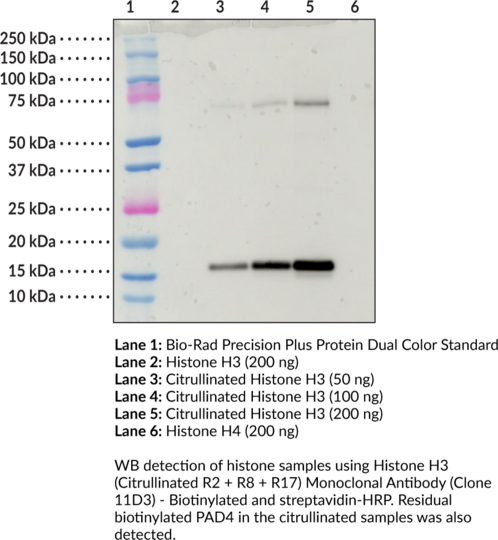
Histone H3 is a nuclear protein and a component of the nucleosome core that is essential for organizing genomic DNA in eukaryotic nuclei. It is a globular protein that contains an unstructured N-terminal tail that extends outside of the nucleosome core and is subject to various post-translational modifications, including citrullination. Histone H3 is subject to citrullination of arginine residues by peptidyl arginine deiminase 4 (PAD4) at positions 2, 8, 17, and 26, and this citrullination blocks methylation of these residues by protein-arginine methyltransferase 4 (PRMT4) and induces transcriptional repression of target genes. Histone H3 is subject to citrullination by protein-arginine deiminase 4 (PAD4) at arginine 2 (R2), R8, and R17 during neutrophil extracellular trap formation (NETosis). Citrullination of histone H3 at these residues reduces the positive charge of histone H3 and leads to decondensed chromatin, which is expelled into the extracellular space when the neutrophil membrane ruptures. Citrullinated histone H3 is a component of neutrophil extracellular traps (NETs) that acts as an autoantigen to induce production of anti-citrullinated protein antibodies (ACPAs) associated with various diseases such as sepsis, multiple sclerosis, rheumatoid arthritis, and multiple myeloma. Increased serum levels of histone H3 citrullinated at R2, R8, and R17 have been found in patients with asthma and in septic shock patients, where they are positively associated with a sequential organ failure assessment (SOFA) score and poor survival. Sputum levels of histone H3 citrullinated at R2, R8, and R17 are increased in patients with rheumatoid arthritis, as well as in individuals identified as at risk for developing rheumatoid arthritis based on their seropositivity for IgA ACPAs. Cayman's Histone H3 (Citrullinated R2 + R8 + R17) Monoclonal Antibody (Clone 11D3) - Biotinylated can be used for ELISA and Western blot (WB) applications. Immunogen: Histone H3 peptide with citrulline at R2, R8, and R17. Clone Designation: 11D3. Formulation (Request formulation change): 100 µg of biotinylated protein G-purified monoclonal antibody. Storage Buffer: PBS, pH 7.2, with 50% glycerol and 0.02% sodium azide. Host: Mouse. Isotype: IgG1K. Applications: ELISA, WB. Cross Reactivity: (+) Citrullinated histone H3 (-) Non-citrullinated histone H3. Species Reactivity: (+) Human. Storage: -20°C. Stability: > 2 years.
| Keywords: | Anti-H3C2, Anti-H3C6, Anti-H3C4, Anti-H3C8, Anti-H3C1, Anti-H3C7, Anti-H3C3, Anti-H3C10, Anti-H3C12, Anti-H3C11, Anti-Histone H3/b, Anti-Histone H3/j, Anti-Histone H3/h, Anti-Histone H3/l, Anti-Histone H3/k, Anti-Histone H3/i, Anti-Histone H3/f, Anti-Hist |
| Supplier: | Cayman Chemical |
| Supplier-Nr: | 44743 |
Properties
| Application: | ELISA, WB |
| Antibody Type: | Monoclonal |
| Clone: | 11D3 |
| Conjugate: | Biotin |
| Host: | Mouse |
| Species reactivity: | human |
| Immunogen: | histone H3 peptide with citrulline at R2, R8, and R17 |
| Format: | Purified |
Database Information
| KEGG ID : | K11253 | Matching products |
| UniProt ID : | P68431 | Matching products |
| Gene ID : | GeneID 8350 | Matching products |
Handling & Safety
| Storage: | -20°C |
| Shipping: | -20°C (International: -20°C) |
Caution
Our products are for laboratory research use only: Not for administration to humans!
Our products are for laboratory research use only: Not for administration to humans!
Information about the product reference will follow.
more
You will get a certificate here
Viewed