
Cookie preferences
This website uses cookies, which are necessary for the technical operation of the website and are always set. Other cookies, which increase the comfort when using this website, are used for direct advertising or to facilitate interaction with other websites and social networks, are only set with your consent.
Configuration
Technically required
These cookies are necessary for the basic functions of the shop.
"Allow all cookies" cookie
"Decline all cookies" cookie
CSRF token
Cookie preferences
Currency change
Customer-specific caching
FACT-Finder tracking
Individual prices
Selected shop
Session
Comfort functions
These cookies are used to make the shopping experience even more appealing, for example for the recognition of the visitor.
Note
Show the facebook fanpage in the right blod sidebar
Statistics & Tracking
Affiliate program
Conversion and usertracking via Google Tag Manager
Track device being used


| Item number | Size | Datasheet | Manual | SDS | Delivery time | Quantity | Price |
|---|---|---|---|---|---|---|---|
| NSJ-FY13358 | 100 µg | - | - |
3 - 10 business days* |
790.00€
|
If you have any questions, please use our Contact Form.
You can also order by e-mail: info@biomol.com
Larger quantity required? Request bulk
You can also order by e-mail: info@biomol.com
Larger quantity required? Request bulk
Adding 0.2 ml of distilled water will yield a concentration of 500 ug/ml. HCK antibody detects... more
Product information "Anti-HCK / Hematopoietic cell kinase"
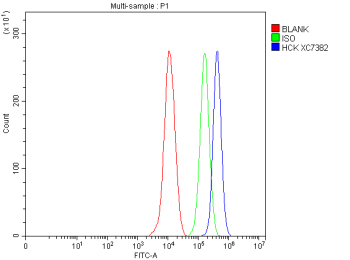
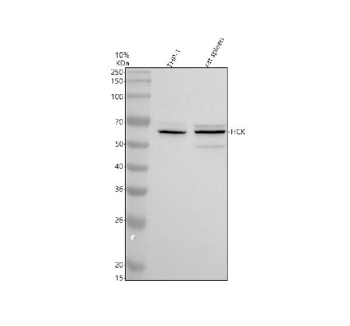
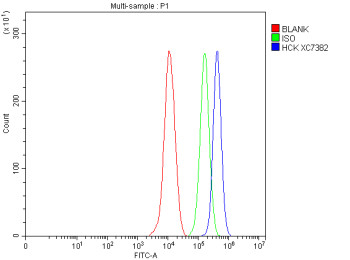
Adding 0.2 ml of distilled water will yield a concentration of 500 ug/ml. HCK antibody detects Hematopoietic cell kinase, a non-receptor tyrosine kinase encoded by the HCK gene on chromosome 20q11.21. HCK is a member of the Src family of kinases and is expressed predominantly in cells of the myeloid and B-lymphoid lineages, including macrophages, neutrophils, and monocytes. It plays essential roles in signal transduction pathways that regulate immune cell activation, adhesion, migration, and phagocytosis. HCK serves as a key mediator linking receptor engagement at the plasma membrane to downstream signaling cascades controlling inflammation and innate immunity.Structurally, HCK contains an N-terminal myristoylation site for membrane attachment, followed by SH3 and SH2 domains involved in protein-protein interactions, and a C-terminal tyrosine kinase domain responsible for catalytic activity. It belongs to the Src kinase family, which includes LYN, FGR, and FYN, sharing conserved regulatory mechanisms. HCK exists in two isoforms (p59HCK and p61HCK) generated by alternative translation initiation, with p61HCK showing stronger membrane association and signaling potency.Functionally, HCK transduces activation signals from immune receptors such as Fc gamma receptors, integrins, and toll-like receptors (TLRs). It phosphorylates downstream effectors including STAT3, PI3K, and MAPK pathway components, driving cytokine production and cell motility. HCK also interacts with cytoskeletal proteins to coordinate phagocytic cup formation and immune synapse assembly. Known substrates and partners include cortactin, paxillin, and focal adhesion kinase, supporting its role in cytoskeletal rearrangement during immune responses.HCK participates in signaling pathways regulating inflammatory gene expression and antimicrobial defense. In macrophages, it mediates responses to lipopolysaccharide (LPS) through activation of NF-kappaB and p38 MAPK pathways. In B cells, HCK modulates B-cell receptor (BCR) signaling and survival. During development, HCK expression increases as myeloid progenitors differentiate into mature macrophages and neutrophils, highlighting its role in immune cell maturation.Dysregulation of HCK activity is associated with immune disorders and cancer. Overexpression or constitutive activation has been observed in chronic myeloid leukemia and other hematologic malignancies, contributing to enhanced proliferation and resistance to apoptosis. Conversely, HCK deficiency impairs phagocytic and inflammatory responses. Pathway associations include JAK-STAT signaling, MAPK signaling, and Fc receptor-mediated phagocytosis. Pharmacological inhibition of HCK has shown potential in treating inflammatory and myeloproliferative diseases.Immunohistochemical staining using HCK antibody shows cytoplasmic and membrane localization in macrophages, neutrophils, and B cells. The HCK antibody from NSJ Bioreagents is a reliable reagent for research on immune signaling, hematopoietic differentiation, and tyrosine kinase regulation.
| Keywords: | Anti-HCK, Anti-p59Hck, Anti-p61Hck, Anti-p59-HCK/p60-HCK, Anti-Hemopoietic cell kinase, Anti-Hematopoietic cell kinase, Anti-Tyrosine-protein kinase HCK, HCK Antibody / Hematopoietic cell kinase |
| Supplier: | NSJ Bioreagents |
| Supplier-Nr: | FY13358 |
Properties
| Application: | WB, FC, ELISA |
| Antibody Type: | Polyclonal |
| Conjugate: | No |
| Host: | Rabbit |
| Species reactivity: | human, rat |
| Immunogen: | E.coli-derived human HCK recombinant protein (Position: R14-R501) |
| Format: | Purified |
Database Information
| KEGG ID : | K08893 | Matching products |
| UniProt ID : | P08631 | Matching products |
| Gene ID : | GeneID 3055 | Matching products |
Handling & Safety
| Storage: | +4°C |
| Shipping: | +4°C (International: +4°C) |
Caution
Our products are for laboratory research use only: Not for administration to humans!
Our products are for laboratory research use only: Not for administration to humans!
Information about the product reference will follow.
more
You will get a certificate here
Viewed