
Cookie preferences
This website uses cookies, which are necessary for the technical operation of the website and are always set. Other cookies, which increase the comfort when using this website, are used for direct advertising or to facilitate interaction with other websites and social networks, are only set with your consent.
Configuration
Technically required
These cookies are necessary for the basic functions of the shop.
"Allow all cookies" cookie
"Decline all cookies" cookie
CSRF token
Cookie preferences
Currency change
Customer-specific caching
FACT-Finder tracking
Individual prices
Selected shop
Session
Comfort functions
These cookies are used to make the shopping experience even more appealing, for example for the recognition of the visitor.
Note
Show the facebook fanpage in the right blod sidebar
Statistics & Tracking
Affiliate program
Conversion and usertracking via Google Tag Manager
Track device being used


| Item number | Size | Datasheet | Manual | SDS | Delivery time | Quantity | Price |
|---|---|---|---|---|---|---|---|
| NSJ-FY12185 | 100 µg | - | - |
3 - 10 business days* |
790.00€
|
If you have any questions, please use our Contact Form.
You can also order by e-mail: info@biomol.com
Larger quantity required? Request bulk
You can also order by e-mail: info@biomol.com
Larger quantity required? Request bulk
Adding 0.2 ml of distilled water will yield a concentration of 500 ug/ml. GLYAT antibody detects... more
Product information "Anti-GLYAT / Glycine-N-acyltransferase"
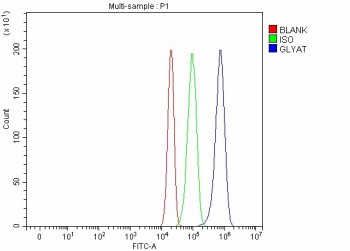
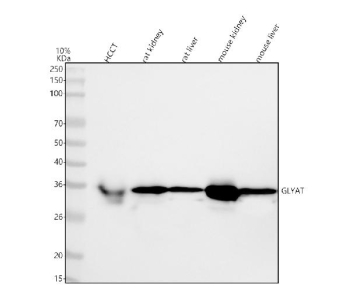
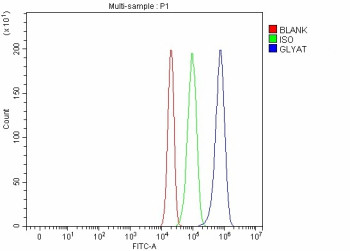
Adding 0.2 ml of distilled water will yield a concentration of 500 ug/ml. GLYAT antibody detects Glycine-N-acyltransferase, encoded by the GLYAT gene on chromosome 11q12.1. GLYAT antibody is widely used to study this phase II conjugating enzyme involved in detoxification and metabolism of acyl-CoA thioesters. GLYAT catalyzes conjugation of glycine to acyl-CoA substrates, producing acylglycines that are more water-soluble and easily excreted. Expression is highest in liver and kidney, the major detoxification organs, but it is also present in brain and other tissues involved in metabolic processing.Structurally, GLYAT is a mitochondrial matrix enzyme belonging to the acyltransferase family. It contains conserved motifs for CoA binding and catalytic activity. Structural studies suggest GLYAT functions as a homodimer, with active sites capable of accommodating medium- to long-chain acyl-CoA substrates. This structural adaptability allows it to process a wide range of xenobiotic and endogenous compounds.Functionally, GLYAT contributes to detoxification of acyl-CoA intermediates generated during fatty acid, amino acid, and xenobiotic metabolism. By conjugating glycine to these intermediates, GLYAT prevents their accumulation and toxicity. Acylglycines produced by GLYAT can serve as diagnostic markers of inborn errors of metabolism, including organic acidemias. Knockdown studies demonstrate impaired detoxification capacity and increased cellular stress. Researchers use GLYAT antibody to study metabolic regulation, detoxification, and biomarker pathways.Clinically, GLYAT deficiency or reduced activity is associated with metabolic disorders characterized by elevated toxic acyl-CoA levels. Acylglycine profiling is used in newborn screening for metabolic diseases such as isovaleric acidemia. GLYAT expression has also been linked to cancer, where metabolic reprogramming alters detoxification pathways. Additionally, GLYAT is implicated in drug metabolism and may influence individual responses to xenobiotics. NSJ Bioreagents offers GLYAT antibody as a research tool in toxicology, metabolism, and disease studies.Experimentally, GLYAT antibody is applied in western blotting to detect the ~34 kDa protein, in immunofluorescence microscopy to confirm mitochondrial localization, and in immunohistochemistry to analyze tissue expression. Enzymatic assays combined with GLYAT antibody detection help characterize acyltransferase activity under different conditions.
| Keywords: | Anti-GLYAT, Anti-HRP-1(CLP), Anti-Glycine N-acyltransferase, Anti-Glycine N-benzoyltransferase, Anti-Aralkyl acyl-CoA N-acyltransferase, Anti-Acyl-CoA:glycine N-acyltransferase, Anti-Benzoyl-coenzyme A:glycine N-acyltransferase, Anti-Aralkyl acyl-CoA:amin |
| Supplier: | NSJ Bioreagents |
| Supplier-Nr: | FY12185 |
Properties
| Application: | ELISA, FC, WB |
| Antibody Type: | Polyclonal |
| Conjugate: | No |
| Host: | Rabbit |
| Species reactivity: | human, mouse, rat |
| Immunogen: | E.coli-derived human GLYAT recombinant protein (Position: K44-L296) |
| Format: | Purified |
Database Information
| KEGG ID : | K00628 | Matching products |
| UniProt ID : | Q6IB77 | Matching products |
| Gene ID : | GeneID 10249 | Matching products |
Handling & Safety
| Storage: | +4°C |
| Shipping: | +4°C (International: +4°C) |
Caution
Our products are for laboratory research use only: Not for administration to humans!
Our products are for laboratory research use only: Not for administration to humans!
Information about the product reference will follow.
more
You will get a certificate here
Viewed