
Cookie preferences
This website uses cookies, which are necessary for the technical operation of the website and are always set. Other cookies, which increase the comfort when using this website, are used for direct advertising or to facilitate interaction with other websites and social networks, are only set with your consent.
Configuration
Technically required
These cookies are necessary for the basic functions of the shop.
"Allow all cookies" cookie
"Decline all cookies" cookie
CSRF token
Cookie preferences
Currency change
Customer-specific caching
FACT-Finder tracking
Individual prices
Selected shop
Session
Comfort functions
These cookies are used to make the shopping experience even more appealing, for example for the recognition of the visitor.
Note
Show the facebook fanpage in the right blod sidebar
Statistics & Tracking
Affiliate program
Conversion and usertracking via Google Tag Manager
Track device being used



| Item number | Size | Datasheet | Manual | SDS | Delivery time | Quantity | Price |
|---|---|---|---|---|---|---|---|
| NSJ-V6080-20UG | 20 µg | - | - |
3 - 10 business days* |
684.00€
|
||
| NSJ-V6080-100UG | 100 µg | - | - |
3 - 10 business days* |
1,160.00€
|
If you have any questions, please use our Contact Form.
You can also order by e-mail: info@biomol.com
Larger quantity required? Request bulk
You can also order by e-mail: info@biomol.com
Larger quantity required? Request bulk
Antibody in 1X PBS with 0.05% BSA, 0.05% sodium azide. Glutamate-ammonia ligase, encoded by the... more
Product information "Anti-GLUL / Glutamate-ammonia ligase, clone MSVA-750M"
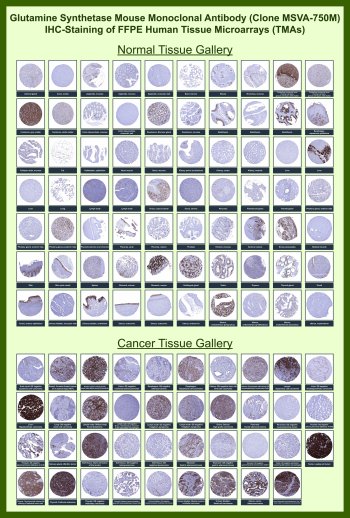
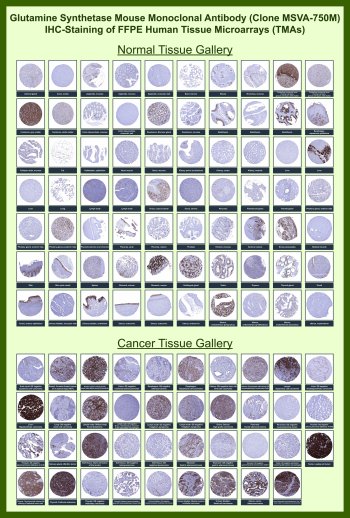
Antibody in 1X PBS with 0.05% BSA, 0.05% sodium azide. Glutamate-ammonia ligase, encoded by the GLUL gene, is widely known as Glutamine synthetase and functions as a key cytoplasmic enzyme involved in nitrogen metabolism and cellular glutamine production. GLUL Antibody for IHC MSVA-750M is designed for immunohistochemical detection of glutamine synthetase in formalin-fixed, paraffin-embedded tissue sections. Because GLUL expression follows highly characteristic tissue distribution patterns, immunohistochemistry provides a powerful method for visualizing cellular localization and evaluating tissue-specific metabolic organization.In immunohistochemical studies of normal tissues, glutamine synthetase shows distinct cytoplasmic staining patterns that reflect specialized metabolic zones. In the liver, GLUL is strongly expressed in pericentral hepatocytes surrounding central veins, producing a sharply defined zonal staining pattern that is frequently used to assess hepatic architecture and metabolic compartmentalization. In the central nervous system, immunohistochemistry reveals GLUL expression primarily in astrocytes, where cytoplasmic staining outlines astrocytic cell bodies and processes within the neuropil. This distribution corresponds to the enzyme's role in the glutamate-glutamine cycle and regulation of neurotransmitter metabolism.Immunohistochemical detection of GLUL is also observed in kidney, gastrointestinal epithelium, and selected epithelial and glandular tissues depending on metabolic demand. Cytoplasmic staining typically appears diffuse to finely granular within positive cells, reflecting the known intracellular localization of glutamine synthetase. These patterns allow investigators to evaluate both tissue distribution and cell-type specific expression when examining normal physiology or disease-associated alterations.GLUL immunohistochemistry is frequently used in tumor biology research. Altered glutamine synthetase expression has been reported in hepatocellular carcinoma and other malignancies, where IHC staining can reveal changes in metabolic pathway activation and cellular differentiation. The ability to visualize GLUL-positive cells within tissue architecture makes immunohistochemistry particularly valuable for correlating metabolic enzyme expression with histologic features.As a monoclonal reagent optimized for tissue staining, GLUL Antibody for IHC MSVA-750M supports clear cytoplasmic detection of glutamine synthetase in formalin-fixed tissue sections. This antibody is well suited for studies examining tissue distribution, metabolic zonation, and tumor-associated changes in glutamine metabolism through immunohistochemical analysis.This antibody is also part of a broader collection of IHC antibodies validated by tissue microarray analysis, supporting consistent staining across normal and cancer tissues.
| Keywords: | Anti-GLUL, Anti-Glutamine synthetase, Anti-Palmitoyltransferase GLUL, Anti-Glutamate--ammonia ligase, GLUL Antibody / Glutamate-ammonia ligase |
| Supplier: | NSJ Bioreagents |
| Supplier-Nr: | V6080 |
Properties
| Application: | IHC |
| Antibody Type: | Monoclonal |
| Clone: | MSVA-750M |
| Conjugate: | No |
| Host: | Mouse |
| Species reactivity: | human |
| Immunogen: | Recombinant fragment (around amino acids 50-250) of human GLUL protein (exact sequence is proprietary) |
| Format: | Purified |
Database Information
| KEGG ID : | K01915 | Matching products |
| UniProt ID : | P15104 | Matching products |
| Gene ID : | GeneID 2752 | Matching products |
Handling & Safety
| Storage: | -20°C |
| Shipping: | -20°C (International: -20°C) |
Caution
Our products are for laboratory research use only: Not for administration to humans!
Our products are for laboratory research use only: Not for administration to humans!
Information about the product reference will follow.
more
You will get a certificate here
Viewed