
Cookie preferences
This website uses cookies, which are necessary for the technical operation of the website and are always set. Other cookies, which increase the comfort when using this website, are used for direct advertising or to facilitate interaction with other websites and social networks, are only set with your consent.
Configuration
Technically required
These cookies are necessary for the basic functions of the shop.
"Allow all cookies" cookie
"Decline all cookies" cookie
CSRF token
Cookie preferences
Currency change
Customer-specific caching
FACT-Finder tracking
Individual prices
Selected shop
Session
Comfort functions
These cookies are used to make the shopping experience even more appealing, for example for the recognition of the visitor.
Note
Show the facebook fanpage in the right blod sidebar
Statistics & Tracking
Affiliate program
Conversion and usertracking via Google Tag Manager
Track device being used

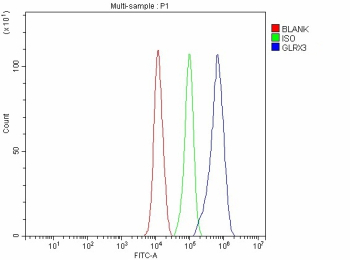
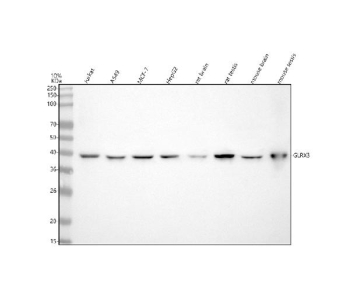
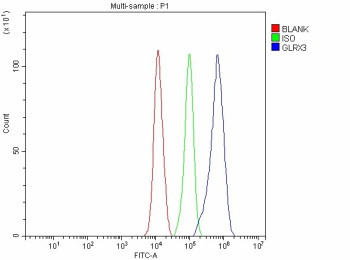

| Item number | Size | Datasheet | Manual | SDS | Delivery time | Quantity | Price |
|---|---|---|---|---|---|---|---|
| NSJ-FY12722 | 100 µg | - | - |
3 - 10 business days* |
790.00€
|
If you have any questions, please use our Contact Form.
You can also order by e-mail: info@biomol.com
Larger quantity required? Request bulk
You can also order by e-mail: info@biomol.com
Larger quantity required? Request bulk
Adding 0.2 ml of distilled water will yield a concentration of 500 ug/ml. GLRX3 antibody detects... more
Product information "Anti-GLRX3 / Glutaredoxin 3 / PICOT"
Adding 0.2 ml of distilled water will yield a concentration of 500 ug/ml. GLRX3 antibody detects Glutaredoxin-3 (also known as PICOT or Thioredoxin-like protein 2), a multifunctional redox enzyme that regulates cellular redox homeostasis, iron-sulfur cluster assembly, and signal transduction. Encoded by the GLRX3 gene on chromosome 10q26.3, this protein belongs to the glutaredoxin family, characterized by their thiol-disulfide oxidoreductase activity. GLRX3 contains two monothiol glutaredoxin domains that utilize glutathione to catalyze reversible thiol exchange reactions, thereby maintaining protein thiol status and redox balance. Beyond redox control, GLRX3 acts as a scaffold protein for Fe-S cluster delivery and as a modulator of intracellular signaling cascades.GLRX3 is ubiquitously expressed but particularly abundant in heart, skeletal muscle, and liver, where it contributes to mitochondrial function and oxidative stress resistance. The protein forms complexes with BolA-like proteins to facilitate Fe-S cluster biogenesis, which is essential for electron transport chain integrity. In cardiomyocytes, GLRX3?originally identified as PICOT (PKC-interacting cousin of thioredoxin)?binds to protein kinase C theta and inhibits its activity, modulating hypertrophic signaling and contractility. This redox-regulatory interaction links GLRX3 to cardiac protection against oxidative damage and maladaptive stress responses.The GLRX3 antibody is widely used in redox biology, metabolism, and cardiovascular research to examine oxidative stress regulation, Fe-S cluster metabolism, and cell signaling. Western blot analysis identifies a 38 kilodalton band corresponding to GLRX3, while immunofluorescence shows cytoplasmic and mitochondrial localization. Studies using the antibody have revealed that GLRX3 depletion leads to increased ROS levels, impaired mitochondrial respiration, and reduced iron homeostasis. Because these effects contribute to cellular senescence and disease progression, GLRX3 is of growing interest as a therapeutic target in oxidative and metabolic disorders.Beyond its roles in redox and energy metabolism, GLRX3 contributes to developmental processes and immune function. It modulates NF-?B and MAPK pathways, influencing inflammatory gene expression. Overexpression has been reported in cancers such as hepatocellular carcinoma and breast carcinoma, where it promotes proliferation and resistance to oxidative stress. The GLRX3 antibody therefore provides a valuable reagent for investigating molecular mechanisms of redox regulation, signal transduction, and disease adaptation. NSJ Bioreagents supplies this antibody validated for its applications, ensuring high specificity and reproducibility for both basic and translational research applications.
| Keywords: | Anti-GLRX3, Anti-Glutaredoxin-3, Anti-Thioredoxin-like protein 2, Anti-PKC-theta-interacting protein, Anti-PKC-interacting cousin of thioredoxin, GLRX3 Antibody / Glutaredoxin 3 / PICOT |
| Supplier: | NSJ Bioreagents |
| Supplier-Nr: | FY12722 |
Properties
| Application: | WB, FC, ELISA |
| Antibody Type: | Polyclonal |
| Conjugate: | No |
| Host: | Rabbit |
| Species reactivity: | human, mouse, rat |
| Immunogen: | E.coli-derived human GLRX3 recombinant protein (Position: K31-V307) |
| Format: | Purified |
Database Information
| UniProt ID : | O76003 | Matching products |
| Gene ID : | GeneID 10539 | Matching products |
Handling & Safety
| Storage: | +4°C |
| Shipping: | +4°C (International: +4°C) |
Caution
Our products are for laboratory research use only: Not for administration to humans!
Our products are for laboratory research use only: Not for administration to humans!
Information about the product reference will follow.
more
You will get a certificate here
Viewed