
Cookie preferences
This website uses cookies, which are necessary for the technical operation of the website and are always set. Other cookies, which increase the comfort when using this website, are used for direct advertising or to facilitate interaction with other websites and social networks, are only set with your consent.
Configuration
Technically required
These cookies are necessary for the basic functions of the shop.
"Allow all cookies" cookie
"Decline all cookies" cookie
CSRF token
Cookie preferences
Currency change
Customer-specific caching
FACT-Finder tracking
Individual prices
Selected shop
Session
Comfort functions
These cookies are used to make the shopping experience even more appealing, for example for the recognition of the visitor.
Note
Show the facebook fanpage in the right blod sidebar
Statistics & Tracking
Affiliate program
Conversion and usertracking via Google Tag Manager
Track device being used

| Item number | Size | Datasheet | Manual | SDS | Delivery time | Quantity | Price |
|---|---|---|---|---|---|---|---|
| NSJ-FY12192 | 100 µg | - | - |
7 - 12 business days* |
790.00€
|
If you have any questions, please use our Contact Form.
You can also order by e-mail: info@biomol.com
Larger quantity required? Request bulk
You can also order by e-mail: info@biomol.com
Larger quantity required? Request bulk
Adding 0.2 ml of distilled water will yield a concentration of 500 ug/ml. GLI1 antibody detects... more
Product information "Anti-GLI1 / Glioma-associated oncogene homolog 1"
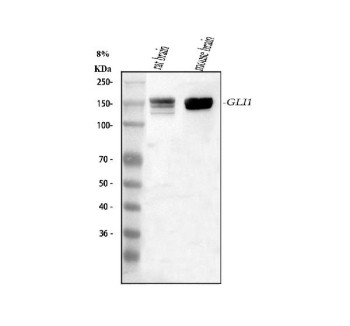
Adding 0.2 ml of distilled water will yield a concentration of 500 ug/ml. GLI1 antibody detects Glioma-associated oncogene homolog 1, encoded by the GLI1 gene on chromosome 12q13.3. GLI1 antibody is used in research on developmental signaling, transcriptional regulation, and cancer biology. GLI1 is a zinc finger transcription factor and a key effector of the Hedgehog signaling pathway, which controls cell fate, proliferation, and differentiation during embryogenesis. Aberrant activation of GLI1 contributes to tumorigenesis, particularly in basal cell carcinoma, medulloblastoma, and other cancers. GLI1 expression is found in embryonic tissues, stem cells, and tumor cells, with tightly regulated activity in development and disease.Structurally, GLI1 contains five C2H2-type zinc finger DNA-binding motifs that recognize consensus sequences in Hedgehog target genes. Its N-terminal region regulates transcriptional activity, while the C-terminal domain contains transactivation motifs. GLI1 functions as a transcriptional activator, unlike GLI2 and GLI3 which can act as both activators and repressors. Regulation of GLI1 involves nuclear-cytoplasmic shuttling, post-translational modifications, and interaction with cofactors.Functionally, GLI1 activates transcription of genes controlling proliferation, survival, and differentiation. In development, it directs patterning of the nervous system, limbs, and other organs. In adult tissues, GLI1 is normally quiescent but can be reactivated in stem cell niches. Dysregulation results in uncontrolled proliferation and cancer initiation. Researchers use GLI1 antibody to study Hedgehog signaling, transcriptional control, and oncogenesis.Clinically, GLI1 is strongly linked to cancer. Overexpression or constitutive activation drives tumor growth in basal cell carcinoma, medulloblastoma, gliomas, and pancreatic cancer. GLI1 serves as a biomarker of Hedgehog pathway activity and a therapeutic target in oncology. Inhibitors targeting upstream components such as Smoothened indirectly reduce GLI1 activity, while direct GLI inhibitors are in development. GLI1 is also associated with developmental disorders caused by Hedgehog pathway disruption. NSJ Bioreagents provides GLI1 antibody for reliable detection in developmental biology and oncology research.Experimentally, GLI1 antibody is used in western blotting to detect the ~110 kDa protein, in immunohistochemistry to analyze tumor expression, and in immunofluorescence microscopy to study nuclear localization. Immunoprecipitation with GLI1 antibody enables analysis of transcriptional complexes and cofactors. These applications provide a versatile toolkit for dissecting Hedgehog pathway regulation.
| Keywords: | Anti-GLI1, Anti-Oncogene GLI, Anti-Zinc finger protein GLI1, Anti-Glioma-associated oncogene, GLI1 Antibody / Glioma-associated oncogene homolog 1 |
| Supplier: | NSJ Bioreagents |
| Supplier-Nr: | FY12192 |
Properties
| Application: | WB, ELISA |
| Antibody Type: | Polyclonal |
| Conjugate: | No |
| Host: | Rabbit |
| Species reactivity: | human, mouse, rat |
| Immunogen: | E.coli-derived human GLI1 recombinant protein (Position: Y800-Q1057) |
| Format: | Purified |
Database Information
| KEGG ID : | K16797 | Matching products |
| UniProt ID : | P08151 | Matching products |
| Gene ID : | GeneID 2735 | Matching products |
Handling & Safety
| Storage: | +4°C |
| Shipping: | +4°C (International: +4°C) |
Caution
Our products are for laboratory research use only: Not for administration to humans!
Our products are for laboratory research use only: Not for administration to humans!
Information about the product reference will follow.
more
You will get a certificate here
Viewed