
Cookie preferences
This website uses cookies, which are necessary for the technical operation of the website and are always set. Other cookies, which increase the comfort when using this website, are used for direct advertising or to facilitate interaction with other websites and social networks, are only set with your consent.
Configuration
Technically required
These cookies are necessary for the basic functions of the shop.
"Allow all cookies" cookie
"Decline all cookies" cookie
CSRF token
Cookie preferences
Currency change
Customer-specific caching
FACT-Finder tracking
Individual prices
Selected shop
Session
Comfort functions
These cookies are used to make the shopping experience even more appealing, for example for the recognition of the visitor.
Note
Show the facebook fanpage in the right blod sidebar
Statistics & Tracking
Affiliate program
Conversion and usertracking via Google Tag Manager
Track device being used



| Item number | Size | Datasheet | Manual | SDS | Delivery time | Quantity | Price |
|---|---|---|---|---|---|---|---|
| NSJ-V5905-20UG | 20 µg | - | - |
3 - 10 business days* |
375.00€
|
||
| NSJ-V5905-100UG | 100 µg | - | - |
3 - 10 business days* |
810.00€
|
If you have any questions, please use our Contact Form.
You can also order by e-mail: info@biomol.com
Larger quantity required? Request bulk
You can also order by e-mail: info@biomol.com
Larger quantity required? Request bulk
0.2 mg/ml in 1X PBS with 0.05% BSA, 0.05% sodium azide. GFAP antibody targets Glial fibrillary... more
Product information "Anti-GFAP / Glial fibrillary acidic protein, clone GFAP/9420"
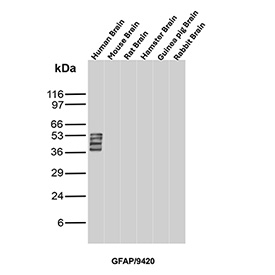
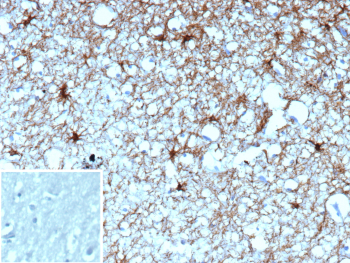
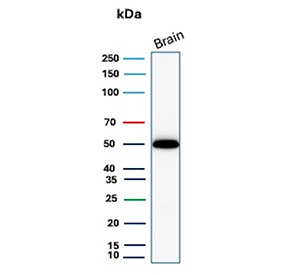
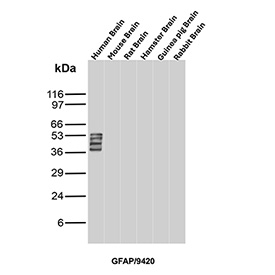
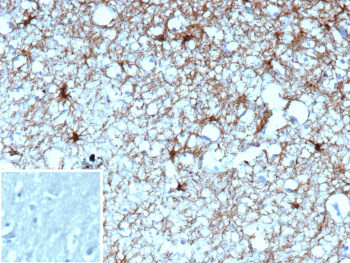
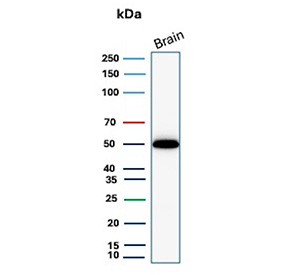
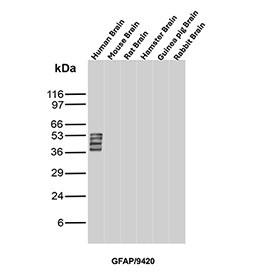
0.2 mg/ml in 1X PBS with 0.05% BSA, 0.05% sodium azide. GFAP antibody targets Glial fibrillary acidic protein, an intermediate filament protein that is a defining structural component of astrocytes in the central nervous system. Glial fibrillary acidic protein is encoded by the GFAP gene and is predominantly localized to the cytoplasm, where it forms filamentous networks that contribute to astrocyte shape, mechanical strength, and interactions with neighboring neurons and blood vessels. As a member of the type III intermediate filament family, GFAP plays a central role in maintaining astrocytic architecture and supporting normal neural tissue organization.Glial fibrillary acidic protein is widely recognized as a canonical marker of astrocytes and astroglial lineage cells. GFAP expression is prominent in fibrous astrocytes of white matter and protoplasmic astrocytes of gray matter, as well as in specialized astrocytic populations such as radial glia and Bergmann glia. Because of this restricted and robust expression pattern, a GFAP antibody is extensively used to visualize astrocyte distribution, morphology, and density in brain and spinal cord tissue under both physiological and pathological conditions.Beyond its structural role, GFAP is dynamically regulated in response to central nervous system injury, inflammation, and disease. Astrocyte activation, commonly referred to as reactive gliosis, is characterized by increased GFAP expression, hypertrophy of astrocytic processes, and cytoskeletal reorganization. Elevated GFAP levels are a hallmark of conditions such as traumatic brain injury, stroke, neurodegenerative diseases, and central nervous system tumors. A glial fibrillary acidic protein antibody is therefore an essential tool for studying astrocyte reactivity, glial scar formation, and neuroinflammatory responses.GFAP exists in multiple isoforms generated through alternative splicing, with GFAP-alpha being the most abundant form in adult brain. Other isoforms contribute to region-specific and developmental regulation of astrocyte structure. The protein assembles into homopolymers or heteropolymers with other intermediate filament proteins, including vimentin and nestin, particularly during development or following injury. Use of a GFAP antibody enables investigation of these cytoskeletal dynamics and their relationship to astrocyte function and plasticity.In clinical and translational research, GFAP has significant diagnostic relevance. GFAP immunoreactivity is a defining feature of astrocytic tumors such as astrocytoma and glioblastoma, and GFAP antibody staining is routinely used to distinguish glial tumors from neuronal or metastatic neoplasms. In addition, circulating GFAP fragments have been explored as biomarkers of brain injury and neurodegeneration, further underscoring the biological importance of this protein.Clone GFAP/9420 is designed to recognize glial fibrillary acidic protein and supports detection of astrocytes and astrocyte-derived structures in research applications. NSJ Bioreagents offers this GFAP antibody to aid investigations into glial biology, neurodevelopment, neuropathology, and central nervous system disease mechanisms.
| Keywords: | Anti-GFAP, Anti-Glial fibrillary acidic protein, GFAP Antibody / Glial fibrillary acidic protein |
| Supplier: | NSJ Bioreagents |
| Supplier-Nr: | V5905 |
Properties
| Application: | IHC, WB |
| Antibody Type: | Monoclonal |
| Clone: | GFAP/9420 |
| Conjugate: | No |
| Host: | Mouse |
| Species reactivity: | human |
| Immunogen: | Recombinant fragment (around amino acids 150-250) of human GFAP protein (exact sequence is proprietary) |
| Format: | Purified |
Database Information
| KEGG ID : | K05640 | Matching products |
| UniProt ID : | P14136 | Matching products |
| Gene ID : | GeneID 2670 | Matching products |
Handling & Safety
| Storage: | -20°C |
| Shipping: | -20°C (International: -20°C) |
Caution
Our products are for laboratory research use only: Not for administration to humans!
Our products are for laboratory research use only: Not for administration to humans!
Information about the product reference will follow.
more
You will get a certificate here
Viewed