
Cookie preferences
This website uses cookies, which are necessary for the technical operation of the website and are always set. Other cookies, which increase the comfort when using this website, are used for direct advertising or to facilitate interaction with other websites and social networks, are only set with your consent.
Configuration
Technically required
These cookies are necessary for the basic functions of the shop.
"Allow all cookies" cookie
"Decline all cookies" cookie
CSRF token
Cookie preferences
Currency change
Customer-specific caching
FACT-Finder tracking
Individual prices
Selected shop
Session
Comfort functions
These cookies are used to make the shopping experience even more appealing, for example for the recognition of the visitor.
Note
Show the facebook fanpage in the right blod sidebar
Statistics & Tracking
Affiliate program
Conversion and usertracking via Google Tag Manager
Track device being used


| Item number | Size | Datasheet | Manual | SDS | Delivery time | Quantity | Price |
|---|---|---|---|---|---|---|---|
| NSJ-FY13353 | 100 µg | - | - |
3 - 10 business days* |
790.00€
|
If you have any questions, please use our Contact Form.
You can also order by e-mail: info@biomol.com
Larger quantity required? Request bulk
You can also order by e-mail: info@biomol.com
Larger quantity required? Request bulk
Adding 0.2 ml of distilled water will yield a concentration of 500 ug/ml. GDF15 antibody detects... more
Product information "Anti-Gdf15 / Growth differentiation factor 15"
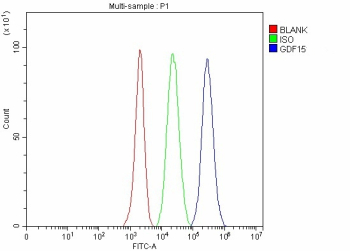
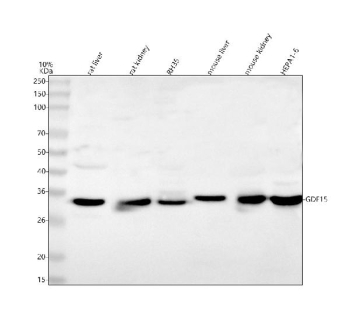
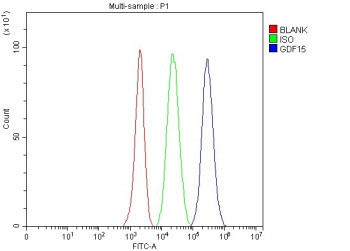
Adding 0.2 ml of distilled water will yield a concentration of 500 ug/ml. GDF15 antibody detects Growth differentiation factor 15, a secreted cytokine belonging to the transforming growth factor beta superfamily. The GDF15 gene is located on chromosome 19p13.11 and encodes a stress-responsive protein that regulates inflammation, metabolism, and cellular stress adaptation. GDF15 is highly expressed in liver, placenta, prostate, and macrophages, and its expression increases dramatically in response to cellular injury, hypoxia, or mitochondrial dysfunction. It plays a central role in energy homeostasis, appetite regulation, and tissue repair through endocrine and paracrine mechanisms.GDF15 is synthesized as a precursor protein that undergoes proteolytic cleavage to release a mature disulfide-linked dimer. It exerts its biological effects primarily through binding to the GDNF family receptor alpha-like (GFRAL) receptor in the brainstem, which, together with RET co-receptor, mediates appetite suppression and energy expenditure. In peripheral tissues, GDF15 influences macrophage activation, anti-inflammatory responses, and tissue protection under stress. Co-localization studies show GDF15 present in secretory vesicles of hepatocytes and trophoblasts, as well as circulating in plasma as a stable cytokine dimer.Structurally, GDF15 shares conserved cysteine residues and dimerization motifs characteristic of the transforming growth factor beta family. It forms a homodimeric structure essential for receptor binding and downstream signaling activation. GDF15 belongs to the growth differentiation factor family, which includes GDF11, GDF8 (myostatin), and GDF9, all of which regulate growth and differentiation processes. Known interacting partners include GFRAL, RET, and transforming growth factor beta receptors in certain contexts.Functionally, GDF15 acts as a key regulator of systemic metabolism and cellular stress response. It suppresses appetite and body weight through the GFRAL-RET signaling axis in the central nervous system while also promoting tissue tolerance to metabolic stress. In macrophages and endothelial cells, GDF15 has anti-inflammatory effects, limiting excessive immune activation. In the cardiovascular system, GDF15 protects against ischemic injury by reducing apoptosis and oxidative stress. During embryonic development, it is expressed in placenta and plays roles in implantation and trophoblast differentiation.Dysregulation of GDF15 expression is associated with numerous pathological conditions. Elevated circulating levels occur in cancer, obesity, cardiovascular disease, and mitochondrial disorders, where GDF15 serves as a biomarker of cellular stress. In oncology, high GDF15 promotes cachexia and tumor progression via immune and metabolic pathways. Conversely, GDF15 has protective effects in metabolic diseases by improving glucose tolerance and reducing inflammation. Pathway involvement includes transforming growth factor beta signaling, mitochondrial stress response, and energy metabolism regulation.Immunohistochemical staining using GDF15 antibody shows cytoplasmic and extracellular localization in hepatocytes, macrophages, and placental trophoblasts. The GDF15 antibody from NSJ Bioreagents is ideal for studies involving stress signaling, metabolism, and cytokine biology.
| Keywords: | Anti-Gdf15, Anti-Growth/differentiation factor 15, Anti-Macrophage inhibitory cytokine 1, Gdf15 Antibody / Growth differentiation factor 15 |
| Supplier: | NSJ Bioreagents |
| Supplier-Nr: | FY13353 |
Properties
| Application: | WB, ELISA |
| Antibody Type: | Polyclonal |
| Conjugate: | No |
| Host: | Rabbit |
| Species reactivity: | mouse, rat |
| Immunogen: | E.coli-derived mouse Gdf15 recombinant protein (Position: S189-A302) |
| Format: | Purified |
Database Information
| KEGG ID : | K05504 | Matching products |
| UniProt ID : | Q9Z0J7 | Matching products |
| Gene ID : | GeneID 23886 | Matching products |
Handling & Safety
| Storage: | +4°C |
| Shipping: | +4°C (International: +4°C) |
Caution
Our products are for laboratory research use only: Not for administration to humans!
Our products are for laboratory research use only: Not for administration to humans!
Information about the product reference will follow.
more
You will get a certificate here
Viewed