
Cookie preferences
This website uses cookies, which are necessary for the technical operation of the website and are always set. Other cookies, which increase the comfort when using this website, are used for direct advertising or to facilitate interaction with other websites and social networks, are only set with your consent.
Configuration
Technically required
These cookies are necessary for the basic functions of the shop.
"Allow all cookies" cookie
"Decline all cookies" cookie
CSRF token
Cookie preferences
Currency change
Customer-specific caching
FACT-Finder tracking
Individual prices
Selected shop
Session
Comfort functions
These cookies are used to make the shopping experience even more appealing, for example for the recognition of the visitor.
Note
Show the facebook fanpage in the right blod sidebar
Statistics & Tracking
Affiliate program
Conversion and usertracking via Google Tag Manager
Track device being used



| Item number | Size | Datasheet | Manual | SDS | Delivery time | Quantity | Price |
|---|---|---|---|---|---|---|---|
| NSJ-FY13385 | 100 µg | - | - |
3 - 10 business days* |
790.00€
|
If you have any questions, please use our Contact Form.
You can also order by e-mail: info@biomol.com
Larger quantity required? Request bulk
You can also order by e-mail: info@biomol.com
Larger quantity required? Request bulk
Adding 0.2 ml of distilled water will yield a concentration of 500 ug/ml. GCLC antibody detects... more
Product information "Anti-GCLC / Glutamate-cysteine ligase catalytic subunit"
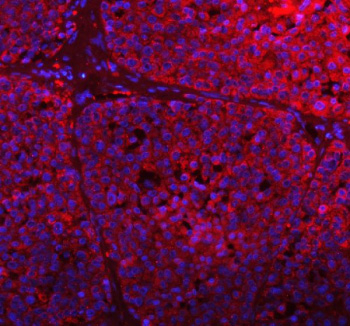
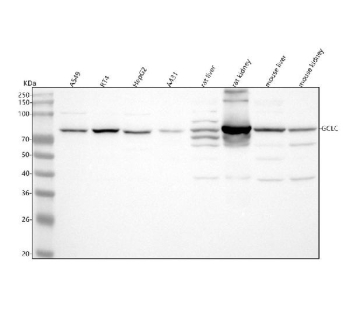
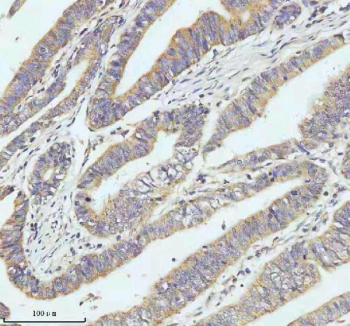
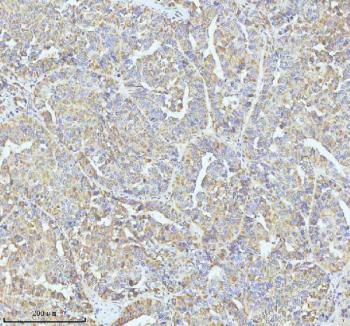
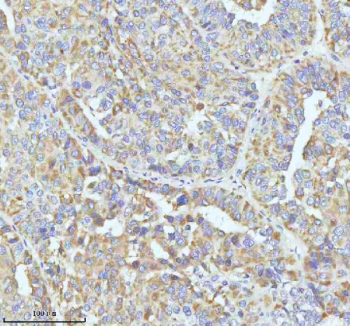
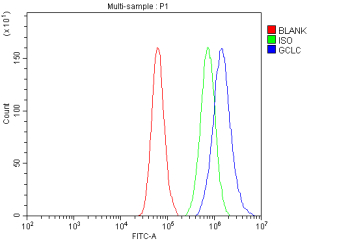
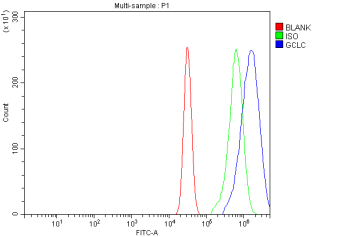
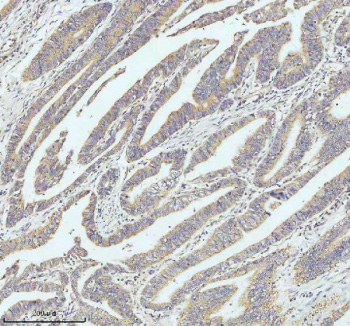
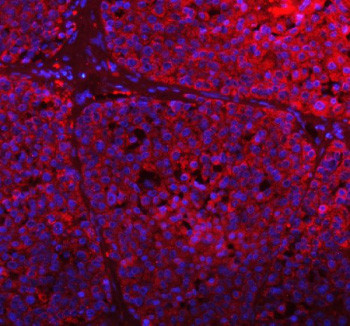
Adding 0.2 ml of distilled water will yield a concentration of 500 ug/ml. GCLC antibody detects Glutamate-cysteine ligase catalytic subunit, a key enzyme encoded by the GCLC gene located on chromosome 6p12.1. GCLC catalyzes the first and rate-limiting step in glutathione (GSH) biosynthesis, forming gamma-glutamylcysteine from glutamate and cysteine. This enzyme plays an essential role in maintaining redox homeostasis, detoxifying reactive oxygen species (ROS), and protecting cells from oxidative stress. GCLC is expressed ubiquitously, with highest levels in liver, kidney, and lung, where glutathione metabolism is most active.Structurally, GCLC is a 73 kDa cytosolic enzyme that functions as the catalytic component of the heterodimeric glutamate-cysteine ligase complex, together with the modifier subunit GCLM. It contains ATP-binding and substrate-recognition domains that mediate the ligation reaction. GCLC belongs to the ATP-dependent ligase family and serves as the principal control point in GSH biosynthesis. Co-localization studies show cytoplasmic distribution in metabolically active tissues, aligning with its antioxidant role.Functionally, GCLC maintains cellular antioxidant defenses by providing the precursor for glutathione synthesis. Glutathione serves as a cofactor for numerous detoxification enzymes, including glutathione peroxidases and glutathione S-transferases. Through GSH production, GCLC supports redox regulation, protein thiol homeostasis, and protection against electrophilic stress. In immune cells, GCLC-derived glutathione regulates T-cell activation and macrophage inflammatory responses. Known substrates include L-glutamate, L-cysteine, and ATP.Deficiency or dysregulation of GCLC results in decreased glutathione levels, leading to oxidative stress, hemolytic anemia, and liver dysfunction. Mutations in GCLC are associated with glutathione synthetase deficiency and neurological disorders linked to oxidative damage. Overexpression is observed in certain cancers, conferring chemoresistance through enhanced antioxidant capacity. Pathway associations include glutathione metabolism, oxidative stress response, and xenobiotic detoxification. During development, GCLC supports organogenesis by protecting proliferating cells from oxidative injury.The GCLC antibody from NSJ Bioreagents is an excellent reagent for studies involving redox biology, detoxification mechanisms, and glutathione metabolism.
| Keywords: | Anti-GCLC, Anti-Gamma-ECS, Anti-GCS heavy chain, Anti-Gamma-glutamylcysteine synthetase, Anti-Glutamate--cysteine ligase catalytic subunit, GCLC Antibody / Glutamate-cysteine ligase catalytic subunit |
| Supplier: | NSJ Bioreagents |
| Supplier-Nr: | FY13385 |
Properties
| Application: | ELISA, FC, IF, IHC, WB |
| Antibody Type: | Polyclonal |
| Conjugate: | No |
| Host: | Rabbit |
| Species reactivity: | human, mouse, rat |
| Immunogen: | E.coli-derived human GCLC recombinant protein (Position: R24-H388) |
| Format: | Purified |
Database Information
| KEGG ID : | K11204 | Matching products |
| UniProt ID : | P48506 | Matching products |
| Gene ID : | GeneID 2729 | Matching products |
Handling & Safety
| Storage: | +4°C |
| Shipping: | +4°C (International: +4°C) |
Caution
Our products are for laboratory research use only: Not for administration to humans!
Our products are for laboratory research use only: Not for administration to humans!
Information about the product reference will follow.
more
You will get a certificate here
Viewed