
Cookie preferences
This website uses cookies, which are necessary for the technical operation of the website and are always set. Other cookies, which increase the comfort when using this website, are used for direct advertising or to facilitate interaction with other websites and social networks, are only set with your consent.
Configuration
Technically required
These cookies are necessary for the basic functions of the shop.
"Allow all cookies" cookie
"Decline all cookies" cookie
CSRF token
Cookie preferences
Currency change
Customer-specific caching
FACT-Finder tracking
Individual prices
Selected shop
Session
Comfort functions
These cookies are used to make the shopping experience even more appealing, for example for the recognition of the visitor.
Note
Show the facebook fanpage in the right blod sidebar
Statistics & Tracking
Affiliate program
Conversion and usertracking via Google Tag Manager
Track device being used


| Item number | Size | Datasheet | Manual | SDS | Delivery time | Quantity | Price |
|---|---|---|---|---|---|---|---|
| NSJ-FY12966 | 100 µg | - | - |
3 - 10 business days* |
790.00€
|
If you have any questions, please use our Contact Form.
You can also order by e-mail: info@biomol.com
Larger quantity required? Request bulk
You can also order by e-mail: info@biomol.com
Larger quantity required? Request bulk
Adding 0.2 ml of distilled water will yield a concentration of 500 ug/ml. GARS1 antibody detects... more
Product information "Anti-GARS1 / Glycyl-tRNA synthetase"
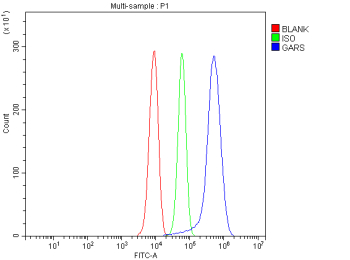
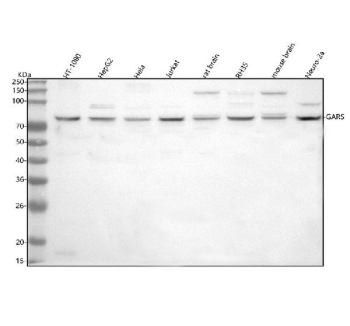
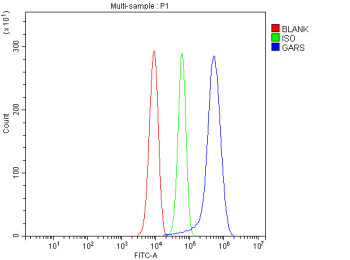
Adding 0.2 ml of distilled water will yield a concentration of 500 ug/ml. GARS1 antibody detects Glycyl-tRNA synthetase, an essential enzyme that catalyzes the attachment of glycine to its corresponding tRNA during protein translation. The UniProt recommended name is Glycyl-tRNA synthetase (GARS1), a class II aminoacyl-tRNA synthetase that ensures fidelity in decoding genetic information into functional proteins. GARS1 is critical for both cytoplasmic and mitochondrial protein synthesis, as it charges tRNAGly with glycine using ATP-dependent activation.Functionally, GARS1 antibody identifies a 739-amino-acid enzyme that performs the aminoacylation reaction in two steps: activation of glycine to form glycyl-adenylate, followed by transfer to tRNAGly. This reaction supplies aminoacyl-tRNA for translation elongation, ensuring proper incorporation of glycine into nascent polypeptides. GARS1 operates as a homodimer and belongs to the multi-synthetase complex in higher eukaryotes, coordinating translation efficiency and cellular growth. Its catalytic precision is essential for maintaining proteome integrity and translational accuracy.The GARS1 gene is located on chromosome 7p15.3 and is ubiquitously expressed in all tissues, reflecting its fundamental role in protein biosynthesis. Mutations in GARS1 cause Charcot-Marie-Tooth disease type 2D (CMT2D) and distal spinal muscular atrophy type V, which are characterized by axonal degeneration and motor neuron dysfunction. These mutations often alter enzyme dimerization or substrate binding, impairing aminoacylation activity and disrupting neuronal protein synthesis.Beyond its canonical translation function, GARS1 exhibits moonlighting roles in signaling and neuroprotection. It can interact with neuropilin-1 and vascular endothelial growth factor (VEGF) receptors to modulate axonal guidance and angiogenesis. In response to cellular stress, GARS1 may relocate to stress granules, linking protein translation to adaptive stress responses. Overexpression or aggregation of mutant GARS1 variants contributes to neuronal toxicity and mitochondrial dysfunction, highlighting its importance in neurodegenerative disease models.GARS1 antibody is used in molecular biology and neurobiology research to examine aminoacylation, translation control, and disease-associated mutations. It is suited for immunoblotting, enzyme activity assays, and immunofluorescence studies of cytoplasmic and mitochondrial distribution. In cancer research, increased GARS1 expression has been linked to enhanced translation rates and tumor proliferation. Its detection also provides insights into translational stress responses in metabolic and neurological disorders.Structurally, GARS1 consists of a catalytic domain containing the active-site lysine responsible for ATP-dependent amino acid activation, a tRNA-binding domain, and a dimerization interface. The enzyme's activity is modulated by phosphorylation and association with other aminoacyl-tRNA synthetases within multi-enzyme assemblies. NSJ Bioreagents provides GARS1 antibody reagents validated for use in translational biology, neurodegeneration, and metabolic research.
| Keywords: | Anti-GARS1, Anti-Glycine--tRNA ligase, Anti-Glycyl-tRNA synthetase, Anti-Glycyl-tRNA synthetase 1, Anti-Diadenosine tetraphosphate synthetase, GARS1 Antibody / Glycyl-tRNA synthetase |
| Supplier: | NSJ Bioreagents |
| Supplier-Nr: | FY12966 |
Properties
| Application: | WB, FC, ELISA |
| Antibody Type: | Polyclonal |
| Conjugate: | No |
| Host: | Rabbit |
| Species reactivity: | human, mouse, rat |
| Immunogen: | E.coli-derived human GARS1 recombinant protein (Position: E61-D673) |
| Format: | Purified |
Database Information
| KEGG ID : | K01880 | Matching products |
| UniProt ID : | P41250 | Matching products |
| Gene ID : | GeneID 2617 | Matching products |
Handling & Safety
| Storage: | +4°C |
| Shipping: | +4°C (International: +4°C) |
Caution
Our products are for laboratory research use only: Not for administration to humans!
Our products are for laboratory research use only: Not for administration to humans!
Information about the product reference will follow.
more
You will get a certificate here
Viewed