
Cookie preferences
This website uses cookies, which are necessary for the technical operation of the website and are always set. Other cookies, which increase the comfort when using this website, are used for direct advertising or to facilitate interaction with other websites and social networks, are only set with your consent.
Configuration
Technically required
These cookies are necessary for the basic functions of the shop.
"Allow all cookies" cookie
"Decline all cookies" cookie
CSRF token
Cookie preferences
Currency change
Customer-specific caching
FACT-Finder tracking
Individual prices
Selected shop
Session
Comfort functions
These cookies are used to make the shopping experience even more appealing, for example for the recognition of the visitor.
Note
Show the facebook fanpage in the right blod sidebar
Statistics & Tracking
Affiliate program
Conversion and usertracking via Google Tag Manager
Track device being used





| Item number | Size | Datasheet | Manual | SDS | Delivery time | Quantity | Price |
|---|---|---|---|---|---|---|---|
| Cay42851-100 | 100 µl | - |
6 - 10 business days* |
571.00€
|
If you have any questions, please use our Contact Form.
You can also order by e-mail: info@biomol.com
Larger quantity required? Request bulk
You can also order by e-mail: info@biomol.com
Larger quantity required? Request bulk
Galectin 9 is a beta-galactoside-binding protein encoded by the LGALS9 gene and a member of the... more
Product information "Anti-Galectin 9 Rabbit (Clone RM499)"
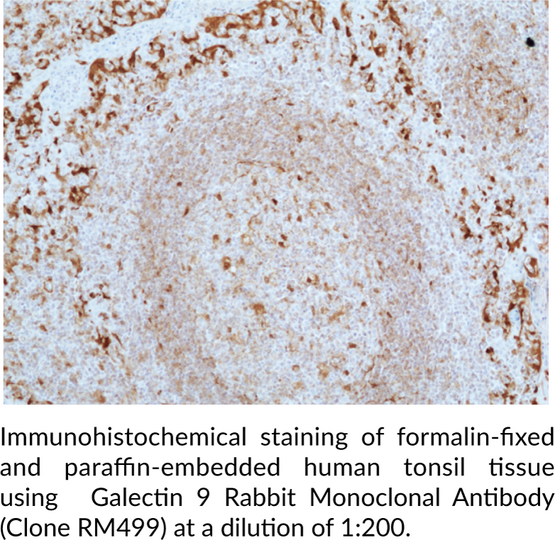
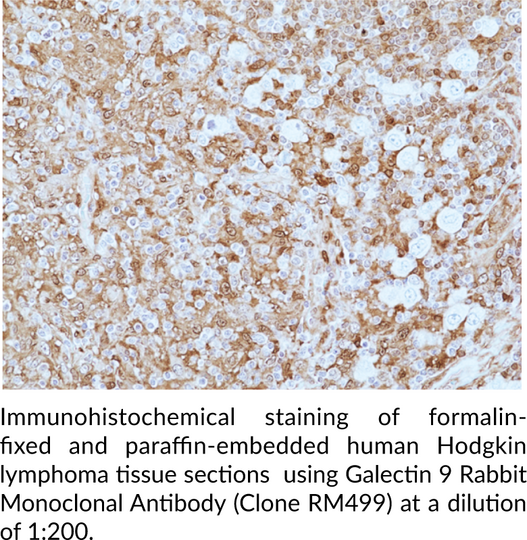
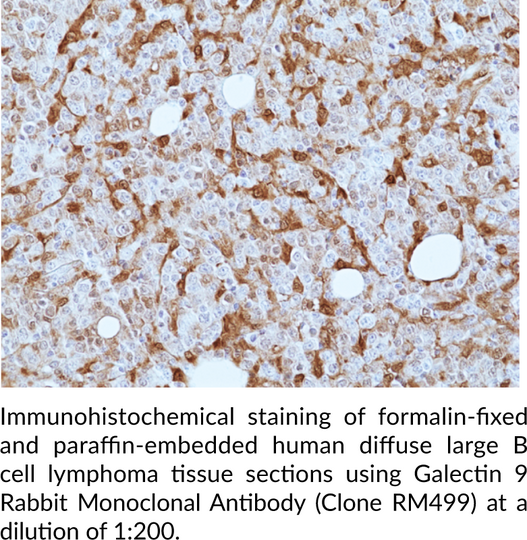
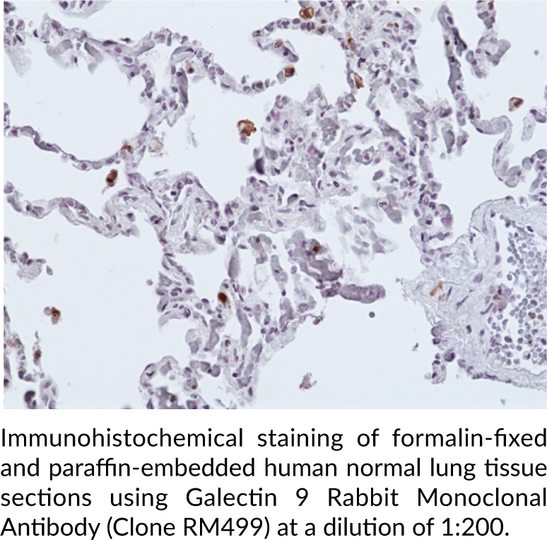
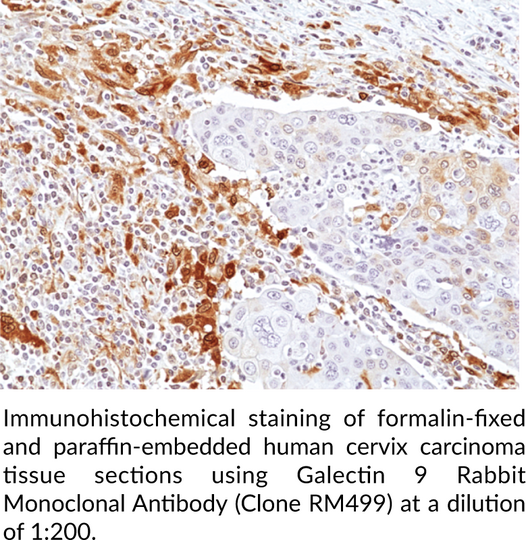
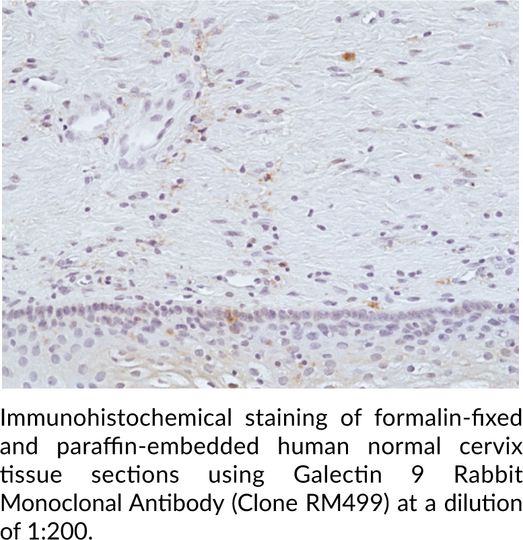
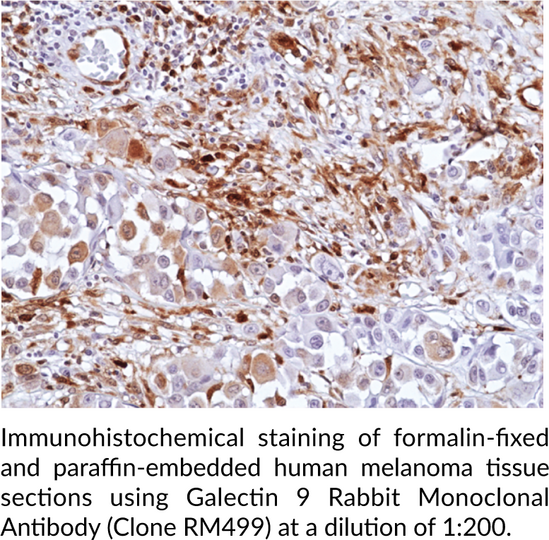
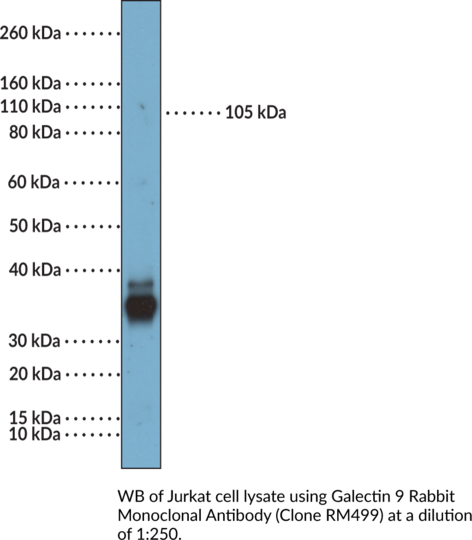
Galectin 9 is a beta-galactoside-binding protein encoded by the LGALS9 gene and a member of the galectin family. It contains two non-identical carbohydrate recognition domains (CRDs) joined by a peptide linker, the length of which depends on alternative splicing of the LGALS9 gene, which produces a short, medium, or long variant of the protein. The non-identical CRDs are responsible for binding to different types of saccharide ligands with the N-terminal CRD (NCRD) preferring more complex glycoconjugates. Galectin 9 is localized to the cytosol, nucleus, and extracellular matrix and is expressed primarily in immune-related tissues and cells. When expressed on immune or tumor cells, galectin 9 binds to glycosylated sites on the immunoregulatory protein TIM-3 and activates signaling that impairs immune synapse formation leading to T cell anergy or apoptosis. It also binds to the transmembrane glycoprotein CD44 on osteoblasts, leading to their proliferation, and it has a role in cell adhesion by preventing hyaluronic acid from binding to CD44. It activates CD4+ T cell populations and induces naïve T cells to acquire a central memory T cell (TCM) phenotype. Galectin 9 was originally identified as a tumor antigen in patients with Hodgkin's disease. It is expressed to a lower extent in tumor cells compared with non-tumor cells but is increased in leukemia and colon cancer cell lines. Cayman's Galectin 9 Rabbit Monoclonal Antibody (Clone RM499) can be used for immunohistochemistry (IHC) and Western blot (WB) applications.. Cross reactivity: (+) Galectin 9: . (+) Human: .. Protein function: Binds galactosides (PubMed:18005988). Has high affinity for the Forssman pentasaccharide (PubMed:18005988). Ligand for HAVCR2/TIM3 (PubMed:16286920). Binding to HAVCR2 induces T-helper type 1 lymphocyte (Th1) death (PubMed:16286920). Also stimulates bactericidal activity in infected macrophages by causing macrophage activation and IL1B secretion which restricts intracellular bacterial growth. Ligand for P4HB, the interaction retains P4HB at the cell surface of Th2 T-helper cells, increasing disulfide reductase activity at the plasma membrane, altering the plasma membrane redox state and enhancing cell migration (PubMed:21670307). Ligand for CD44, the interaction enhances binding of SMAD3 to the FOXP3 promoter, leading to up-regulation of FOXP3 expression and increased induced regulatory T (iTreg) cell stability and suppressive function. Promotes ability of mesenchymal stromal cells to suppress T-cell proliferation (PubMed:23817958). Expands regulatory T-cells and induces cytotoxic T-cell apoptosis following virus infection (PubMed:20209097). Activates ERK1/2 phosphorylation inducing cytokine (IL-6, IL-8, IL-12) and chemokine (CCL2) production in mast and dendritic cells (PubMed:24465902, PubMed:16116184). Inhibits degranulation and induces apoptosis of mast cells (PubMed:24465902). Induces maturation and migration of dendritic cells (PubMed:25754930, PubMed:16116184). Inhibits natural killer (NK) cell function (PubMed:23408620). Can transform NK cell phenotype from peripheral to decidual during pregnancy (PubMed:25578313). Astrocyte derived galectin-9 enhances microglial TNF production. May play a role in thymocyte-epithelial interactions relevant to the biology of the thymus. May provide the molecular basis for urate flux across cell membranes, allowing urate that is formed during purine metabolism to efflux from cells and serving as an electrogenic transporter that plays an important role in renal and gastrointestinal urate excretion. Highly selective to the anion urate. [The UniProt Consortium]
| Keywords: | Gal-9S, HUAT, Human Urate Transporter, Lectin Galactoside-binding Soluble 9, LGALS9A |
| Supplier: | Cayman Chemical |
| Supplier-Nr: | 42851 |
Properties
| Application: | IHC, WB |
| Antibody Type: | Monoclonal |
| Clone: | RM499 |
| Conjugate: | No |
| Host: | Rabbit |
| Species reactivity: | human |
| Immunogen: | Peptide corresponding to the N-terminus of human galectin |
| Format: | Purified |
Database Information
| KEGG ID : | K10093 | Matching products |
| UniProt ID : | O00182 | Matching products |
| Gene ID : | GeneID 3965 | Matching products |
Handling & Safety
| Storage: | -20°C |
| Shipping: | -20°C (International: -20°C) |
Caution
Our products are for laboratory research use only: Not for administration to humans!
Our products are for laboratory research use only: Not for administration to humans!
Information about the product reference will follow.
more
You will get a certificate here
Viewed