
Cookie preferences
This website uses cookies, which are necessary for the technical operation of the website and are always set. Other cookies, which increase the comfort when using this website, are used for direct advertising or to facilitate interaction with other websites and social networks, are only set with your consent.
Configuration
Technically required
These cookies are necessary for the basic functions of the shop.
"Allow all cookies" cookie
"Decline all cookies" cookie
CSRF token
Cookie preferences
Currency change
Customer-specific caching
FACT-Finder tracking
Individual prices
Selected shop
Session
Comfort functions
These cookies are used to make the shopping experience even more appealing, for example for the recognition of the visitor.
Note
Show the facebook fanpage in the right blod sidebar
Statistics & Tracking
Affiliate program
Conversion and usertracking via Google Tag Manager
Track device being used




| Item number | Size | Datasheet | Manual | SDS | Delivery time | Quantity | Price |
|---|---|---|---|---|---|---|---|
| NSJ-V5904SAF-100UG | 100 µg | - | - |
3 - 10 business days* |
810.00€
|
If you have any questions, please use our Contact Form.
You can also order by e-mail: info@biomol.com
Larger quantity required? Request bulk
You can also order by e-mail: info@biomol.com
Larger quantity required? Request bulk
1 mg/ml in 1X PBS, BSA free, sodium azide free. Glutamate decarboxylase 1 (GAD1), commonly known... more
Product information "Anti-GAD67 / GAD1 / Glutamate decarboxylase 1, clone BICCN-GAD67-1A6"
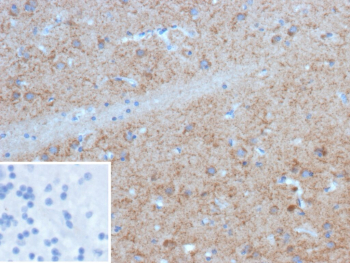
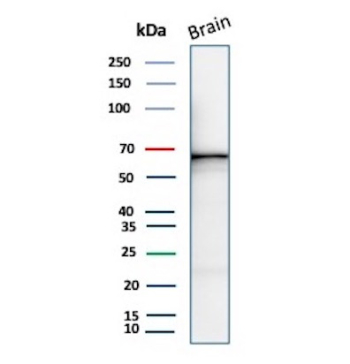
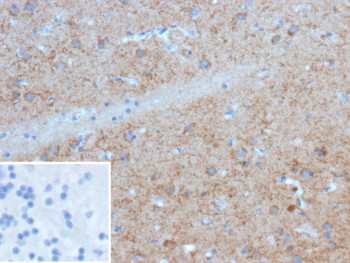
1 mg/ml in 1X PBS, BSA free, sodium azide free. Glutamate decarboxylase 1 (GAD1), commonly known as GAD67, is a pyridoxal phosphate-dependent enzyme that catalyzes conversion of glutamate into gamma-aminobutyric acid (GABA), the major inhibitory neurotransmitter within the central nervous system. GAD1 expression is strongly associated with inhibitory neuronal populations and contributes to regulation of neuronal excitability, synaptic inhibition, cortical signaling balance, and neural circuit organization. GAD1 Antibody is useful for investigations involving inhibitory neurotransmitter biology, interneuron differentiation, GABAergic signaling pathways, and neurodevelopment-associated cellular regulation.GAD1 antibody, also referred to as GAD67 antibody and Glutamate decarboxylase 67 antibody in the literature, recognizes a predominantly cytoplasmic neuronal enzyme encoded on chromosome 2q31. GAD1 localizes mainly within neuronal soma and presynaptic compartments where it supports constitutive GABA synthesis required for inhibitory neurotransmission. Expression of GAD1 is enriched within inhibitory interneurons throughout cortical and subcortical neural tissues and has been associated with neurodevelopmental disorders, epilepsy, schizophrenia, neurodegeneration, and neural lineage-associated tumor biology.GAD1 Antibody / Glutamate Decarboxylase 1 Antibody (clone BICCN-GAD67-1A6) is uniquely positioned for studies involving GABAergic signaling pathways and inhibitory neuronal differentiation. This mouse monoclonal antibody demonstrates strong western blot and immunohistochemical detection together with HuProt(TM) microarray specificity validation against more than 19,000 full-length human proteins. The combined validation profile supports use of clone BICCN-GAD67-1A6 in investigations involving inhibitory neuronal lineage characterization, neurotransmitter-associated signaling pathways, and neurodevelopment-associated cellular regulation.Analysis of HuProt(TM) microarrays containing more than 19,000 individually purified full-length human proteins demonstrated selective recognition of GAD1/GAD67 by clone BICCN-GAD67-1A6. In HuProt(TM) analysis, the Z-score represents the strength of antibody binding signal relative to the overall array mean, while the S-score reflects target specificity relative to the next highest ranked protein signal. Elevated S-score separation supports preferential target recognition and reduced off-target binding across the tested human proteome. This specificity validation strategy supports reliable detection of inhibitory neurotransmitter-associated pathways in complex neural tissues.GAD1 contributes directly to inhibitory synaptic regulation through sustained GABA production required for suppression of excitotoxic signaling and maintenance of neuronal network balance. Because GAD1 expression is highly associated with inhibitory neuronal populations, it serves as an important marker for investigations involving interneuron organization, inhibitory cortical circuitry, and GABAergic neuronal differentiation. GAD1 additionally represents a useful marker in studies involving neural lineage-associated tumors and developmental neural signaling pathways.This GAD1 Antibody supports research involving GABA synthesis, inhibitory neurotransmitter signaling, interneuron differentiation, synaptic inhibition pathways, neural circuit organization, neurodevelopment-associated regulation, and GABAergic neuronal biology. Clone BICCN-GAD67-1A6 may be incorporated into western blot, immunohistochemistry, and tissue-based investigations examining inhibitory neural signaling pathways in normal and diseased tissues.For highly specific detection of GAD67 in inhibitory neurotransmitter pathway studies, see our GAD67 Antibody / GABA Synthesis Enzyme Antibody page featuring strong HuProt(TM) microarray specificity validation data.
| Keywords: | Anti-GAD1, Anti-Glutamate decarboxylase 1, Anti-67 kDa glutamic acid decarboxylase, Anti-Glutamate decarboxylase 67 kDa isoform, GAD67 Antibody / GAD1 / Glutamate decarboxylase 1 |
| Supplier: | NSJ Bioreagents |
| Supplier-Nr: | V5904SAF |
Properties
| Application: | WB, IHC |
| Antibody Type: | Monoclonal |
| Clone: | BICCN-GAD67-1A6 |
| Conjugate: | No |
| Host: | Mouse |
| Species reactivity: | human |
| Immunogen: | Recombinant human GAD1 (GAD67) protein (exact sequence is proprietary) |
| Format: | Purified |
Database Information
| KEGG ID : | K01580 | Matching products |
| UniProt ID : | Q99259 | Matching products |
| Gene ID : | GeneID 2571 | Matching products |
Handling & Safety
| Storage: | -20°C |
| Shipping: | -20°C (International: -20°C) |
Caution
Our products are for laboratory research use only: Not for administration to humans!
Our products are for laboratory research use only: Not for administration to humans!
Information about the product reference will follow.
more
You will get a certificate here
Viewed