
Cookie preferences
This website uses cookies, which are necessary for the technical operation of the website and are always set. Other cookies, which increase the comfort when using this website, are used for direct advertising or to facilitate interaction with other websites and social networks, are only set with your consent.
Configuration
Technically required
These cookies are necessary for the basic functions of the shop.
"Allow all cookies" cookie
"Decline all cookies" cookie
CSRF token
Cookie preferences
Currency change
Customer-specific caching
FACT-Finder tracking
Individual prices
Selected shop
Session
Comfort functions
These cookies are used to make the shopping experience even more appealing, for example for the recognition of the visitor.
Note
Show the facebook fanpage in the right blod sidebar
Statistics & Tracking
Affiliate program
Conversion and usertracking via Google Tag Manager
Track device being used


| Item number | Size | Datasheet | Manual | SDS | Delivery time | Quantity | Price |
|---|---|---|---|---|---|---|---|
| NSJ-FY13414 | 100 µl | - | - |
3 - 10 business days* |
790.00€
|
If you have any questions, please use our Contact Form.
You can also order by e-mail: info@biomol.com
Larger quantity required? Request bulk
You can also order by e-mail: info@biomol.com
Larger quantity required? Request bulk
Rabbit IgG in phosphate buffered saline, pH 7.4, 150mM NaCl, 0.02% sodium azide and 50% glycerol,... more
Product information "Anti-GAD67 / GAD1 / Glutamate decarboxylase 1, clone AAGO-7"
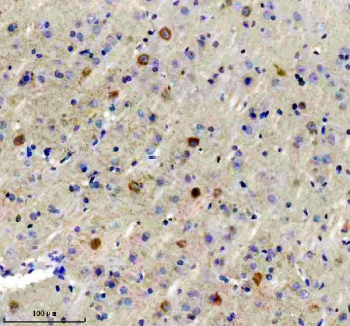
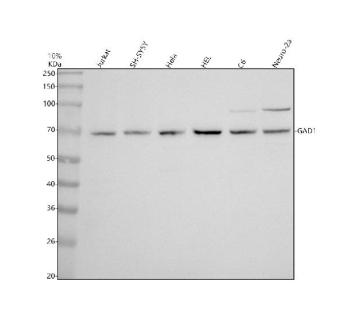
Rabbit IgG in phosphate buffered saline, pH 7.4, 150mM NaCl, 0.02% sodium azide and 50% glycerol, 0.4-0.5mg/ml BSA. Glutamate decarboxylase 1 antibody targets Glutamate decarboxylase 1 (GAD1), also commonly referred to as GAD67, a pyridoxal phosphate-dependent enzyme responsible for catalyzing the conversion of glutamate to gamma-aminobutyric acid (GABA). GAD1 is predominantly localized in the cytoplasm of inhibitory neurons, where it plays a central role in neurotransmitter biosynthesis. As one of the two major glutamate decarboxylase isoforms, GAD67 contributes to the basal production of GABA required for maintaining inhibitory tone within the central nervous system.Functionally, GAD1 is essential for regulating excitatory-inhibitory balance in neuronal circuits. By producing GABA, GAD1 supports synaptic inhibition, neuronal firing control, and network stability. Unlike the closely related GAD2 (GAD65), which is more tightly associated with synaptic vesicles and activity-dependent GABA synthesis, GAD1 is distributed more broadly within neurons and is thought to supply GABA for both synaptic and non-synaptic functions. A Glutamate decarboxylase 1 antibody supports studies focused on inhibitory neurotransmission and neuronal metabolism.GAD1 expression is highly enriched in GABAergic neurons throughout the brain and spinal cord, including regions such as the cortex, hippocampus, cerebellum, and basal ganglia. Its expression pattern is often used as a marker to identify inhibitory neuronal populations in both developmental and adult nervous systems. Analysis of GAD1 localization and abundance provides valuable insight into the organization of inhibitory circuits and changes in neuronal phenotype under different physiological or experimental conditions.From a biological and disease-relevance perspective, altered GAD1 expression or activity has been associated with a range of neurological and psychiatric conditions. Dysregulation of GABA synthesis can disrupt neural circuit balance and has been implicated in epilepsy, schizophrenia, anxiety disorders, and neurodevelopmental abnormalities. GAD1 is also of interest in studies of synaptic plasticity, neuronal differentiation, and brain development. Monitoring GAD1 expression helps clarify how inhibitory signaling contributes to both normal brain function and disease-associated phenotypes.At the molecular level, GAD1 is encoded by the GAD1 gene and produces a protein of approximately 67 kDa, giving rise to the commonly used name GAD67. The enzyme requires pyridoxal phosphate as a cofactor for catalytic activity and forms functional homodimers in cells. Regulation of GAD1 occurs at transcriptional, post-transcriptional, and protein stability levels, allowing precise control of GABA production. A Glutamate decarboxylase 1 antibody supports research applications focused on neurotransmitter biosynthesis, inhibitory neuron identification, and neural circuit analysis, with NSJ Bioreagents providing reagents intended for research use.For highly specific detection of GAD67 in inhibitory neurotransmitter pathway studies, see our GAD67 Antibody / GABA Synthesis Enzyme Antibody page featuring strong HuProt(TM) microarray specificity validation data.
| Keywords: | Anti-GAD1, Anti-Glutamate decarboxylase 1, Anti-67 kDa glutamic acid decarboxylase, Anti-Glutamate decarboxylase 67 kDa isoform, GAD67 Antibody / GAD1 / Glutamate decarboxylase 1 |
| Supplier: | NSJ Bioreagents |
| Supplier-Nr: | FY13414 |
Properties
| Application: | WB, IHC |
| Antibody Type: | Monoclonal |
| Clone: | AAGO-7 |
| Conjugate: | No |
| Host: | Rabbit |
| Species reactivity: | human, mouse, rat, swine |
| Immunogen: | Synthesized peptide derived from human Glutamate decarboxylase 1 protein |
| Format: | Affinity Purified |
Database Information
| KEGG ID : | K01580 | Matching products |
| UniProt ID : | Q99259 | Matching products |
| Gene ID : | GeneID 2571 | Matching products |
Handling & Safety
| Storage: | -20°C |
| Shipping: | -20°C (International: -20°C) |
Caution
Our products are for laboratory research use only: Not for administration to humans!
Our products are for laboratory research use only: Not for administration to humans!
Information about the product reference will follow.
more
You will get a certificate here
Viewed