
Cookie preferences
This website uses cookies, which are necessary for the technical operation of the website and are always set. Other cookies, which increase the comfort when using this website, are used for direct advertising or to facilitate interaction with other websites and social networks, are only set with your consent.
Configuration
Technically required
These cookies are necessary for the basic functions of the shop.
"Allow all cookies" cookie
"Decline all cookies" cookie
CSRF token
Cookie preferences
Currency change
Customer-specific caching
FACT-Finder tracking
Individual prices
Selected shop
Session
Comfort functions
These cookies are used to make the shopping experience even more appealing, for example for the recognition of the visitor.
Note
Show the facebook fanpage in the right blod sidebar
Statistics & Tracking
Affiliate program
Conversion and usertracking via Google Tag Manager
Track device being used


| Item number | Size | Datasheet | Manual | SDS | Delivery time | Quantity | Price |
|---|---|---|---|---|---|---|---|
| NSJ-FY12023 | 100 µg | - | - |
7 - 12 business days* |
790.00€
|
If you have any questions, please use our Contact Form.
You can also order by e-mail: info@biomol.com
Larger quantity required? Request bulk
You can also order by e-mail: info@biomol.com
Larger quantity required? Request bulk
Adding 0.2 ml of distilled water will yield a concentration of 500 ug/ml. FMOD antibody detects... more
Product information "Anti-FMOD / Fibromodulin"
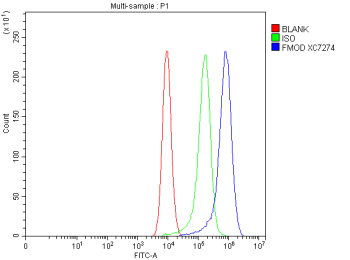
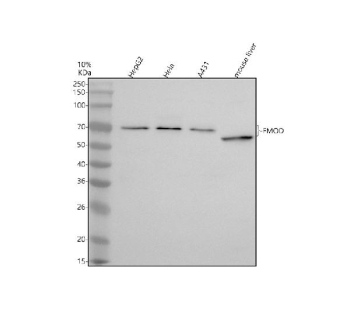
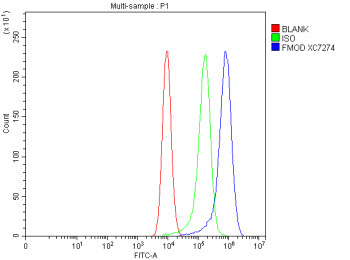
Adding 0.2 ml of distilled water will yield a concentration of 500 ug/ml. FMOD antibody detects Fibromodulin, encoded by the FMOD gene. Fibromodulin is a small leucine-rich repeat proteoglycan of the extracellular matrix that regulates collagen fibrillogenesis and tissue organization. FMOD antibody provides researchers with a specific reagent to study extracellular matrix biology, connective tissue remodeling, and disease processes involving abnormal matrix composition.Fibromodulin is secreted by fibroblasts and chondrocytes and associates with collagen fibrils. Research using FMOD antibody has shown that it binds to type I and type II collagen fibrils, regulating their diameter and spacing. This interaction ensures proper biomechanical properties of tissues such as cartilage, tendons, and skin. Without Fibromodulin, collagen fibrils are irregular in size and arrangement, leading to impaired tissue strength and function.Studies with FMOD antibody have revealed roles in tissue repair and wound healing. Fibromodulin is upregulated following injury and promotes scar formation by modulating collagen deposition and organization. It also influences the recruitment of macrophages and fibroblasts, linking extracellular matrix remodeling with immune responses. These findings highlight the importance of Fibromodulin in regenerative biology.Fibromodulin is also involved in angiogenesis. Research using FMOD antibody has demonstrated that it binds to growth factors and modulates endothelial cell function. By interacting with transforming growth factor beta and vascular endothelial growth factor pathways, Fibromodulin regulates angiogenic responses during development and repair. Dysregulation can contribute to impaired healing or pathological angiogenesis in tumors.Disease studies have connected Fibromodulin with osteoarthritis, fibrosis, and cancer. Research using FMOD antibody has shown that altered Fibromodulin expression affects cartilage integrity and progression of degenerative joint disease. Elevated expression has been associated with fibrotic disorders, while aberrant expression in tumors may contribute to cancer progression by modifying extracellular matrix stiffness and promoting invasion.FMOD antibody is widely applied in immunohistochemistry, western blotting, and immunofluorescence. Immunohistochemistry identifies expression in connective tissues, western blotting quantifies protein levels and isoforms, and immunofluorescence reveals localization within matrix-rich environments. These methods make FMOD antibody valuable in extracellular matrix research.By supplying validated FMOD antibody reagents, NSJ Bioreagents supports studies into collagen biology, tissue repair, and disease. Detection of Fibromodulin provides insight into how small leucine-rich proteoglycans regulate extracellular matrix function and pathology.
| Keywords: | Anti-FMOD, Anti-Fibromodulin, Anti-Collagen-binding 59 kDa protein, Anti-Keratan sulfate proteoglycan fibromodulin, FMOD Antibody / Fibromodulin |
| Supplier: | NSJ Bioreagents |
| Supplier-Nr: | FY12023 |
Properties
| Application: | WB, FC, ELISA |
| Antibody Type: | Polyclonal |
| Conjugate: | No |
| Host: | Rabbit |
| Species reactivity: | human, mouse |
| Immunogen: | E.coli-derived human Fibromodulin/FMOD recombinant protein (Position: Q19-I376) |
| Format: | Purified |
Database Information
| KEGG ID : | K08121 | Matching products |
| UniProt ID : | Q06828 | Matching products |
| Gene ID : | GeneID 2331 | Matching products |
Handling & Safety
| Storage: | +4°C |
| Shipping: | +4°C (International: +4°C) |
Caution
Our products are for laboratory research use only: Not for administration to humans!
Our products are for laboratory research use only: Not for administration to humans!
Information about the product reference will follow.
more
You will get a certificate here
Viewed