
Cookie preferences
This website uses cookies, which are necessary for the technical operation of the website and are always set. Other cookies, which increase the comfort when using this website, are used for direct advertising or to facilitate interaction with other websites and social networks, are only set with your consent.
Configuration
Technically required
These cookies are necessary for the basic functions of the shop.
"Allow all cookies" cookie
"Decline all cookies" cookie
CSRF token
Cookie preferences
Currency change
Customer-specific caching
FACT-Finder tracking
Individual prices
Selected shop
Session
Comfort functions
These cookies are used to make the shopping experience even more appealing, for example for the recognition of the visitor.
Note
Show the facebook fanpage in the right blod sidebar
Statistics & Tracking
Affiliate program
Conversion and usertracking via Google Tag Manager
Track device being used


| Item number | Size | Datasheet | Manual | SDS | Delivery time | Quantity | Price |
|---|---|---|---|---|---|---|---|
| NSJ-V6073-20UG | 20 µg | - | - |
7 - 12 business days* |
684.00€
|
||
| NSJ-V6073-100UG | 100 µg | - | - |
7 - 12 business days* |
1,265.00€
|
If you have any questions, please use our Contact Form.
You can also order by e-mail: info@biomol.com
Larger quantity required? Request bulk
You can also order by e-mail: info@biomol.com
Larger quantity required? Request bulk
Antibody in 1X PBS with 0.05% BSA, 0.05% sodium azide. FABP1 Antibody for IHC recognizes Fatty... more
Product information "Anti-FABP1 / Fatty acid-binding protein 1, clone MSVA-501M"
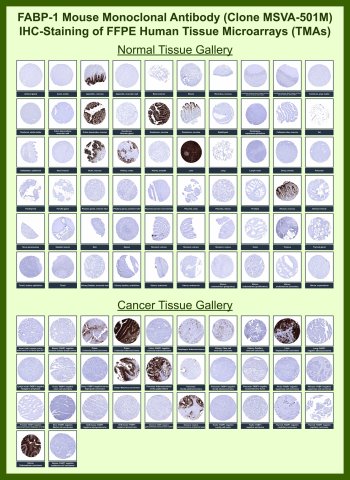
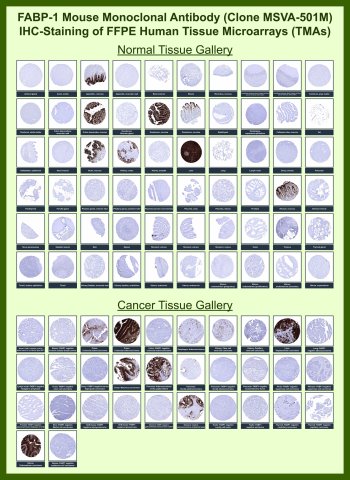
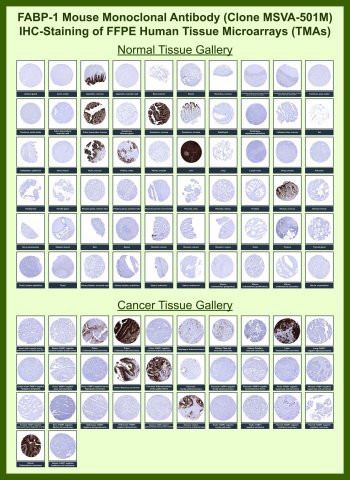
Antibody in 1X PBS with 0.05% BSA, 0.05% sodium azide. FABP1 Antibody for IHC recognizes Fatty acid-binding protein 1, a small cytoplasmic lipid chaperone encoded by the FABP1 gene and commonly referred to as Liver fatty acid binding protein or L-FABP. FABP1 belongs to the fatty acid binding protein family, a group of highly conserved intracellular proteins that coordinate the uptake, transport, and metabolism of long chain fatty acids and other hydrophobic ligands. The human FABP1 gene is located on chromosome 2p11.2 and is predominantly expressed in hepatocytes, with additional expression in renal proximal tubular epithelium and small intestinal enterocytes.Structurally, Fatty acid-binding protein 1 consists of a beta barrel domain that forms a hydrophobic binding pocket capable of accommodating long chain fatty acids, bile acids, and eicosanoids. By binding and solubilizing these ligands, FABP1 facilitates their intracellular trafficking to sites of beta oxidation, triglyceride synthesis, or signaling pathways. In the liver, FABP1 plays a central role in lipid homeostasis, energy metabolism, and protection against lipotoxic stress. Its high cytoplasmic abundance in hepatocytes reflects its importance in hepatic fatty acid handling.In normal tissues, FABP1 expression is strongest in liver, where diffuse cytoplasmic staining in hepatocytes is expected. In kidney, cytoplasmic expression is typically observed in proximal tubular epithelial cells, consistent with a role in fatty acid reabsorption and metabolism. Intestinal epithelial cells of the small intestine also demonstrate cytoplasmic expression. Because of this characteristic distribution, FABP1 antibody is widely used in research to assess hepatocellular differentiation and to study metabolic adaptations in liver and kidney tissues.Altered expression of Fatty acid-binding protein 1 has been associated with metabolic disorders, nonalcoholic fatty liver disease, and hepatocellular carcinoma. Changes in FABP1 levels may reflect shifts in lipid flux, oxidative stress, and cellular metabolic state. A mouse monoclonal antibody such as clone MSVA-501M provides a consistent tool for detecting FABP1 in formalin-fixed, paraffin-embedded tissues. FABP1 Antibody for IHC is suitable for detecting FABP1 expression in research settings focused on hepatic biology, renal tubular function, and lipid metabolism.This antibody is part of a broader collection of IHC antibodies validated by tissue microarray analysis, supporting consistent staining across normal and cancer tissues.Researchers interested in a broadly validated FABP1 antibody for lipid metabolism and fatty acid transport studies may also benefit from our HuProt-validated FABP1 antibody clone FABP1/3487, supported by western blot, immunohistochemistry, and protein microarray specificity data.
| Keywords: | Anti-FABP1, Anti-Fatty acid-binding protein 1, Anti-Fatty acid-binding protein, liver, Anti-Liver-type fatty acid-binding protein, FABP1 Antibody / Fatty acid-binding protein 1 |
| Supplier: | NSJ Bioreagents |
| Supplier-Nr: | V6073 |
Properties
| Application: | IHC |
| Antibody Type: | Monoclonal |
| Clone: | MSVA-501M |
| Conjugate: | No |
| Host: | Mouse |
| Species reactivity: | human |
| Immunogen: | Human recombinant FABP1 protein fragment (around amino acids 1-127) (exact sequence is proprietary) |
| Format: | Purified |
Database Information
| KEGG ID : | K08750 | Matching products |
| UniProt ID : | P07148 | Matching products |
| Gene ID : | GeneID 2168 | Matching products |
Handling & Safety
| Storage: | -20°C |
| Shipping: | -20°C (International: -20°C) |
Caution
Our products are for laboratory research use only: Not for administration to humans!
Our products are for laboratory research use only: Not for administration to humans!
Information about the product reference will follow.
more
You will get a certificate here
Viewed