
Cookie preferences
This website uses cookies, which are necessary for the technical operation of the website and are always set. Other cookies, which increase the comfort when using this website, are used for direct advertising or to facilitate interaction with other websites and social networks, are only set with your consent.
Configuration
Technically required
These cookies are necessary for the basic functions of the shop.
"Allow all cookies" cookie
"Decline all cookies" cookie
CSRF token
Cookie preferences
Currency change
Customer-specific caching
FACT-Finder tracking
Individual prices
Selected shop
Session
Comfort functions
These cookies are used to make the shopping experience even more appealing, for example for the recognition of the visitor.
Note
Show the facebook fanpage in the right blod sidebar
Statistics & Tracking
Affiliate program
Conversion and usertracking via Google Tag Manager
Track device being used


| Item number | Size | Datasheet | Manual | SDS | Delivery time | Quantity | Price |
|---|---|---|---|---|---|---|---|
| NSJ-V6118-20UG | 20 µg | - | - |
7 - 12 business days* |
684.00€
|
||
| NSJ-V6118-100UG | 100 µg | - | - |
7 - 12 business days* |
1,160.00€
|
If you have any questions, please use our Contact Form.
You can also order by e-mail: info@biomol.com
Larger quantity required? Request bulk
You can also order by e-mail: info@biomol.com
Larger quantity required? Request bulk
Antibody in 1X PBS with 0.05% BSA, 0.05% sodium azide. Trefoil factor 1 (TFF1) is a secreted... more
Product information "Anti-Estrogen Inducible Protein pS2 / TFF1, clone MSVA-482M"
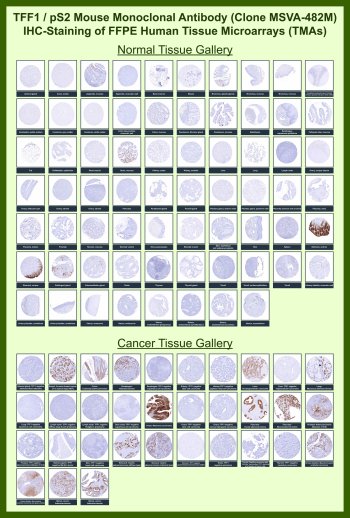
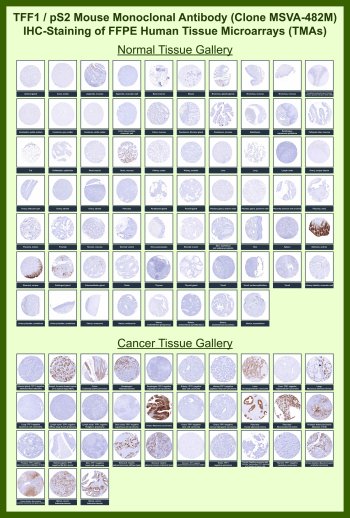
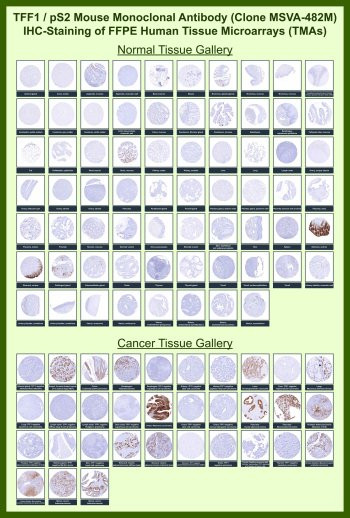
Antibody in 1X PBS with 0.05% BSA, 0.05% sodium azide. Trefoil factor 1 (TFF1) is a secreted epithelial peptide encoded by the TFF1 gene and a member of the trefoil factor family that contributes to mucosal protection and epithelial repair within the gastrointestinal tract. The protein is predominantly localized to the cytoplasm and secretory granules of mucus-producing epithelial cells in the stomach, especially within gastric foveolar epithelium. Trefoil Factor 1 Antibody for IHC / TFF1 Immunohistochemistry Antibody (clone MSVA-482M) is designed for detection of TFF1 protein expression in formalin-fixed, paraffin-embedded tissues using immunohistochemistry, enabling visualization of epithelial staining patterns associated with this gastric secretory peptide. TFF1 antibody, also referred to as Trefoil factor 1 antibody or pS2 antibody in the literature, targets a protein widely used as a marker of gastric epithelial differentiation and hormone-responsive epithelial tumors.In immunohistochemistry studies, TFF1 expression is most commonly detected as cytoplasmic staining within mucus-secreting epithelial cells of the stomach. Gastric tissue sections typically demonstrate strong staining in the surface epithelium and foveolar glands, reflecting the protein's secretion into the protective mucus layer that coats the gastric mucosa. Because this staining pattern is highly characteristic of gastric epithelial differentiation, TFF1 antibody detection is frequently used in histological and pathological investigations of gastric tissue organization and epithelial lineage markers. Tissue microarray (TMA) analysis further supports these observations, as gastric cores within multi-tissue arrays consistently demonstrate strong epithelial staining compared with the minimal or absent signal seen in most other normal tissues.Tissue microarray immunohistochemistry also provides an efficient method to evaluate TFF1 expression across many tissue types simultaneously. In large human TMA panels containing dozens of normal organs, TFF1 staining is largely restricted to gastric epithelium and certain mucin-producing epithelial compartments. This restricted distribution highlights the protein's specialized role in maintaining the integrity of the gastric mucosal barrier. Because TMAs allow side-by-side comparison of multiple tissues under identical staining conditions, they are commonly used to confirm the tissue specificity of epithelial markers such as TFF1 and to evaluate antibody performance in immunohistochemical applications.TFF1 has also been widely studied in the context of breast cancer biology. The protein was originally identified as an estrogen-inducible secretory peptide known as pS2 in breast carcinoma cells. In immunohistochemistry analyses, TFF1 expression is frequently detected in subsets of estrogen receptor positive breast carcinomas, where cytoplasmic staining may be observed within tumor epithelial cells. TMA-based cancer profiling studies similarly demonstrate that TFF1 expression is present in a subset of epithelial tumors, particularly those influenced by hormone signaling pathways, while many other tumor types show little or no staining. These patterns highlight the usefulness of TFF1 antibody staining in studies examining hormone-regulated gene expression and epithelial tumor differentiation.Trefoil Factor 1 Antibody for IHC / TFF1 Immunohistochemistry Antibody (clone MSVA-482M) enables visualization of TFF1 protein localization in tissue sections and supports immunohistochemistry analysis of epithelial differentiation, gastric mucosal biology, and hormone-responsive tumors. The ability to evaluate staining patterns across multi-tissue arrays, including normal and cancer TMAs, provides valuable insight into tissue-specific expression and disease-associated changes in epithelial cells.This antibody is also part of a broader collection of IHC antibodies validated by tissue microarray analysis, supporting consistent staining across normal and cancer tissues.
| Keywords: | Anti-TFF1, Anti-PNR-2, Anti-Protein pS2, Anti-Polypeptide P1.A, Anti-Trefoil factor 1, Anti-Breast cancer estrogen-inducible protein, Estrogen Inducible Protein pS2 / TFF1 Antibody |
| Supplier: | NSJ Bioreagents |
| Supplier-Nr: | V6118 |
Properties
| Application: | IHC |
| Antibody Type: | Monoclonal |
| Clone: | MSVA-482M |
| Conjugate: | No |
| Host: | Mouse |
| Species reactivity: | human |
| Immunogen: | Recombinant fragment (around amino acids 1-84) of human TFF1 protein (exact sequence is proprietary) |
| Format: | Purified |
Database Information
| KEGG ID : | K22456 | Matching products |
| UniProt ID : | P04155 | Matching products |
| Gene ID : | GeneID 7031 | Matching products |
Handling & Safety
| Storage: | -20°C |
| Shipping: | -20°C (International: -20°C) |
Caution
Our products are for laboratory research use only: Not for administration to humans!
Our products are for laboratory research use only: Not for administration to humans!
Information about the product reference will follow.
more
You will get a certificate here
Viewed